Wyoming advances land exchange for proposed West Fork Dam
Aug 13, 2025 | 1:04 pm ET
Description
Photo courtesy of WyoFile
Wyoming water developers appear to be closing in on a land exchange between the state and the Medicine Bow National Forest to enable construction of a dam and reservoir above the Little Snake River Valley in Carbon County.
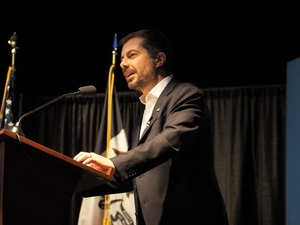
Wyoming lawmakers voted last Thursday to transfer $300,000 to the state land office to help complete a swap. The money would enable the Wyoming Office of Lands and Investments and the Forest Service to complete surveys, minerals reports and other elements necessary for the exchange, Wyoming Water Development Office Director Jason Mead told lawmakers.
A land exchange, which has stirred public interest and opposition, is critical to the proposed dam and reservoir. “In order to get our permits, we have to acquire that U.S. Forest Service property,” Mead told lawmakers.
A motion to approve the transfer passed without dissent at a joint meeting of the Legislature’s Select Water Committee and Wyoming Water Development Commission last week. The money comes from $4.2 million already allocated to the water office for the proposed dam on the West Fork of Battle Creek.
“If they can consolidate … there’s potential[ly] more revenue to state lands for schools.”
Jason Mead
Medicine Bow forest officials appear ready to sign and approve a feasibility analysis and public interest determination that could move the exchange forward, Mead told lawmakers.
“The land exchange process has gone through a feasibility analysis to make sure it can be completed through the Forest Service regulations and if it’s in the public interest,” Mead said. “That, I think, currently is awaiting signature.”
The signing of a report affirming the feasibility and public interest of an exchange would advance the process, Mead said. “The next step would be an ‘agreement to initiate’ … a 64-step process, literally to complete that land exchange.”
As the effort advances, forest officials cautioned that tasks so far represent “preliminary steps.” The Forest Service, after consultation with officials in Washington, D.C., stated in an email that it “has not approved or completed a land exchange,” and that “the process is in early stages and subject to further analysis and public review.”
A draft Environmental Impact Statement on the project, announced in 2022, is expected to be published early next year by the federal Natural Resources Conservation Service.
More irrigation in troubled basin
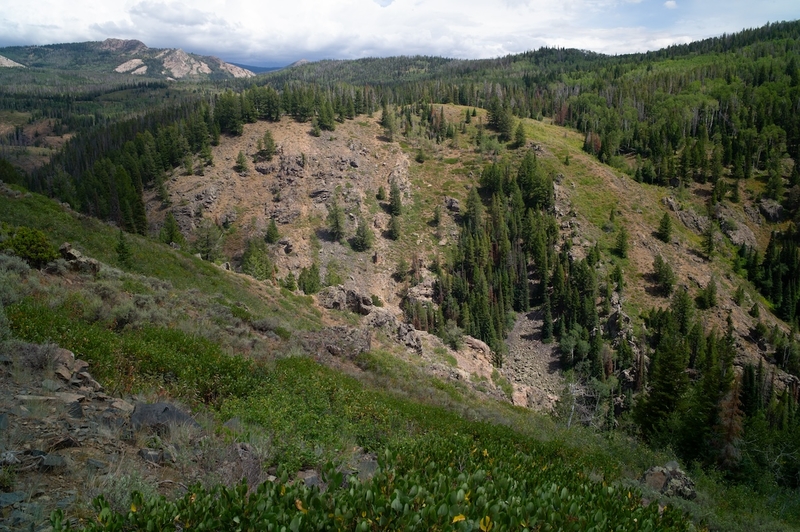
The West Fork dam is proposed to be a 264-foot-high, 700-foot-long concrete plug in a canyon just south of scenic Wyoming Highway 70 between Saratoga and Baggs. The reservoir would be about 130 acres and cover what is now largely forested land. About 44 irrigators have expressed interest in contracting for late-season water from the planned reservoir. In 2017, water developers estimated the dam would cost $80 million and hold 8,000 acre feet.
The drainage is in the Colorado River Basin, where states are scrambling to agree on new methods to share water in the face of climate change, over-promised supplies and dwindling flows. Wyoming believes it has not used its share of basin-wide water rights and is allowed to use more on hay and alfalfa fields.
To enable the dam’s construction, the state lands office proposed exchanging Wyoming school trust property for approximately 1,490 acres of National Forest land. The state lands office has identified “a number of state parcels,” Mead said.
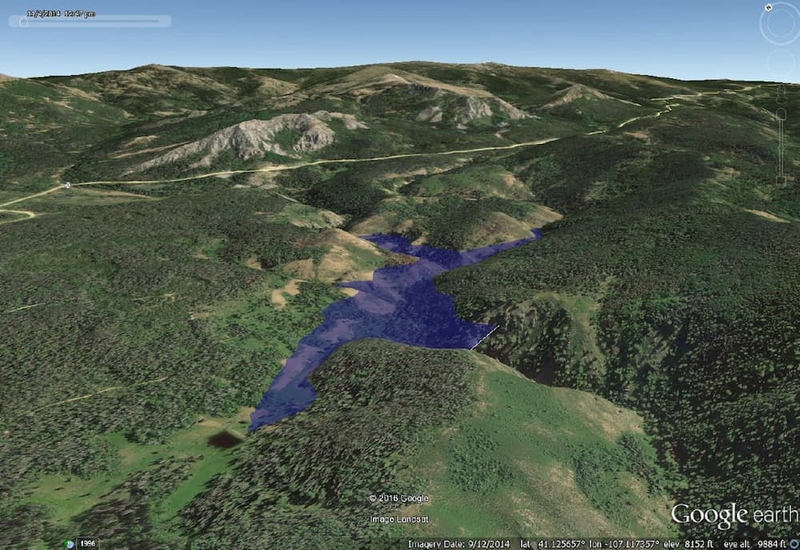
“The majority of those [state] parcels that they’re looking to trade are actually in roadless areas — or what maybe used to be roadless areas,” Mead told lawmakers. “They’re very isolated parcels out in the middle of forest, and the access to them is very limited.
“So if they can consolidate those into this project location of West Fork Reservoir that has access from the highway,” Mead said, “there’s potential[ly] more revenue to state lands for schools.”
The exchange would have to be of properties that are of equal value, or nearly equal value, with a payment that would make up any difference.
Half of the $300,000 would be used by the state for its surveys and other work and the other half would go to the Medicine Bow for its share of the examinations.
Medicine Bow National Forest spokesman Aaron Voos in 2023 outlined his agency’s exchange process. “The feasibility analysis, report, and public interest are all inter-related,” he wrote. “That analysis will culminate in the report and public interest statement.”
“Input previously received … on the land exchange proposal has informed the feasibility analysis, and then subsequently the report/public interest statement,” Voos wrote in 2023. The Forest Service will not take more public input before releasing the analysis and public interest report, he wrote at the time.
What is the public’s interest?
It’s uncertain what elements the Forest Service has considered in determining public interest.
“There is some flexibility in how the report can be written and how ‘public interest’ is explained throughout the report,” Voos has explained in emails. “Regardless, ‘public interest’ is required to be addressed and will be heavily factored into the Forest Supervisor’s recommendation to proceed or not proceed.”
One gauge of public interest emerged when the Natural Resources Conservation Service announced in 2022 the preparation of an Environmental Impact Statement that would examine the proposal. The agency received 936 comments, according to a WyoFile tally.
Dam proponents didn’t expect so much feedback. The state water office’s consultant assumed there would be 100 comments, “with only 40 being substantive.”
WyoFile’s count found 96% of commenters opposed to the West Fork plan. Many comments were simple statements of opposition.
The Forest Service will determine which comments will be considered in the public interest determination. That’s because federal agencies have a rule on what comments they consider. Only “substantive” comments are factored into the environmental impact process according to a primer on the procedure published by the Bureau of Land Management.
“Comments that are not substantive include: Comments in favor of or against an action without any reasoning (such as ‘I do/don’t like ____’ without providing any rationale),” the BLM primer states. In contrast, substantive comments “provide relevant and new information with sufficient detail,” the primer states.
Cheyenne, WY