Water quality buffer program grows following $8 million boost from lawmakers
Jul 10, 2026 | 6:30 pm ET
Description
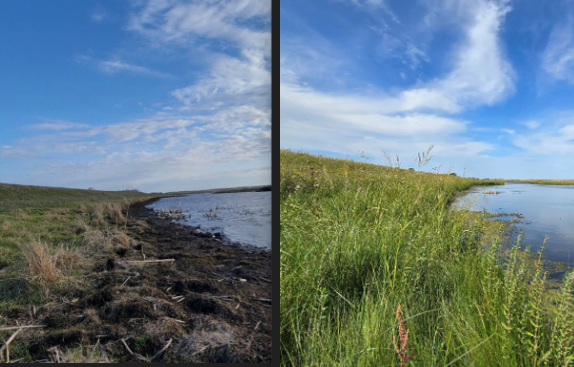
A section of Blue Dog Lake shoreline before and after the implementation of a South Dakota state government program paying for buffer strips to improve water quality. The program covered the Big Sioux River watershed. (Photos courtesy of the Department of Agriculture and Natural Resources)
A state program that pays landowners to plant vegetation along streams now has 130 buffer projects spanning 379 miles of shoreline statewide, and more landowners are waiting to enroll.
The update, presented Friday to the Game, Fish and Parks Commission, comes months after state lawmakers approved an additional $8 million to expand the program statewide.
The initiative is administered by the Department of Agriculture and Natural Resources. It pays landowners to establish grassy buffers along eligible waterways. That reduces erosion, filters pollutants and improves wildlife habitat while allowing continued agricultural use, explained Dan Nelson, a private lands habitat biologist with the department.
“It’s not a land retirement program,” Nelson said. He described it as a “working buffer” program. Landowners keep cattle off the enrolled acres from May 1 to Sept. 30, and can’t mow or bail hay from May 1 to Aug. 1.
He shared that the 130 projects are along 118 streams, mostly within the Big Sioux River watershed, and 19 lakes for a total of 3,984 acres enrolled. The buffer contracts run 10 years, and buffers must be at least 50 feet wide.
Nelson did not have annual enrollment figures, but said interest is strong enough that “many projects” are awaiting approval.
The Legislature created the Riparian Buffer Initiative in 2021 as a voluntary effort to reduce agricultural runoff into rivers and streams — particularly the Big Sioux River, which runs through Sioux Falls.
The program initially struggled to attract participants, with only 35 projects established by late 2024. Enrollment accelerated when the state increased payouts.
The state now pays 250% of the average rate a farmer pays to rent an acre of farmland in their county for one year. The entire 10-year payment is made upfront and covers many of the costs of establishing the buffer.
“The payments are pretty incredible,” Nelson said.
Nelson highlighted several projects during Friday’s meeting. One showed how land that returned to row-crop production after being enrolled in a conservation program experienced severe erosion, including a roughly 25-foot-deep ravine carved by water that carried soil downstream.
Goose depredation mitigation
Another project used buffers to reduce crop damage from geese by separating fields from waterways, where resident geese congregate during their summer molting season. The buffer made it harder for the birds to walk into fields to feed.
Canada geese are a growing concern in eastern South Dakota, the commission would also learn during Friday’s meeting. Wildlife officials have received 358 requests for assistance this year and installed 409 temporary electric fences to protect crops. Department Wildlife Director Tom Kirschenmann said that work annually costs the department upwards of $300,000.

Pierre, SD