Major state employee union approves new contract after bitter negotiations
Aug 11, 2025 | 5:24 pm ET
Description
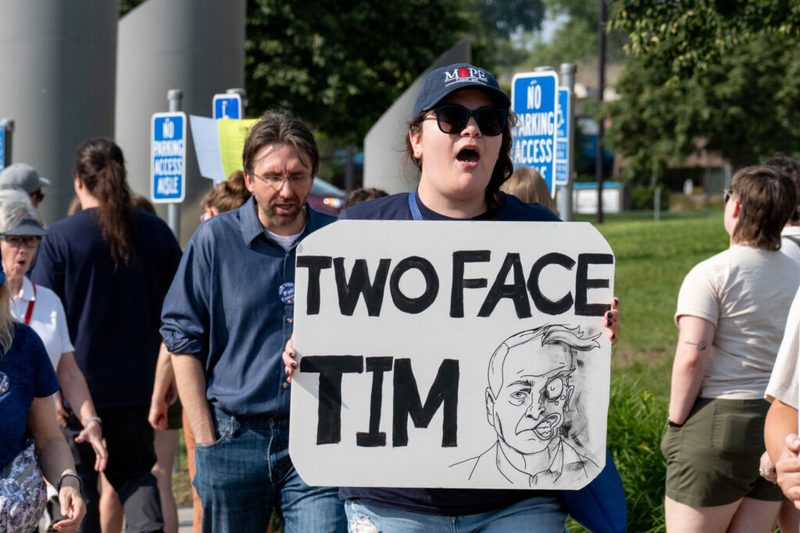
Members of the Minnesota Association of Professional Employees picket in St. Paul on Wednesday, June 4. (Photo by Izzy Wagener/Minnesota Reformer)
After one of the most bitter contract campaigns in recent memory, members of the union representing some 18,000 state employees approved a two-year contract that largely maintains the status quo with modest pay increases.
Although voting, dues-paying members supported ratifying the contract by a wide margin — 6,857 to 1,813 — the Minnesota Association of Professional Employees said the 79% approval was the lowest since the union went on strike in 2001.
MAPE President Megan Dayton said in a news release on Friday that the relatively lackluster response to the contract was “an indictment on the anti-worker attacks from Gov. Tim Walz.”
Many MAPE members, who work in hundreds of different jobs from data analyst to social worker, have been fuming at Walz since he ordered state employees back to the office part time. Workers held protests outside the governor’s residence in St. Paul, and many said they’d be willing to strike over the directive.
The continued icy relations with a major public employee union — a key Democratic constituency — comes just weeks before Walz is expected to announce his re-election plans.
In the end, the union backed down and settled for a contract with no significant changes to the return-to-office policy that took effect June 1. One minor tweak: The state must provide 21 days notice for telework changes, up from 14 days.
“While this contract does not give us everything we deserve, especially on telework protections, it is a hard-fought foundation for future progress,” Dayton said.
It’s unclear how many MAPE members had telework arrangements. The union says state officials pleaded ignorance, although Walz has said about 60% of state employees worked in-person during the pandemic.
The union did claim victory in beating back state health care proposals that they estimated would raise workers’ costs by thousands of dollars a year.
Workers will receive a 1.5% raise in the first year of the contract and a 1.75% increase in the second along with seniority raises. The modest increases reflect the state’s cloudy budget forecast with a significant deficit on the horizon. If inflation matches projections — estimated to remain stubbornly elevated in the wake of President Trump’s import taxes — then workers’ raises might not keep up with the cost of living.
The union also beat back a proposal from the state to allow for “emergency layoffs” during epidemics, natural disasters and other “fiscal exigencies.” The new kind of layoff would have allowed the state to idle workers without having to follow the usual contractual procedures governing layoffs, like placing laid off workers in vacant positions at the same seniority level.
AFSCME Council 5, which represents another 18,000 state employees, announced a tentative agreement on the same day as MAPE in June and will count votes on the contract from their members next week.

Saint Paul, MN