SC Board of Education OKs financial takeover of Pee Dee school district
Jul 18, 2025 | 3:42 pm ET
Description
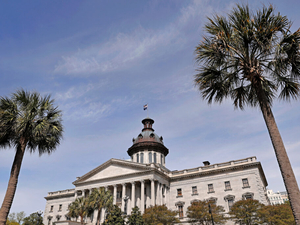
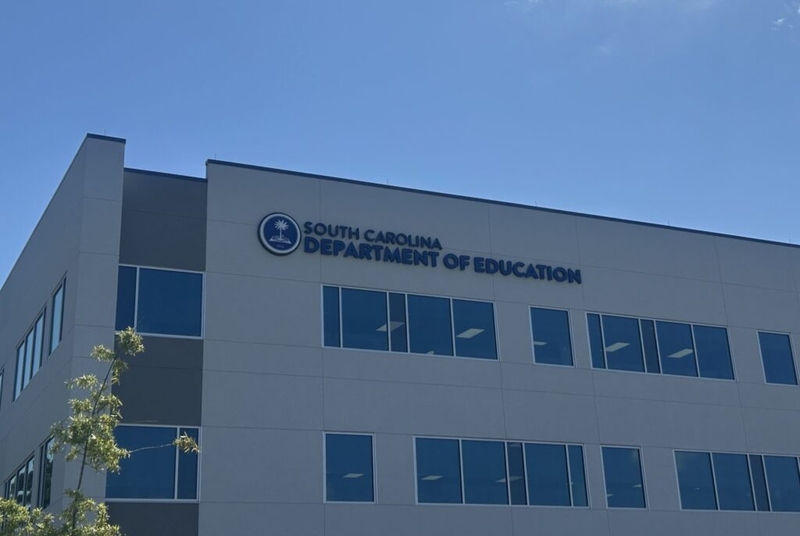
The state Department of Education building in West Columbia on Friday, July 18, 2025. (Photo by Skylar Laird/SC Daily Gazette)
WEST COLUMBIA — The state education department will take over the finances of a rural Pee Dee school district, pausing a plan to consolidate schools to make up a hole in the budget, the state Board of Education decided Friday.
The decision comes a week after the South Carolina Law Enforcement Division launched an investigation into another district under state financial control following an inspector general investigation that found evidence of potential fraud and criminal activity.
The state board’s unanimous decision to take control of Marlboro County School District’s finances Friday means any decisions on contracts, hiring and other financial transactions must first go through state Department of Education staff. A team of financial and operational managers will help the district come up with a plan to address its funding issues, according to the department.
“My hope is that no district in the state of South Carolina does not have the finances, the leadership and the expertise to move forward so that we can better educate the students of South Carolina,” said Rita Allison, chair of the state board. “At the end of the day, that’s what it’s all about are those students and how they’re being served in their academics.”
The 3,200-student district has been under fiscal watch, the lowest of three escalating tiers of concern, since 2022, state attorney Henry Gunter told the state board Friday. The state escalated its status to fiscal emergency in February over concerns with its most recent financial audit.
Superintendent Ellen Weaver recommended taking full control of the district’s finances in a letter to the board last week. Her suggestion came soon after the district’s school board passed a budget that would deplete its financial reserves and consolidate schools in an effort to fill a nearly $7 million deficit.
Whether consolidating schools would actually save the district money in the long run was unclear from the district’s budget, which the board adopted more than a week after the state-imposed deadline of July 1. The logistics of trying to consolidate schools in the weeks before the school year starts would also pose a problem, she said.
“It is simply untenable to consolidate schools in the short window of time that they were seeking to do it, and that is not fair to the communities, to the teachers and to the students of those schools,” Weaver said.
The state has already sent experts in finances and school district operations to help sort out the district’s financial problems, Weaver said. With the board’s approval Friday, the experts will take a closer look at how the district can address its financial woes and make suggestions for the local school board to adopt, she said.
Until then, the existing budget will remain in place, aside from the school consolidation plan, which the state has told the district to put on pause, Weaver said.
If the local school board doesn’t agree to follow the state’s suggestions, the state board can take further action, including removing the local board if necessary, Weaver said. District Superintendent Helena Tillar and board chair Michael Coachman said in a joint statement Friday they welcomed the state’s help.
“Together — as the School Board, administrative team, employees, families, and community partners — we share one vision, one mission, and one goal: to deliver a high quality education to every child, every day in Marlboro County,” the statement read.
The priority for the time being will be to get schools open July 28, the district’s scheduled back to school date, with as little impact on students and teachers as possible, Weaver said.
After that, staff from the state education department will focus on finding ways to cover the funding shortfall in the district. One possible way of doing so could be reexamining the ratio of staff to students, especially at a district level, Weaver said.
Since the 2021-2022 school year, the number of students in the district has decreased by 10%, while the number of teachers rose 22% and staff members increased 37%, according to a letter from state officials to the district.
Weaver also requested the inspector general investigate claims of mismanaged purchasing cards, without providing more details on her concerns. That request is still pending, according to the department.
Jasper County investigation
A similar request to investigate Jasper County School District turned up potential fraud and criminal activity, according to a report released by the inspector general’s office last week.
The state Board of Education agreed to take financial control of the 2,600-student district in December, after years of missed deadlines for audits and reports of misspending. By that point, the inspector general’s office was already looking into claims of mismanagement following a request from Weaver in August of last year, according to the report.
Inspector General Brian Lamkin found that, along with failing to file completed audits, the district’s “financial records were in disarray, lacking a fully functional financial department with experienced staff,” according to the report.
The district failed to follow its own procurement policies when hiring vendors, and some employees received “questionable payments” in the forms of bonuses and payments for dual roles, according to the report. Lamkin recommended the state education department use its financial control to take a closer look at those issues.
Also in question was the relationship between former Superintendent Rechel Anderson and the district’s accreditation agency, Cognia. While working as the district’s superintendent from 2018 until February of this year, Anderson also received payments and filled out employee tax forms for Cognia, which would constitute a conflict of interest, according to the report.
Over the course of those seven years, Anderson received about $48,000 from the accreditation agency, which she failed to report on her state-required financial statements, according to the investigation.
At one point, Anderson used her role with Cognia to file a complaint against her own board, launching an investigation through the accreditation agency that cost the district nearly $4,600 in legal fees, the report found.
Anderson’s employment with Cognia was one of several outside jobs she pursued while superintendent, violating a clause in her contract that said she could have another job only if it didn’t interfere with her work running the school district, according to the report.
During her time as superintendent, for which she was hired at $145,000 per year, Anderson started two separate businesses that claimed to operate group homes for children, opened a Caribbean cafe and wrote a book, according to the report. Anderson was rarely in her office or on district property during work hours, and she sometimes used district time and resources on her other business ventures, staff and board members told investigators.
“Writing a book, starting a restaurant (not in Jasper County), multiple for-profit ‘boys homes’ (not in Jasper County), as well as substantial outside employment/contracting as a paid agent for Cognia, diluted the attention and availability of Dr. Anderson to adequately perform the duties required by her employment contract,” Lamkin wrote.
The investigation also raised questions as to whether Anderson improperly took out loans to start one of her group homes and submitted fraudulent certifications to found another, according to the report. And it pointed to evidence that Anderson didn’t live in the school district, which her contract required, and claims that she forged a lease when asked to prove her residency in the county.
All the while, the school board failed to supervise Anderson or fire her despite knowing she violated parts of her contract, according to the report. The district conducted its own investigation into Anderson in 2024 but never followed up with SLED, despite finding evidence of potential criminal violations, the report found.
The board voted in October 2024, to fire Anderson but failed to finish the termination process, only officially breaking ties with her after reaching a settlement agreement in February, according to the report.
After reviewing the report, SLED launched an investigation into Anderson and the district on Thursday, spokeswoman Renée Wunderlich said.
The district did not respond to a request for comment Friday. Anderson, when reached by phone, hung up on a reporter, then did not respond to a follow-up email requesting comment.
Jasper County School District remains under financial control from the state. State officials are reviewing the inspector general’s findings and watching the district closely, Allison said.
“I am sure, at the end of the day, the state Department of Education, with the OK of the state board, will do all that they can to make sure that Jasper continues to move well,” Allison said.
Columbia