NH judge blocks Trump attempt to end birthright citizenship, grants class action status
Jul 10, 2025 | 1:07 pm ET
Description
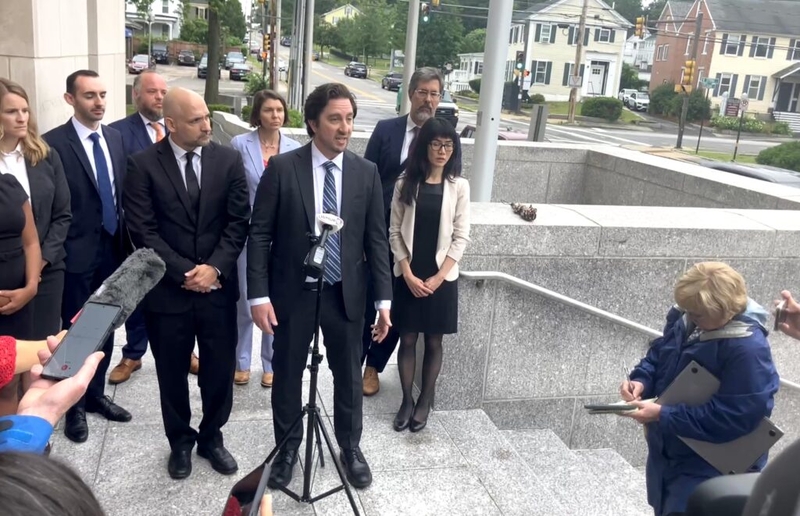
Deputy Director of the ACLU Immigrants' Rights Project Cody Wofsy (center) speaks to reporters after a U.S. District Court of New Hampshire hearing in which Judge Joseph Laplante said he would block President Donald Trump's anti-birthright citizenship executive order, July 10, 2025. (Photo by Ethan DeWitt/New Hampshire Bulletin)
A federal district court judge in New Hampshire issued an injunction against President Donald Trump’s executive order to eliminate birthright citizenship, and held that a group of noncitizens suing the government have class action standing to sue.
Judge Joseph Laplante’s decision will stop the executive order from taking effect July 27 in New Hampshire and other states that don’t currently have injunctions, but the decision has been stayed until July 17 to allow the government to appeal, he announced in court Thursday.
Issued in January, the executive order, titled “Protecting the meaning and value of American citizenship,” seeks to redefine the 14th Amendment to deny automatic citizenship to children born in the U.S. to undocumented parents. The executive order would reverse more than a century of precedent establishing automatic citizenship, and plaintiffs say it would unfairly deprive them of government benefits, such as SNAP and Medicaid.
On Thursday, Laplante agreed.
“The deprivation of U.S. citizenship and the abrupt change of policy that was longstanding, perpetuated by executive order and not statute … that’s irreparable harm,” he said. “It is the greatest privilege that exists in the world, and that’s what makes it irreparable harm.”
Cody Wofsy, deputy director of the American Civil Liberties Union’s Immigrant Rights Project, which helped bring the lawsuit, hailed the ruling in a press conference after the hearing.
“This is going to protect every single child around the country from this lawless, unconstitutional, cruel executive order,” he said. “We appreciate the court’s rapid consideration of this issue.”
Laplante’s order comes weeks after the Supreme Court limited the ability of federal courts to block such policies. In that landmark decision, Trump v. Casa, Inc., the high court ruled that nationwide injunctions exceed the authority granted to courts by Congress, and that relief should be targeted only to plaintiffs. But the ruling made an exception for class action lawsuits: national injunctions are possible in those cases if the classes are national, it held.
Thursday’s decision in the U.S. District Court of New Hampshire is the first time a court has approved a class action lawsuit designation in order to block the president’s anti-birthright citizenship order. The ACLU had scrambled to file the class action lawsuit within days of the Casa decision in June.
A new interpretation of citizenship
In issuing its executive order, the Trump administration has argued that the longstanding interpretation of who received citizenship under the 14th Amendment is wrong.
That amendment, passed after the Civil War, was designed in part to overturn the Dred Scott Supreme Court decision and grant citizenship to formerly enslaved individuals. But it also established the tradition that those who are born within the U.S. automatically attain citizenship — with exceptions for children of enemy combatants and diplomats — an understanding that was upheld in the 1898 case of U.S. v. Wong Kim Ark.
Trump, in his executive order, contended instead that the 14th Amendment does not apply to children of noncitizens because it refers specifically to people “subject to the jurisdiction” of the United States. Lawyers for the Department of Justice have argued that a person must have legal domicile in the U.S. to qualify for birthright citizenship.
But plaintiffs say that interpretation is ahistorical and unconstitutional, and say birthright citizenship is “bedrock law.” They have noted that should the executive order be allowed to stand, families could be unable to access needed social safety net programs, and some siblings could be split between citizens and noncitizens, depending on whether they were born before or after the order.
And lawyers for the plaintiffs have said the order could render children of noncitizens stateless if the country of their parents’ origin does not recognize their nationality.
Objections to the class action
In federal court on Thursday, attorneys on both sides largely sidestepped the larger debate on the meaning of birthright citizenship and focused on the class certification question.
The plaintiffs, represented by the American Civil Liberties Union, include “Barbara,” an asylum applicant from Honduras who is living in New Hampshire and expecting a child; “Susan,” a student visa holder from Taiwan living in Utah, who gave birth to “Sarah” in April; and “Mark,” a Brazilian citizen living in Florida who gave birth to “Matthew” in March. The names are pseudonymous to protect their identities.
Two of the plaintiffs, Barbara and Susan, have older children, but because the executive order denies citizenship only to babies of noncitizens born after Feb.19, those children’s citizenship status is not in question.
The plaintiffs had attempted to include both the infants and their parents in the class action lawsuits, but Laplante said he would narrow the class certification to include just the infants.
The defendants, who include the Department of Homeland Security, the State Department, the U.S. Department of Agriculture, and the Centers for Medicare and Medicaid Services, argued that there was a lack of “commonality” between the plaintiffs due to the plaintiffs’ differing immigration status. The lawyers said a class certification should not be established without the court conducting discovery to determine the domicile status of each plaintiff. They also argued the pseudonyms meant it is impossible to determine whether the plaintiffs are representative of the class.
Eric Hamilton, an attorney for the government, argued in court that the class certification should not be granted because the plaintiffs were too different from each other, and that the court should not grant a national class certification because it would deny the ability for other district courts to arrive at their own rulings.
Instead, Hamilton contended, any injunction by Laplante should apply only to the jurisdiction of the New Hampshire U.S. District Court, and not the whole country. Laplante rejected that reasoning.
“Plaintiffs are now trying to accomplish through a different means what the United States Supreme Court held was beyond the equitable jurisdiction of different district courts,” Hamilton said.
But Wofsy countered that the plaintiffs are a “classic example” of the group of people who meet the standards for a class action lawsuit.
The government is expected to appeal Laplante’s ruling to the U.S. Circuit Court of Appeals, and lawyers will push for an expedited process there.
Thursday’s court order does not affect another New Hampshire lawsuit against Trump’s birthright citizenship: New Hampshire Indonesian Community Support, et al. v. Trump. In that case, the Indonesian support organization and individual members sued to block the executive order. In February, Laplante issued an injunction against the executive order that was narrowly tailored to apply to the plaintiffs — and not the whole country — and is likely not affected by the Casa decision. That lawsuit is proceeding before the 1st Circuit Court of Appeals.
Laplante’s decision to issue a national injunction Thursday stands in contrast to his decision in the February case to narrow his ruling. At that time, he had called it inappropriate for a district court judge to issue a national injunction.
On Thursday, he clarified that position.
“It’s a better process to narrow these types of decisions and not have judges create national policy,” Laplante said at one point during oral arguments.
But at a different point, he added: “I wasn’t a judge that was comfortable with a national injunction. But class action is different.”
Concord, NH