Missouri school leaders concerned ahead of ‘A’ through ‘F’ report card rollout
Sep 04, 2026 | 8:00 am ET
Description
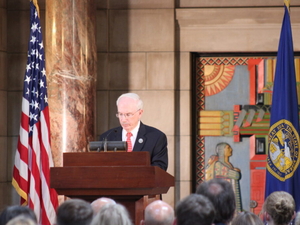
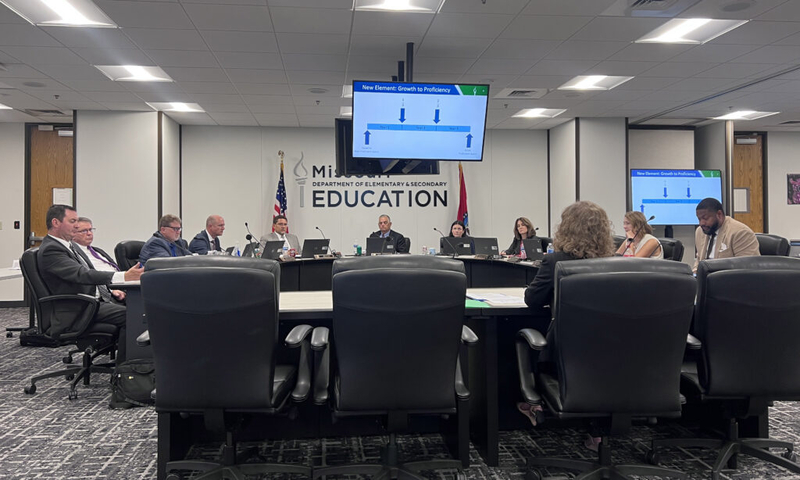
Missouri Department of Elementary and Secondary Education's Deputy Commissioner of Learning Services Lisa Sireno explains the department's 'A' through 'F' report card framework to the State Board of Education on Aug. 18, 2026. The department is holding feedback sessions to gather educators' input on the plan (Annelise Hanshaw/Missouri Independent)
Missouri educators voiced concerns Thursday that the state is rushing to roll out an “A” through “F” report card system for public schools without fully considering its provisions.
In the second of four feedback sessions the Department of Elementary and Secondary Education is holding to meet with stakeholders about the proposal, public school leaders peppered state officials with questions about the plan — particularly the prospect of publicly labeling schools as failing based on a system that is still being developed.
“It is tough to address the (questions) that are asking for justification for what was written in the executive order,” Stuart Smith, the department’s improvement and accountability manager, told the session’s 275 attendees Thursday. “We received that as it was written, and that’s kind of been our operational approach: to address the language as it was written.”
The initiative to assign schools letter grades stems from an executive order Gov. Mike Kehoe issued in January with specific requests regarding the content and presentation of the report cards.
The department is not legally obligated to enact Kehoe’s request, though its staff and the State Board of Education appear poised to follow the executive order completely.
“We’ve got the executive order, and we’re trying to make the best of it that we can,” said Jeremy Ellis, the department’s National Assessment of Educational Progress coordinator.
The department plans to release a draft of the report cards within weeks using data from the 2024-25 school year. This first report will be simplified and lack some elements that will later impact scores, like a metric tracking students’ progress toward proficiency.
Officials told the State Board of Education in August that the draft report was intended to meet Kehoe’s call for a fall 2026 rollout, with financial and time constraints pushing full implementation to sometime next year.
Some of Thursday meeting’s participants worried that districts have not yet seen how they might score even though the grades could soon become public.
Sandy Leech, Hollister R-V School District’s assistant superintendent of teaching and learning, typed into the virtual meeting chat that she understood the department’s “challenge” but was looking for more support between the state and districts.
“Will releasing the A-F draft report card publicly, before running simulations and qualifying data (support students)?” Leech asked. “Or will an unintended consequence be that it pits districts and communities against each other due to inaccurate data and potentially low scores across the state?”
Jocelyn Strand, the department’s incoming improvement and accountability administrator, said she doesn’t “have any really specific thoughts” on circulating the draft to schools without a public release but pointed to the executive order’s call for schools to post their report on their websites “no later than Sept. 30 of each year.”
“We are going to follow the executive order’s requirements related to the release of data and anticipate that the governor’s office and others expect to see data released,” Strand said.
Earlier in the department’s development of the report cards, the state’s 12 largest school districts got a preliminary look at their performance, Ellis said.
“Our biggest concern is that you create this thing and it doesn’t actually categorize the buildings, at least in comparison to each other, correctly,” he said of the initial test. “So we are still very concerned about that. All of these chats are discussions we’ve had over the last six months internally fighting about what we should do and how to do it best.”
The department has made some tweaks to the plan in response to feedback over the past few months. Previously, it had anticipated that the testing window for teachers would be shortened by two weeks but has since backtracked at least for the current school year.
Other details have yet to be finalized, like whether schools with few students or limited grade levels receive a grade. The department is also asking the state board whether demographic information, like socioeconomic status, should be included.
A handful of attendees commented that they were concerned the scores would penalize schools with a large population of low-income students. Joplin Schools Superintendent Kerry Sachetta, pointed to Texas’s report cards, which have a section dedicated to vulnerable student groups, like those enrolled in special education or learning the English language.
“What precludes (the department) from adding the socioeconomic Status of each district on the grade card to provide context and offer a grade for each area of the grade card like Texas does?” she asked.
The State Board of Education briefly discussed the idea in August and appeared opposed to improving the scores of districts who educate a large number of low-income students.
“We should have the same expectation for all children,” said board member Kerry Casey, of Chesterfield.
The board’s vice president Jon Otto, from Kansas City, said he liked the idea of a disclosure giving context to schools’ report cards while not impacting scoring.
The department has two in-person feedback sessions scheduled for Sept. 9 in St. Louis and Sept. 10 in Columbia before presenting the A-F framework to the state board for approval Sept. 15.
Jefferson City, MO