Kobach urged Congress to legislate birth tourism hours before judge blocked Trump’s order
Sep 03, 2026 | 4:34 pm ET
Description
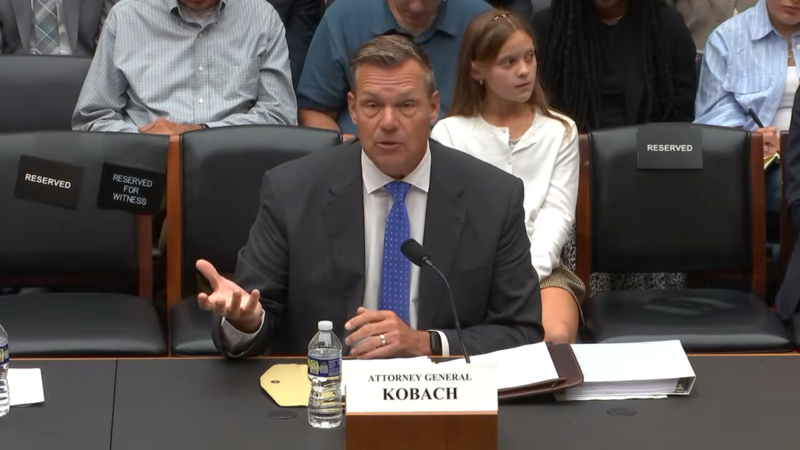
Kansas Attorney General Kris Kobach appears on Capitol Hill on Sep. 2, 2026, testifying before a U.S. House Judiciary subcommittee about birthright citizenship. His daughter appears behind him. (U.S. House Judiciary Committee)
TOPEKA — Kansas Attorney General Kris Kobach slammed the U.S. Supreme Court majority that blocked President Donald Trump’s effort to unravel birthright citizenship, suggesting its decision “may not stand the test of time.”
Testifying before a U.S. House subcommittee Wednesday, Kobach encouraged Congress to pass a law that would cement Trump’s Aug. 6 executive order that targeted “birth tourism.” He made the urging hours before the executive order was blocked Wednesday by a federal judge.
Kobach was one of at least 25 state attorneys general who supported the government’s position in the U.S. Supreme Court case Trump vs. Barbara that upheld birthright citizenship, the constitutional guarantee that people born in the United States are United States citizens regardless of the parents’ citizenship.
He called the court’s June decision “weakly reasoned.”
But Kobach praised Justice Clarence Thomas’ 91-page dissent and said it was “truly bizarre” that the majority opinion rested “on this futile notion that you are attached to the lord of the soil.”
“I suggest that this decision may not stand the test of time,” Kobach said.
He added: “This one, because it is so weakly reasoned, is particularly vulnerable.”
Democrats on the U.S. House Judiciary’s subcommittee on the Constitution and Limited Government expressed frustration and confusion as to the purpose of the hearing, since the Supreme Court decision precludes Congress from altering birthright citizenship in the way Trump envisioned.
But Kobach encouraged Congress to consider narrowly tailoring a federal law to address “birth tourism,” or the act of entering a country while pregnant to secure U.S. citizenship for one’s child once born. Mimicking Trump’s Aug. 6 executive order in statute could pass muster, he said.
Then, a federal judge Wednesday blocked the Trump administration from enforcing the order that attempted to redefine birthright citizenship. U.S. District Judge Deborah Boardman referred to the Supreme Court’s June decision in her own decision, calling Trump’s order “almost certainly unconstitutional.”
Kobach appeared alongside Ken Cuccinelli, former acting deputy secretary of the U.S. Department of Homeland Security and former Virginia attorney general; Rosemary Jenks, policy director at the Immigration Accountability Project; and Jonathan Weinberg, Wayne State University law professor.
Kobach, Cuccinelli and Jenks shared the sentiment that the Supreme Court got its decision wrong.
Weinberg said it would be “chaos” to implement Trump’s vision for eradicating birthright citizenship. Applying it prospectively, as the president intended, would be chaotic on its own, Weinberg said, and he theorized Trumps theory would render every current U.S. citizen’s status questionable.
“We’d all have to look around and find out whether we’re citizens or not, trace our lineage back and see if our parents or our grandparents could pass the test set by President Trump’s executive order,” Weinberg said.

Topeka, KS