Almost 60% of SC taxpayers would owe more income taxes for 2026 under GOP bill
Apr 01, 2025 | 5:00 am ET
Description
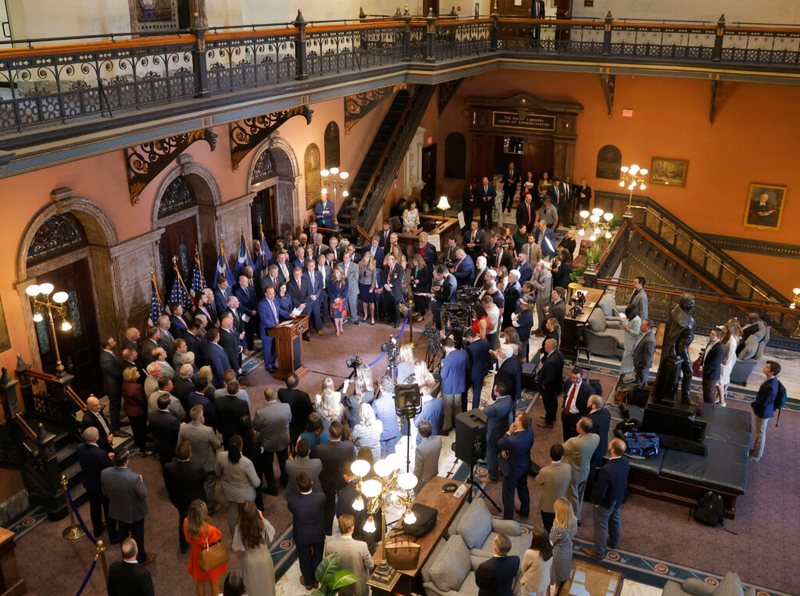
House Ways and Means Chairman Bruce Bannister, R-Greenville, announces the GOP income tax reform legislation surrounded by House and Senate Republicans at the South Carolina Statehouse in Columbia on Tuesday, March 25, 2025. (Photo by Travis Bell/STATEHOUSE CAROLINA/Special to the SC Daily Gazette)
Editor’s note: This article has been updated following the bill’s advancement.
COLUMBIA — Legislation touted by GOP leaders as making South Carolina’s tax code appear more competitive by making it “fair and flat” would require most tax filers to pay more initially, according to an analysis by state fiscal experts.
The bill easily advanced Tuesday to the full House Ways and Means Committee.
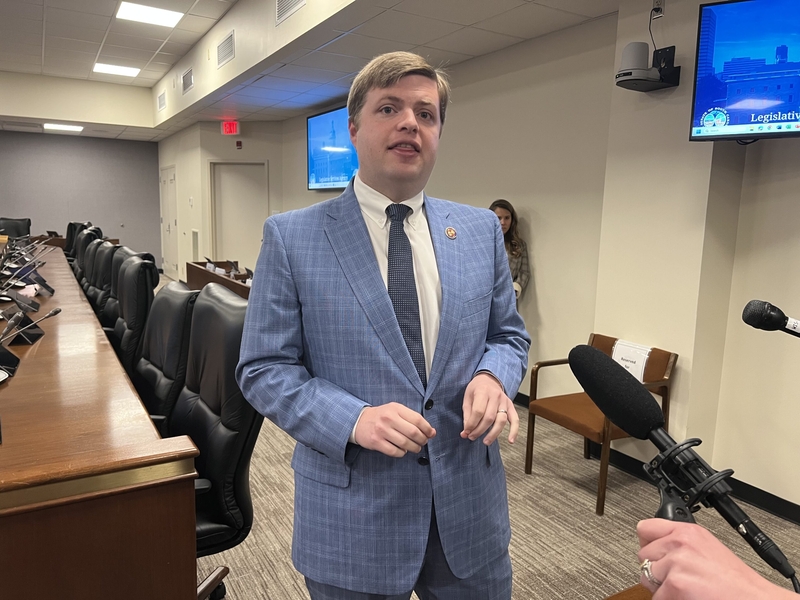
“It is a conservative revolution of our income tax system,” Rep. Brandon Newton, R-Lancaster, said ahead of his subcommittee’s unanimous vote of Republicans. The panel’s two Democrats did not attend the hearing. The bill could reach the House floor as early as next week, he said.
The goal
Collapsing South Carolina’s tax brackets into a single flat tax rate of 3.99% in 2026 would reduce state revenues by $216.6 million overall. But the revamp isn’t really about cutting taxes — at least, not in year one.
It’s about removing what Ways and Means Chairman Bruce Bannister called the state’s “glaring black eye” on income taxes: a tax structure that seems to be the highest in the Southeast, even though it’s not.
Despite the Legislature’s 2022 law that has cut taxes by $1 billion, this year’s top marginal rate of 6.2% remains the region’s highest number. So, it appears that South Carolinians are taxed higher than residents in nearby states. However, as Bannister explains, that’s not accurate. The effective rate — what South Carolinians pay — is lower. It just doesn’t appear that way.
The bill would decouple South Carolina’s tax code from the federal system and tax adjusted gross income as almost every state with an income tax does, while keeping all of the state’s existing deductions and exemptions.
But untethering from the federal code and its standard deduction means South Carolinians will start their state calculations with more income to report.
Doing that while collapsing three tax brackets into one allows the state to immediately appear to tax the least in the Southeast — other than Tennessee and Florida, which don’t have a state income tax — even as taxes rise for most South Carolinians.
That’s done by broadening and shifting the tax burden: 19.4% of filers would owe less in spring 2027, while a whopping 59.4% of filers would owe more; 21.2% would experience no change, according to the fiscal impact report by the state Revenue and Fiscal Affairs Office released ahead of Tuesday’s meeting.
More people would be contributing to state coffers.
Under the proposal, 23% of tax filers would still pay zero in state income taxes. But that compares to roughly 45% currently, according to Revenue and Fiscal Affairs.
“We believe everyone who has sufficient income should pay something for the services of living here in South Carolina,” Bannister, R-Greenville, said at Tuesday’s meeting.
What the analysis shows
The fiscal analysis cautions against generalizing who will pay more in what income level or age: “The impact on individual taxpayers varies widely within each range depending on the specific tax situation of each tax filer,” reads the seven-page summary signed by the office’s director, Frank Rainwater.
Still, the report provided hard estimates on how many South Carolina taxpayers will pay more versus less — and the extent of the swings per taxpayers’ income levels after all applicable deductions, exemptions and tax credits are applied to reduce their reported earnings.
Of the nearly 1.7 million tax filers expected to pay more in state income taxes under the plan, their increase for calendar year 2026 will average $560, with hikes ranging from $98 on the low end of income levels to over $10,000 for taxpayers reporting more than $1 million in adjusted income.
That compares to about 550,000 tax filers who would see an average decrease of $2,110.
Several hundred people at the bottom end of the pay scale would see an average decrease of $3,700, while tens of thousands of people reporting $30,000 to $50,000 of income would see a dip of less than $40. On the top end of the scale, roughly 9,900 tax filers reporting more than $1 million would see their income tax liability plummet by an average of $31,000.
Gov. Henry McMaster reiterated his support for the bill Tuesday.
The rate “needs to be flat, broad, low and fair,” he told reporters asking about the analysis. “We have 40% of our people who don’t pay any income tax today under the current system. Everybody ought to pay a little something, at least just to be in South Carolina and enjoy this great state. But nobody should pay an unfair burden.”
A new personal state adjustment (smaller than the federal standard) would provide a $6,000 deduction for single filers making up to $30,000, then provide some relief up to $40,000 of income. Married couples filing jointly could deduct $12,000 for incomes up to $60,000, with the deduction phasing out at $80,000.
Republicans’ ‘historic’ tax-cut plan attempts to give SC competitive edge
Yet, looking at South Carolinians reporting an adjusted gross income between zero and $40,000, nearly 714,400 tax filers will owe more for 2026, while fewer than 20,000 would pay less.
Rep. Gilda Cobb-Hunter, D-Orangeburg, said she wants to see more tax relief for working people, to include a tax break for low- and moderate-income workers — called an earned income tax credit — that’s at least partly refundable, meaning it could provide those workers money after they file.
“We need to be serious about providing tax relief for as many South Carolinians as we can,” she said, especially considering public employees could be paying more out of pocket for health care for the first time in 13 years. That’s because the House budget plan does not fully cover employees’ premium increases for the coming fiscal year.
Plus, she said, it could be dangerous to the state’s fiscal health to bet on ever-increasing revenues.
“Given the chaos at the federal level and uncertainty … we may need to tread lightly,” said Cobb-Hunter, the House’s longest-serving legislator and first vice-chair of the budget-writing committee.
Any tax shift needs to be thoroughly vetted, she said, pointing to the state’s last huge tax swap as a cautionary example.
The 2006 law known by its number, Act 388, increased the state sales tax by a penny on the dollar to reduce homeowners’ property taxes, creating a host of unintended consequences for real estate, business property taxes, and school district budgets. (And, for years, that extra cent in sales tax didn’t cover all the property taxes it was supposed to, requiring the Legislature to use other taxes for the full swap.)
Continued cuts
The bill promises to keep cutting the tax rate as revenue collections increase.
For every year income tax projections rise by 5%, the bill would reduce revenue by another $200 million until the tax rate gets to 2.49%.
When and if that happens, then the bill would truly be a tax cut for the overwhelming majority of South Carolinians: More than 77% of tax filers would see a collective decrease in their income taxes of $2.5 billion. That’s compared to what they paid for tax year 2026 after the big revamp; 23% would still see no change whatsoever.
After the first-year move to a flat rate, taxes would only go down. That doesn’t mean everyone will pay less than they did this year. It means taxes will only go down or stay flat after the reboot.
“From the change going forward, it’s a tax decrease,” Rainwater said.
How many years it would take to get to 2.49% would depend on the economy and income growth.
Asked about the likelihood of getting to that number, Newton said, “I’ll guarantee we get to 2.49%.” He couldn’t guess how long that might take.
He dismissed concerns about an economic slowdown.
“South Carolina’s economy is extremely strong,” he said. “It isn’t slowing down.”
Rep. Sarita Edgerton, a member of the ultra-conservative Freedom Caucus, argued the state should go to 2.49% immediately for instant relief. The real estate agent said she figured out her family’s state income taxes will rise by almost $800 for 2026 under the proposal. “I want to see going to 2.49 out of the gate,” said the Spartanburg Republican.
That would require cutting $2.7 billion from the state budget in a single year.
The Freedom Caucus offered amendments during the House budget debate last month that didn’t come anywhere close to its own goal of slashing $1 billion.
Taxes withheld from paychecks
There is another part of the bill that could cause workers to see a bump in their take-home pay.
The bill requires the state Department of Revenue to adjust employers’ withholding tables — what businesses are told to withhold from workers’ paychecks — to align with the new tax structure. The state now requires more to be set aside for workers’ income taxes than is needed, which results in big refunds at tax time.
The adjustments would, on average, result in employers setting aside 20% less for state income taxes from workers’ pay.
It’s unclear when those adjustments would start — maybe sometime next year, maybe not until Jan. 1, 2027.
But a full year of those changes would result in all workers across South Carolina collectively getting $1.4 billion more in their take-home pay. Their big, once-a-year refund would go away, but they would see a bump in what goes in their bank accounts every payday, according to Revenue and Fiscal Affairs.
Advocates promise to make the Legislature’s ruling Republicans feel the pressure to pass the bill.
The state chapter of Americans for Prosperity announced last week plans to launch a “six figure campaign” urging legislators to approve the plan. The group’s marketing push will include mailings, as well as online and radio ads and an “unmatched grassroots presence” going door to door asking residents to call their legislators.
Columbia