University of Wyoming to close DEI office, reassign staff in response to legislative mandate
May 10, 2024 | 5:14 pm ET
Description
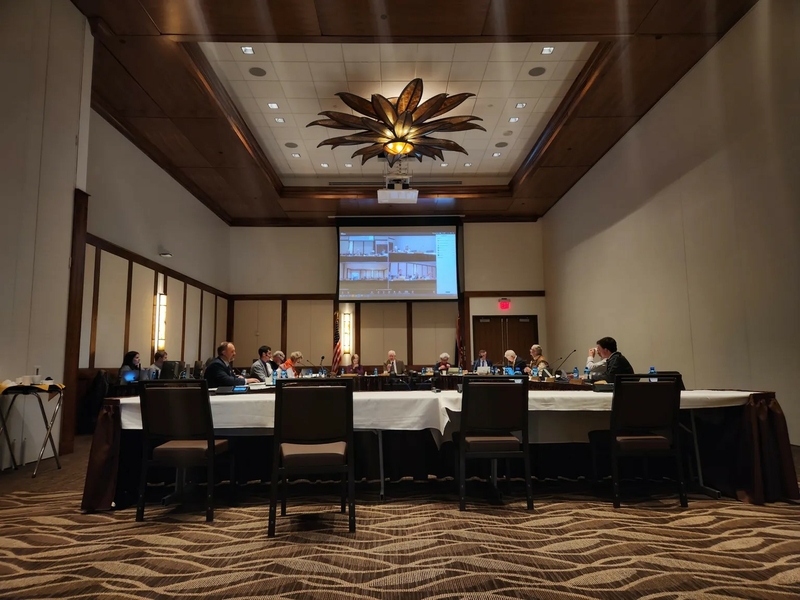
UW Board of Trustees met to discuss actions on the DEI office on May 10, 2024. (Madelyn Beck/WyoFile)
The University of Wyoming is closing its Office of Diversity, Equity and Inclusion, and its staff will be reassigned and many of its programs will continue.
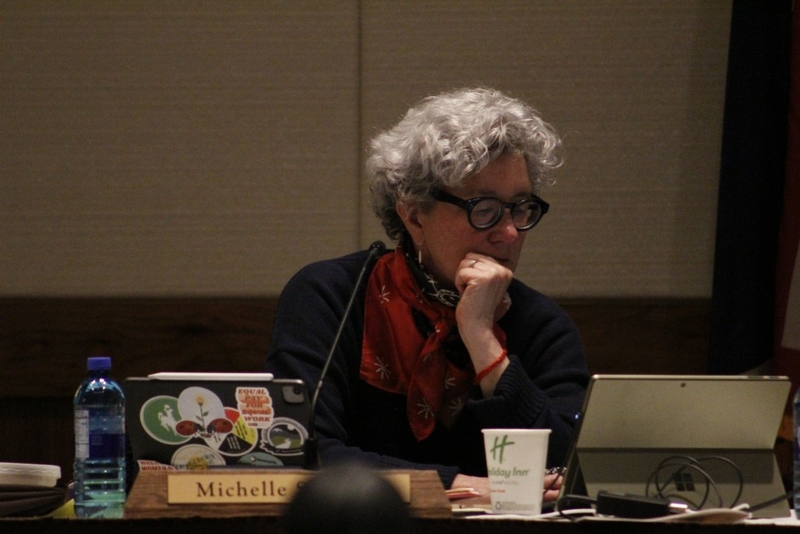
The school’s Board of Trustees backed President Ed Seidel’s recommendation Friday to close the office, with Trustee Michelle Sullivan saying they were put in “an impossible situation.” Earlier this year, the Wyoming Legislature — UW’s largest funder — cut the university’s block grant and forbade it from spending that appropriation on the DEI office.
In addition to closing the office and reassigning staff, Seidel said the university will create “a vice provost for faculty, staff and student access, opportunity and well being.” That position will help transition programs previously under the DEI office into new university units.
Programs that are either required or key to UW community success will be maintained, Seidel said, including, but not limited to: “Academic freedom, research freedom, compliance with federal laws — including the Americans with Disabilities Act, Title VI, VII and IX — Native American Affairs, the Shepard Symposium, the Latina Youth Conference, and others.”
In a later press release, he added that the university will seek out private funding for “preferential” programs deemed essential to helping students, like the Wyoming Latina Youth Conference and Women in STEM activities.
The Legislature’s decision and the university’s subsequent conversations about how to respond prompted widespread discussion, both in previous board meetings and in other public comments. Seidel noted this in his statement released after Friday’s vote.
“What I can say is that we are moving forward the best we can to meet the expectations of elected officials and the people of Wyoming and continue serving our students and communities,” he said.
UW leaders considered five options for responding to the Legislature’s decision to defund the DEI office. More severe suggestions included laying off all of the employees within the office. On the other end, school leaders could have kept the office, but funded it through private support.
Employment practices
Beyond the DEI office, the university is also changing employment practices, effective immediately.
“We will not allow units of UW to require job candidates to submit statements regarding diversity, equity and inclusion,” Seidel said. “We will not have a requirement for employees to be evaluated on components of diversity, equity and inclusion in the performance evaluation process. These actions reaffirm UW’s commitment to merit-based employment practices including hiring and promotion.”
This aligns with what MIT did recently, ending diversity statements in hiring.
Seidel also plans to look into many other practices listed in a working group report to ensure UW doesn’t encourage preferential treatment. That includes admissions practices, speakers at the university, recruitment, retention, scholarship awards, assistantships, some research programs, summer institutes and student organization structures.
“I am committed to maintaining and enhancing a campus community that promotes success for all, and I encourage all of us to lean into this next chapter for our university,” he said.
What’s in a name?
In prior board meetings, trustees, students, staff and others discussed the meaning of DEI — both to opponents that want to see it eliminated and to the UW community itself.
Seidel’s working group looked into what it believed was the Legislature’s intent when it aimed to eliminate funding for DEI.
The group’s new definition of DEI — which trustees also adopted Friday — included things like promoting programs that give advantages or disadvantages based on race, color, sex, national origin, gender identity, or sexual orientation.
The definition also said DEI would mean promoting the “position that the action of a group or an individual is inherently, unconsciously, or implicitly biased, privileged or inherently superior or inferior on the basis of color, sex, national origin, gender identity, or sexual orientation.”

“There are many things that we do under the umbrella of DEI that do not fit within those definitions,” Board of Trustees Chairman Kermit Brown said Thursday before opening up public comment. “And it’s not the intent of the university to terminate any of those things.”
Efforts to eliminate DEI aren’t about eliminating diversity or inclusivity, according to Megan Degenfelder, the state’s superintendent of public instruction and an ex-officio trustee.
“What we’re talking about here is an extreme interpretation that has really taken over the definition of DEI and made it into this preferential treatment of one race, one gender over another, and then this notion of one race, gender being inherently racist over another,” she said. “That’s what people across the state are very angry about and they don’t want to see at their university.”
Trustees, Seidel and Degenfelder noted the differences between UW and many other universities across the country. For example, Seidel said, UW never had admissions policies that considered an applicant’s race, which the U.S. Supreme Court found to be illegal for institutions like Harvard. The student vigil for recent deaths in Israel and Gaza was another example trustees noted. In contrast to protests at some other college campuses, the vigil remained peaceful.
Public comment
As was the case in March, staff, students and alumni reiterated passionate support for the DEI office on Thursday. They talked about how it’s helped them, could help others and supports diverse members of the university, including veterans, people with disabilities, Native Americans and members of the LGBTQ+ community. They talked about the importance of having a central office where all these groups could go for help.
“This is not about an agenda,” said UW student Paula Medina. “This is about students having a place on campus — students who previously have not had places on campus.”
Unlike the March meeting, though, there was opposition to the DEI office: three current and former Natrona County Moms for Liberty members.
“DEI fosters a culture of groupthink, fear, resentment, entitlement, and increasingly distrust of leaders and institutions,” said Jenifer Hopkins, former Moms for Liberty and current Natrona County school board member. “Diversity simply means replacing some members with others with different characteristics.”
The office is at odds with American ideals of meritocracy, added fellow school board member Mary Schmidt. Beyond that, Schmidt said the true intent of DEI departments isn’t to promote diversity, but “to facilitate a societal shift in the communities of Wyoming through the promotion of gender chaos.”
She referenced UW’s fight to stop a preacher from tabling at the university for targeting a transgender student with a sign, the lawsuit over that student’s admission into a UW sorority, and Seidel’s statement when Sen. Cynthia Lummis was booed for her commencement speech stating that there were only two genders.
Hopkins and Schmidt’s comments were met with a few boos. Another commenter speaking in support of DEI was met with applause. That stopped after a little scolding, though.
“The booing, the applause is inappropriate on both sides, so I would appreciate it if you would just knock it off,” Brown said.
There was also pushback to the trio’s anti-DEI claims, including from Michelle Mason, who’s getting a second Ph.D. at UW while writing about power dynamics in academia. The concerns are more about the label of DEI than the work, she said, similar to critical race theory a few years ago.
“We do not push an agenda, people come to our office asking for services,” she said. “Just because the Legislature has a warped view of what DEI is does not make it true.”
And finally, there were concerns about how actions that affect DEI programs could harm the institution’s ability to attract and retain students and employees.
“I would say please think not only about what the state or the working group thinks, but also think about what the students think,” said Kameron Murfitt, president of the Associated Students of the University of Wyoming.
He referenced a spring student issue survey, which found that half of participating students felt there wasn’t enough being done to support LGBTQ+ students. Another third weren’t sure. To support that group further, students wrote in support for DEI office.
Both Natrona County Moms for Liberty Chapter Chair Sarah Bieber and several students noted that many of the programs under the DEI office — like multicultural affairs, ADA compliance and Title VI — have helped students for decades before finding a home in the office that only formed in 2017.
Perhaps, they suggested, they could simply exist again without being under those contentious three letters.
This story has been updated with more information since it was initially posted. -Ed
Cheyenne, WY