How the Ruby Garcia case generates conversation around domestic violence and immigration
Apr 11, 2024 | 8:00 am ET

Description
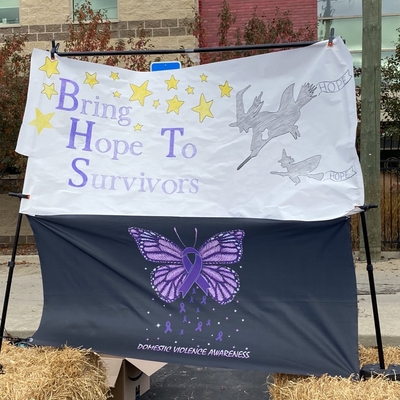
LA VIDA Partnership's Bringing Hope to Survivors Trunk or Treat in 2023
The killing of a West Michigan woman has become the center of a national debate on immigration and it has domestic violence advocates worried that anti-immigrant rhetoric could stop victims from seeking help.
State police alerted Michiganders on March 23 that they had found the body of a woman on the side of the highway in West Michigan. The woman has since been identified as 25-year-old Grand Rapids resident Ruby Garcia.

Court documents show the suspect, Brandon Ortiz-Vite, 25, whom law enforcement say was dating Garcia, confessed to shooting and killing her during an argument.
But Ortiz-Vite’s immigration status, having been deported to Mexico in 2020, has turned the case into a national discussion on border policy.
“My stomach dropped like everybody else when you hear about a horrific murder and domestic violence is connected to it,” said Ruby Robinson, managing attorney at the Michigan Immigrant Rights Center. “Knowing that the alleged perpetrator was a non-citizen, that fuels this myth that has no basis in fact or reality that immigrants are dangerous and that makes the clients in the communities that we’re working with more uncomfortable and fearful to reach out.”
Former President Donald Trump joined several Michigan Republican leaders, as well as members of law enforcement on April 2 in Grand Rapids to reinvigorate the conversation surrounding border security and condemn the killing of Garcia and other victims, casting the blame on President Joe Biden’s border policies.
“Under crooked Joe Biden, every state is now a border state. Every town is now a border town because Joe Biden has brought the carnage and chaos and killing from all over the world and dumped it straight into our backyards,” Trump said. “And people are coming in from prisons and mental institutions and nobody’s ever seen anything like it. Under the Trump administration we had a tough policy of getting the bad people out. We wanted to get them out and we took them out by the 1000s.”
Trump went on to call immigrants who have entered the country illegally “animals” and “not human”.
But it’s inaccurate to paint the actions of one person as the behavior of an entire community, Robinson said. His primary focus at the Michigan Immigrant Rights Center, or MIRC is addressing the unique struggles of victims of domestic violence who are immigrants or who are non-citizens.
“The destructiveness of violence and abusive relationships in general, and intimate partner violence does not notice and does not make decisions between citizens or non-citizens. It pervades every community and every type of relationship that’s out there,” Robinson said.
Having worked with clients with varying immigration statuses seeking help from intimate partner violence for 13 years, Robinson said the seriousness of domestic violence as an “epidemic” is rarely publicized. He hopes that conversations on domestic violence prevention and care can take priority over false claims that non-citizens increase crime rates.
“I hope that people, policymakers and others see this not as something about non-citizens or immigration status and see it really as about domestic violence and intimate partner violence, and thinking about ways that we can bring more awareness to that,” Robinson said.
And while a recent increase in deadliness of domestic violence in Michigan is suggested by a combination of state police data, COVID-19 pandemic era research and observations by domestic violence care providers, a correlation between crime rates and undocumented residents has been refuted by several extensive studies.
The Marshall Project in particular, cross-referenced local crime data from the Federal Bureau of Investigation, or FBI, and estimates of undocumented resident populations from the Pew Research Center from 2007 to 2016 to show that there is “no evidence” to support a connection between undocumented immigrants and crime.
On the contrary, a study published by Proceedings of the National Academy of Sciences found that in examining arrest data in Texas from 2012 to 2018, undocumented immigrants were responsible for “substantially” lower rates of crime compared to native-born citizens or legal immigrants. The research further determined that native-born citizens were more than twice as likely to be arrested for violent crimes and drug crimes than undocumented immigrants.
Law enforcement hasn’t released extensive information about the case outside of how Garcia was found and her relationship to the suspect. Not much is known by the public about what led to her death and her family has limited their interactions to a few local news outlets in Grand Rapids.
Trump said during his event in Grand Rapids that he had spoken to Garcia’s family, which her sister Mavi Garcia promptly told WOOD-TV was not true. She added that it makes her mad that anyone would politicize her sister’s death.
“It’s always been about illegal immigrants,” she told WOOD-TV. “Nobody really speaks about when Americans do heinous crimes, and it’s kind of shocking why he would just bring up illegals. What about Americans who do heinous crimes like that?”
Domestic violence isn’t about immigration status, it’s about relationships and power and control, Jessie Urban-Guzman, a domestic and sexual assault care advocate in Detroit, said.
Urban-Guzman is the Youth and Legal Program director for the LA VIDA Partnership program at Community Health and Social Services Center which provides specialized care for victims in the Latinx community.

“For many survivors who are immigrants, they are more vulnerable in certain ways,” Urban-Guzman said. “The dynamic where the perpetrator is the citizen or U.S. permanent resident and then the survivor is not…the perpetrator will use that and take advantage of that and use that as another power and control tactic or potentially against their family members. So even if the person is documented, or has legal residency, they could say ‘I’ll call ICE on your mom or your dad.”’
That family component is very important when considering particularly the needs of the Latinx community in Southwest Detroit and Southeast Michigan who Urban-Guzman said made it clear to LA VIDA early on that rather than investing in a shelter that specialized in care for the Latinx community, they wanted counseling services for all ages.
“People didn’t feel comfortable going to a shelter, they prefer to stay with family or friends,” Urban-Guzman said. “The vast majority of our staff either has ties to Southwest Detroit or they’re Detroit residents or they speak Spanish, so our community and our program is very much community based and so that really helps a lot with building relationships.”
Domestic violence services across the state are limited, Urban-Guzman said, adding that COVID put a huge strain on providing services and care providers haven’t really caught up on the need for services from those trying to leave abusive situations.
And even when someone is able to climb barriers and can finally leave an abusive relationship, especially for non-English speaking survivors, regardless of immigration status, the task of continuing life after abuse carries even more challenges.
It can be hard to find employment to sustain a survivor if they don’t speak English regardless if they are a legal resident, Urban-Guzman points out. Michigan’s lack of public transportation and barriers to education also add on to difficulty in finding a job.
LA VIDA tries to work with survivors on micro entrepreneurship endeavors where survivors can sell food or handmade items to become financially independent. But as organizations do the work of helping immigrants who experience domestic violence seek wellness and justice, Urban-Guzman said the anti-immigrant rhetoric surrounding the Garcia case is affecting the general well-being of the community.
“People get scared. People start to post on Facebook groups about ICE raids,” Urban-Guzman said. “It’s a heightened sense of fear from 2016 for sure and I would anticipate that that’s going to be building throughout the summer.”
The suspect in Garcia’s killing was deported, but he returned. He could have gone to jail, been released and the same thing would have happened, Urban-Guzman said. Jail and deportation are not adequate deterrents for domestic violence, neither fixes the problem.
“We… need to be able to figure out a way to intervene more effectively in these high lethality cases,” Urban-Guzman said.
Lansing, MI