Map with 2nd Black Louisiana Supreme Court district clears House committee
Jan 16, 2024 | 3:17 pm ET
Description
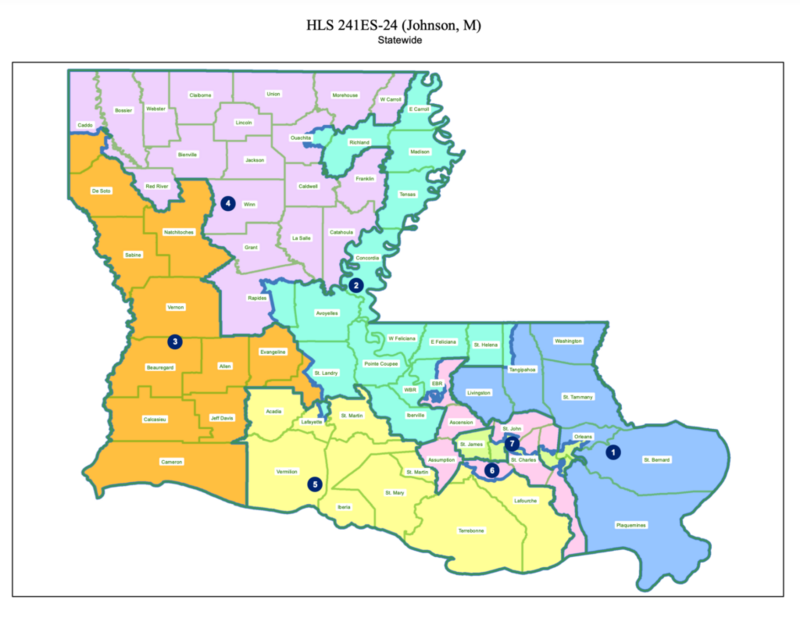
A map of the new Louisiana Supreme Court districts as proposed by state Rep. Mike Johnson and five of the current justices on the bench. (Image credit: House Bill 8)
A committee of state lawmakers advanced a bill Tuesday that would redraw the Louisiana Supreme Court districts and add a second majority-Black seat to the map.
House Bill 8, sponsored by state Rep. Mike Johnson, R-Pineville, was approved in the House and Governmental Affairs committee without objection as part of the Louisiana Legislature’s special redistricting session.
The bill maintains seven Louisiana Supreme Court districts but apportions each with equal populations of roughly 665,000 people. Districts 2 and 7 would have Black voting age populations of about 55% and 53%, respectively.
District 2 would form a “L” shape stretching from the northeast corner of the state, south along the Mississippi River before turning east to East Baton Rouge Parish. District 7 would encompass a condensed area from St. John the Baptist to Orleans parishes.
The court’s current seven districts include only one majority-Black seat, currently held by Justice Piper Griffin of Orleans Parish, and have severe population imbalances — a concept politicians call malapportionment.
“The problem has been ignored for far too long,” Rep. Denise Marcelle, D-Baton Rouge, said.
Currently, as few as 477,000 people live in the New Orleans-based District 7, while nearly 839,000 people live in the Baton Rouge-based District 5, according to 2020 U.S. Census data.
“One district has votes that count for half the votes in another,” Johnson, who is unrelated to the U.S. House Speaker of the same name, said.
Two years ago, Republicans largely opposed all redistricting measures that would have added majority-Black seats, but Tuesday’s proposal drew no opposition. Gov. Jeff Landry, a conservative Republican, has called on lawmakers to draw a second Black congressional district, and a majority of the current Supreme Court justices proposed the new map Johnson is backing.
5th Circuit denies Louisiana’s appeal in congressional redistricting case
State lawmakers had asked the court to study the issue and come up with a redistricting proposal of their own. In December, five of the justices signed a letter to lawmakers that voiced their support for the newly-proposed map with a second majority-Black district.
However, Chief Justice John Weimer and Associate Justice Scott Crichton oppose the map.
The proposed boundaries of the 6th District, which Weimer represents, split his home Lafourche Parish between two Supreme Court seats. It’s one of a dozen parishes divided between different districts in the proposed map, an alignment that “unnecessarily creates administrative issues” for the court, the chief justice wrote in a response to his colleagues.
Crichton took issue with how the justices’ proposal “obliterates” the current District 2, which he represents. It goes from being a largely contiguous area along most of Louisiana’s western border to one that stretches along the Mississippi River from northeast Louisiana down to Baton Rouge, stretching out to include central parts of the state and the Florida Parishes.
The state faces multiple Voting Rights Act lawsuits over the current political boundary maps for Congress, the legislature and the state Supreme Court. The plaintiffs, which include Black voters and civil rights groups, have sued over gerrymandering and are asking for the creation of a second majority-Black district. Drawing one would likely put an end to much of the litigation.
The proposal still has a long way to go. Having passed Tuesday’s committee vote, it will next face a House floor vote. If it passes the House, the entire process is then repeated on the Senate side.
Lawmakers will also consider proposals for Louisiana Supreme Court districts with more contiguous boundaries that don’t split parishes, as well as bills that seek to add two more districts for a total of nine.
Baton Rouge, LA