Medicaid rates hikes would take longer but apply to more beneficiaries in budget request
Oct 31, 2023 | 5:00 am ET
Description
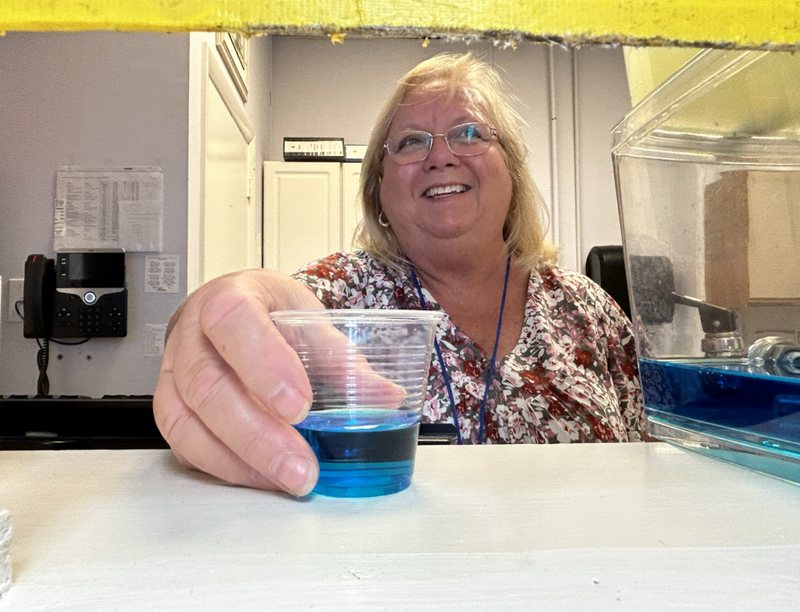
Bonnie Martin, an LPN and lead nurse at CODAC Behavioral Healthcare, administers doses of methadone mixed with colored water in plastic cups at the agency's Newport dispensary. Approximately 80 patients received doses from Martin between 5:45 and 10 a.m. on Friday, Oct. 27, 2023. Most of CODAC's Medicaid patients are covered by Managed Care Organizations. (Janine L. Weisman/Rhode Island Current)
An eagerly anticipated report released by the Rhode Island Office of the Health Insurance Commissioner (OHIC) in September recommended a $45 million increase in Medicaid fee-for-service reimbursement rates paid to providers, some of whom have not seen a change in rates in years.
The response from the state agency that administers the Medicaid program: Too fast.
Instead, the Executive Office of Health and Human Services (EOHHS) recommends increasing reimbursement rates over a couple years in its fiscal 2025 budget request to Gov. Dan McKee. Federal funding would cover almost two-thirds of the $3.95 billion spending plan.
But the good news is EOHHS proposes spending more than what OHIC asked for to fund Medicaid reimbursements – $80.5 million for increases that would take effect three months into the fiscal year on Oct. 1, 2024. State spending would account for $32.7 million of that amount.
The reason: Fee-for-service rates apply for only 10% of Rhode Island Medicaid beneficiaries. The vast majority are covered by private health insurance companies or Managed Care Organizations (MCOs). The EOHHS budget request would extend the recommended rate increases to MCOs.
The state contracts with three MCOs: Neighborhood Health Plan of Rhode Island, UnitedHealthcare, and Tufts Health Plan. A request for proposals for new six-year contracts with four option years starting July 1, 2025, is expected to go out in mid-to-late November with proposals due early next year, said Medicaid Program Director Kristin Sousa.
“Phasing in the rate increases over two fiscal years is the result of acknowledging that increasing rates – to account for uninflated reimbursement rates over the years – may not be achievable in one year, given the size of the investment,” said EOHHS spokeswoman Kerri White in an email. “We are trying to balance the needs of our providers with the structural deficit of the state budget.”
About $59 million of the additional $80.5 million sought to lift Medicaid reimbursement rates applies to MCOs.
“We then took that document and reviewed it and added in or contemplated the effect that that would have on managed care,” Sousa said of the OHIC report.
McKee is noncommittal about the high rates, saying he wanted to wait and see what the next semi-annual projection on future state revenues and expenses will look like in November.
“We know that there’s a call to accelerate that funding, and we’ll see what we can do,” McKee said last week.
The General Assembly passed legislation that took effect on July 1, 2022, requiring OHIC to conduct a comprehensive review of social and human service programs having a contract with or licensed by the state. These include publicly funded services for behavioral health services, like substance use treatment, home and community-based services (HCBS), and children’s services.
OHIC hired a consultant, Milliman Inc., to conduct the review, which examined factors that influenced the cost of providing a specific service and compared rates paid by other New England state Medicaid programs.
We know that there’s a call to accelerate that funding, and we’ll see what we can do.
Under a new legislative mandate, OHIC will review rates every other year. The next rate review will be completed by September 2025 and its impact would occur in fiscal year 2027.
Stretching out the rate increases over two years may disappoint providers who say higher reimbursements will help prevent them from losing clinicians to higher paying jobs in Massachusetts or Connecticut. But requiring MCOs to mirror the baseline for fee-for-service rates, as Massachusetts already does, was welcome news to David Nefussy, chief business agent for CODAC Behavioral Healthcare.
“This is critical for the RI providers to maintain financial sustainability,” Nefussy said in an email.
OHIC conducted a Sept. 22 public hearing before the report was finalized and submitted to EOHHS. Nefussy had been among the providers who expressed concerns that the recommended increases, while welcome, did not go far enough.
The bundled rate for methadone treatment and therapy provided by opioid treatment programs has been unchanged at about $85 per week since 2016. OHIC recommended increasing the rate to about $133 per week. That’s still much less than the approximately $191 Massachusetts Medicaid pays for the same service, Nefussy said.
Nefussy said he was under the impression that the rate increases OHIC recommended would take effect in the next fiscal year. Phasing in the higher reimbursements over two years “would be disheartening,” Nefussy said via email.
“I want to emphasize the importance of these rate enhancements to maintain the longevity of these important services for the RI community,” he added.
Nefussy had also asked OHIC to include an annual cost-of-living-adjustment, typically between 2-3% annually, in its recommendations to EOHHS. Even with rate reviews every other year, an automatic increase tied to inflation would help providers of opioid and substance use disorder treatment programs like CODAC to maintain fiscal sustainability, he said.
Sousa said cost-of-living adjustments would be out of the control of EOHHS officials and up to the budget process.
The entire review had to be completed within the state’s budget submission deadline, which OHIC Acting Director Cory King called “a very quick turnaround time” in an email.
In his cover letter to the report, King said the recommendations “represent a destination for reimbursement rates, but do not furnish a road map for getting there.”
“I enjoyed working on this,” King said. “It was some of the most intellectually engaging work I have done during my time in state government.”
Providence, RI