NJ labor chief criticizes ‘river of misinformation’ about independent contractor rule
Sep 21, 2026 | 7:18 am ET

Description
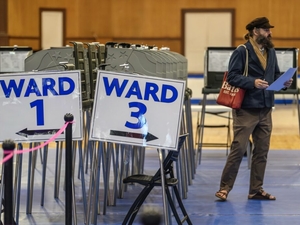
A rule set to take effect Oct. 1 has caused a furor among business groups and freelancers, but the state insists enforcement won't change. (Photo by Dana DiFilippo/New Jersey Monitor)
New Jersey’s acting labor commissioner said a “river of misinformation” is fueling opposition to a state rule used to determine whether a worker is an employee entitled to benefits or an independent contractor who is not.
Acting Labor Commissioner Kevin Jarvis told the New Jersey Monitor that the rule, adopted in May and set to take effect next week, makes no changes to the state’s worker classification regime. Claims to the contrary have become a source of frustration for the agency that oversees unemployment, workers’ compensation, and other workplace benefit programs, Jarvis said.
“There’s absolutely some frustration because we’re swimming upstream against a river of misinformation,” he said in an interview. “This is not a new test. This is not a change in enforcement. The reason the regulations were adopted is because the New Jersey Supreme Court recommended the department exercise its regulatory authority.”
The rule codifies court and administrative law decisions surrounding the ABC test, the three-pronged assessment that determines a worker’s classification status.
It has drawn concern and confusion from business groups and freelancers who worry their or their workers’ classifications could change as a result of the rule. Some legislators — including Senate President Nicholas Scutari (D-Union) — have urged the department to delay its effective date to allow even more months for a legislative fix.
As laid out in statute, the ABC test’s three prongs ask whether a worker is free from their employer’s control when performing their service, whether that service lies outside the employer’s usual course of business, and whether the worker is engaged in independent trade or business. Workers are presumed to be employees and are marked as independent contractors only if they meet each of the test’s three prongs.
One of the rule’s chief detractors on Thursday indicated the resistance may stem from opposition to the 90-year-old unemployment statute that lays out the ABC test’s three prongs.
“With remote work and the gig economy of today, applying a test from the 1930s to 2026 — I think that’s where we’re missing the mark here,” said Jack Kelly, a government affairs associate for the New Jersey Business and Industry Association.
Legislators’ consideration of bills exempting swathes of workers — like insurance brokers, certain truck drivers, and amateur sports officials — shows the flaws in the test, said Kelly, who pointed to laxer standards in other states and at the federal level.
California uses the ABC test to classify most workers but classifies some as contractors as a matter of law without applying the test. It uses a separate multi-factor assessment called the Borello test for some other workers.
New Jersey’s test is “flawed,” Kelly said.
“If everyone’s failing it and the Legislature needs to decide who’s exempt from its scope, why go through the exemptions when you can just fix the test?” he said.
Some freelancers and groups caution the regulations would cost them treasured flexibility, but Jarvis said that worry is a mirage.
“All the groups I keep hearing from who keep saying it’s going to take away their flexibility or it’s going to change how they do their business and it’s some sort of an expansion, I’ve asked on multiple occasions for someone — anyone — point to me what specific reg is different than the way it was before. I’ve yet to get an example,” he said.
Employers are not barred from giving employees flexible hours, Jarvis said, and law does not limit workers to a single job.
He cautioned misclassification has real fiscal and financial consequences. In audits conducted last year, the state found about 14,000 workers had been misclassified, resulting in $1.3 billion in underreported wages and $32.5 million in missed contributions to the state’s unemployment insurance and disability insurance funds.
This year, the department has issued stop work orders over misclassification to MCH Masonry Group, Fine Quality Builders Corp., and Kismet International Limo & Teaneck Taxi Service, and other firms. The department has issued more than 200 such orders since 2019.
Because rates for the unemployment tax that New Jersey levies on employers are set based on the health of the fund, missed contributions can increase other employers’ tax burdens.
The state’s unemployment insurance trust fund is still recovering after record jobless claims during the pandemic. Its recovery caused rates to decline last year, and Jarvis said rates could fall again next year, though he warned it is too early to say for sure.
It’s unclear whether the department can accede to calls to further delay the rules’ implementation.
“The regs that were adopted require they be implemented on October 1st. I don’t even know if we have the legal ability to delay their implementation,” Jarvis said.
The Legislature could step in with its own fix or Gov. Mikie Sherrill could blunt it through executive action, Kelly said.
The uproar over worker classification comes almost six years after public outcry defeated legislation that would have altered a leg of the ABC test and expanded it to cover all New Jersey employment laws.
Under present law, the ABC test flows from New Jersey’s Unemployment Compensation Law, though the New Jersey Supreme Court in 2015 ruled the test should also be used to gauge employment class under its Wage Payment and Wage and Hour laws.
The regulations don’t go that far, but they’ve still caused some consternation among lawmakers.
On Thursday, the Assembly Financial Institutions and Insurance Committee passed a bill to exempt some insurance brokers from the ABC test.
Assemblyman Roy Freiman (D-Somerset), the panel’s chair, said during that hearing that he was frustrated that the new rule had spurred calls for new or updated exemptions for workers he said are clearly independent contractors.
“We should not be wasting our time and energy to pass legislation to clarify what the independent contractor statuses are on various different industries,” Freiman said. “It is frustrating to me that we are spending time on something like this on industries, on professions that are so plain as day to the rest of us.”

Trenton, NJ