‘You can’t even cover them’: Andy Biggs’ 2011 bid to end Medicaid in Arizona
Sep 15, 2026 | 9:11 pm ET

Description
Andy Biggs at a Turning Point USA rally for President Donald Trump in Phoenix on April 17. 2026. (Photo by Gage Skidmore/Flickr/CC BY-SA 2.0)
When Andy Biggs, the Republican nominee for governor, was a state senator, he tried to abolish Medicaid in the Grand Canyon State because it cost taxpayers too much to provide health insurance for low-income Arizonans.
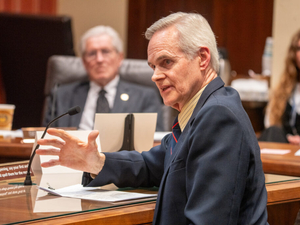
“When we allow the generations in the future to be robbed and enslaved to pay for the healthcare costs of people today, we’re not being good stewards,” Biggs said during an Arizona Senate Appropriations Committee hearing in 2011. “We’re allowing the future generation to be placed in bondage.”
As he called for the end of the Arizona Health Care Cost Containment System, the Republican said that some Arizonans with severe mental illnesses and developmental and physical disabilities would have to go without healthcare coverage to address the national debt and deficits in the state budget.
“What did they do before we built the infrastructure?” Biggs said of the people who relied on AHCCCS.
Multiple studies have shown that when Americans who need it don’t have access to healthcare through Medicaid, they are more likely to die.
In early 2011, when he sponsored Senate Bill 1519, Biggs was in his first term as a state senator after eight years in the Arizona House of Representatives. The proposed legislation would have done away with AHCCCS months later on Oct. 1, 2011, to partially replace it with “safety net” coverage for the “most needy” that would be administered by the Department of Health Services.
AHCCCS cost about $10 billion that year, but Arizona was responsible for about $2 billion of that, with the rest paid by the federal government. Under Biggs’ proposal, the Health Department would get $1.2 billion — “subject to the availability of funding” — to design a new healthcare program to provide behavioral healthcare, and care for developmentally disabled people and the “medically indigent.”
Biggs made it clear that his proposed alternative to Medicaid would only serve a fraction of the nearly 1.4 million Arizonans enrolled at the time. He said that another option might be to charge those people premiums to stay on the program, but that the enrollees didn’t “want to pay for it.”
The proposal wouldn’t even fully cover the nearly 100,000 severely mentally ill and developmentally and physically disabled people who relied on AHCCCS in 2011, which Biggs said was by design because of the high cost to provide care to those Arizonans.
“You can’t even cover them, because if you were to cover them, you have no savings,” Biggs said during a Feb. 22, 2011, Senate Appropriations Committee hearing on his proposal.
The catalyst behind Biggs’ plan was what he called an impending fiscal cliff caused by too much borrowing at the state and federal level in the wake of the Great Recession. At the time, the U.S. national debt was around $14.7 trillion and Arizona faced a projected $1.1 billion deficit in 2013.
The only way you get attention from these folks is to do something draconian, something magnificent, something big and large.
Biggs’ proposed solution would have initially saved the state around $1 billion in 2012, but would come with a corresponding reduction in federal funding of $4.8 billion, according to an analysis by the Joint Legislative Budget Committee.
Members of his own party on the Appropriations Committee were highly skeptical of his proposal. Even some of his fellow Republicans who supported nixing Medicaid, like Republican Sen. Sylvia Allen, saying that there was no way to responsibly eliminate AHCCCS in a matter of months.
Moderate Republican Sen. Rich Crandall said he was certain that Biggs’ proposal would decimate rural hospitals that get a large portion of their budgets from Medicaid patients.
“The only way you get attention from these folks is to do something draconian, something magnificent, something big and large,” Biggs said of the hospitals that opposed doing away with AHCCCS.
His bill passed out of the Appropriations Committee but didn’t make it to the Senate floor.
But Biggs, who has served in Congress since 2017, seemingly doesn’t feel the same way when it comes to increasing the national debt for his party’s own ideological reasons. Last year, he voted for President Donald Trump’s “One Big Beautiful Bill Act,” which is projected to add at least $3.7 trillion to the national debt over the next decade, while also cutting Medicaid and food benefits for low-income people.
In June, Biggs voted against a bipartisan resolution ordering Trump to withdraw forces from Iran or obtain approval from Congress to remain there. The Iran War has cost the U.S. more than $40 billion since it began in February.
In August, when the nation’s debt reached $40 trillion, Biggs issued a statement condemning “unchecked federal spending.”
“For decades, Members of Congress have shown catastrophic unseriousness about reining in government spending and leaving a better future for the next generation,” he said in the statement. “Regardless of which party controls Congress, I have sounded the alarm on this fiscal cliff since I entered the U.S. House of Representatives and have introduced legislation to help solve this crisis.”
When Biggs made his pitch to do away with AHCCCS in 2011, critics and local media panned his dismissal of the impacts on low income people, drawing attention to the fact that Biggs could afford to live on an Arizona senator’s $24,000 a year salary because he won a $10 million American Family Sweepstakes in 1993.
Neither the Biggs campaign nor the campaign of his opponent, Democratic Gov. Katie Hobbs, commented for this story.
“Andy Biggs’ dangerous scheme to rip away Arizonans’ healthcare is clear: close hospitals, drive up costs, and abolish Medicaid,” Nicholas Simões Machado, spokesman for the Copper State War Room, told the Arizona Mirror in a statement. “Biggs has spent his career trying to take healthcare away from Arizonans, and his toxic record makes it clear he would put every Arizonan’s health and livelihood at risk.”
The Copper State War Room is the coordinated campaign to reelect statewide Democrats in Arizona.
Phoenix, AZ