Wyoming Supreme Court concludes crossover-voting ban is constitutional
Oct 01, 2026 | 2:13 pm ET
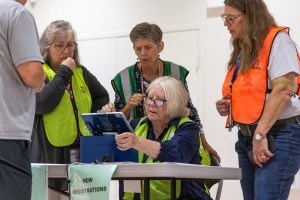
Description
Photo courtesy of WyoFile
The Wyoming Supreme Court upheld the state’s crossover-voting ban Thursday, ruling that the 96-day period in which voters are prohibited from changing party affiliation ahead of Election Day does not violate their constitutional rights.
“After balancing the right to vote against the legislature’s duty to ‘secure the purity of elections’ and to ‘guard against abuses of the elective franchise,’… we conclude the party affiliation deadline is not an unconstitutionally onerous burden on Appellants’ right to vote and does not violate equal protection guarantees,” the court stated in its unanimous ruling.
The decision clears the way for November’s general election to proceed as it has since 2023, when the Wyoming Legislature adopted a law that prohibits what’s known as crossover voting.
The deadline lines up with the candidate-filing period, requiring voters to affiliate with a party before the slate of candidates has been finalized. Supporters of the law said it was needed to stop registered Democrats, minor party and unaffiliated voters from changing their party affiliation in order to participate as Republicans in the primary election. They’ve blamed farther-right candidates losing to more moderate candidates in primaries on the practice, though those claims were shown to be statistically unfounded.
Prior to the crossover-voting ban, Wyoming voters could change their party affiliation at the polls on Election Day.

“Today’s Supreme Court ruling is a huge win for Wyoming elections, which we have consistently worked to defend,” Secretary of State Chuck Gray said in a press release. The suit named Gray in his official capacity as the defendant.
Bill Schwartz, an attorney for the plaintiffs, told WyoFile in a statement, “We are of course disappointed the Court declined to give fundamental voting rights the preeminent weight we believe our founders intended.”
“That said, we read the decision as the Court’s considered view under our system of checks and balances that the judiciary should defer to the legislature’s authority to regulate elections,” Schwartz wrote. “We take some solace the Court rejected Secretary Gray’s radical notion that our state constitution provides no protection for the fundamental right to vote in state funded primaries.”
Schwartz also said his clients are hoping that the incoming Legislature will “reform the unnecessarily restrictive election laws implemented in recent years by the right wing of the Republican party.”
Filed in 2024, the lawsuit initially sought to overturn the state’s “sore loser law,” which bars failed primary candidates from appearing on the general election ballot as independents. The plaintiffs, who include voters, former political candidates and a retired state lawmaker, expanded the complaint in 2025 to also challenge the state’s closed primaries and party-affiliation restrictions. After a Laramie County District Court upheld the laws, siding with the state and ruling that the statutes are a “valid exercise of legislative power,” the plaintiffs appealed to the Wyoming Supreme Court.
The plaintiffs, however, also narrowed the appeal, seeking only to challenge the lower court’s ruling on the 96-day freeze period ahead of the election in which registered voters are prohibited from changing their party affiliation.
Both parties presented oral arguments in June. At the hearing, the plaintiffs pointed to two sections of the Wyoming Constitution — one that protects the “untrammeled exercise of the right of suffrage” and one that guarantees “equal political rights.” Lawyers with the Wyoming Attorney General’s Office pushed back, arguing that the case is not about voting rights but the state’s constitutional interest in protecting the purity of elections.
While the Supreme Court disagreed with the state’s argument that primary elections are not elections in the constitutional sense because primaries were not used to select candidates at the time the Wyoming Constitution was adopted, the high court ultimately upheld the lower court’s ruling.
“The claims at issue here depend on the language of the voting-rights provisions of the Wyoming Constitution, and we begin with those provisions,” the court wrote.
Those provisions include protecting voters’ interests by providing that “elections shall be open, free and equal, and no power, civil or military, shall at any time interfere to prevent an untrammeled exercise of the right of suffrage.” The constitution also requires the Legislature to “pass laws to secure the purity of elections, and guard against abuses of elective franchise.”

The court measures “the 96-day Freeze Period against these provisions,” the ruling states. “Not every restriction on voting is constitutionally forbidden. Article 1, section 27 protects the franchise. Article 6, section 13 directs the legislature to regulate elections to keep them pure. We give effect to both. Election laws will necessarily impose some burden upon voters.”
The burden of the freeze period “is slight,” the court wrote.
“The freeze does not lock voters into a party,” the ruling states. “It sets a deadline — affiliation must be declared or changed 96 days before the primary. Electors have fair notice of that deadline, and the statutes provide clear rules for enforcement.”
Furthermore, the freeze period “applies the same rule to every elector on the same calendar,” the court wrote. “Where the burden is slight and the rule is uniform, article 6, section 13 leaves that line drawing to the legislature. The Freeze Period deters affiliation changes that are not motivated by genuine attachment to the party and the state’s interest in doing so is legitimate and reasonable.”
Justice Kari Gray authored the decision. Wyoming Seventh District Court Judge Joshua C. Eames filled in on the case after Justice Bridget Hill recused herself because she was attorney general when the lawsuit was filed in 2024.
This is a breaking news story and may be updated.
Cheyenne, WY