Work begins on major new shipping terminal at former Bethlehem Steel site
May 01, 2026 | 6:35 pm ET
Description
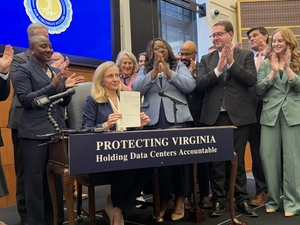
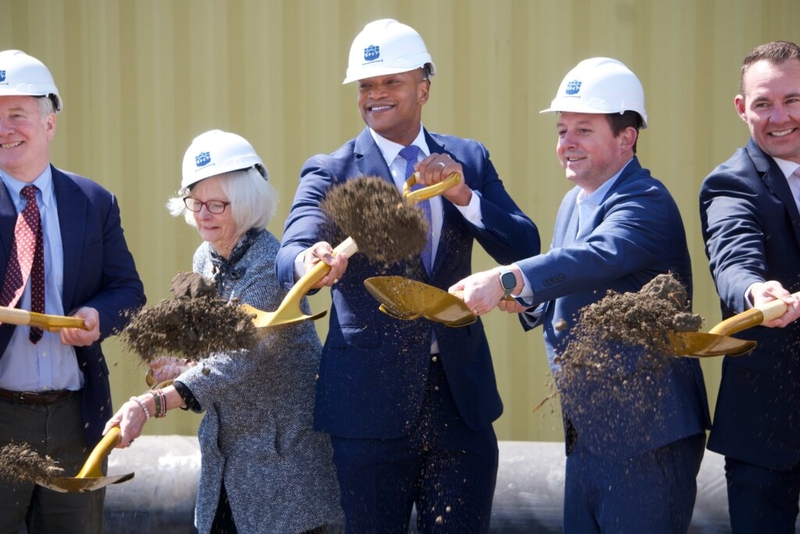
Gov. Wes Moore (D) and other dignitaries participate in a ceremonial groundbreaking at the site of the future Sparrows Point Container Terminal on May 1, 2026. The new Tradepoint Atlantic terminal, expected in 2029, will greatly increase capacity at the Port of Baltimore. (Photo by Christine Condon/Maryland Matters)
The next chapter of Baltimore County’s former Bethlehem Steel mill dawned on Friday, with the official groundbreaking of a new container terminal expected to be complete within the next few years.
To get there, crews will need to dredge up 4.2 million cubic yards of sediment from a Patapsco River tributary, much of it contaminated by the site’s steelmaking history.
But when all is said and done, the privately held Tradepoint Atlantic site on Sparrows Point will be home to two new deep berths, allowing more large ships stacked high with shipping containers to offload cargo in Baltimore.
Officials say that the project will supplement the nearby Port of Baltimore by accepting about 1 million containers per year, expanding Baltimore’s container capacity by an estimated 70%. With the new terminal, Baltimore’s port would have the third largest container capacity on the East Coast.
“Congratulations on making it to the starting line,” said Kerry Doyle, managing director at Tradepoint Atlantic, during a groundbreaking event Friday. “This juncture is perhaps the most consequential in the history of Sparrows Point.”
Friday’s convening was perhaps a sign of the enthusiasm for the new terminal at Coke Point, attracting Maryland Gov. Wes Moore (D), along with three members of Congress and scores of local politicians.
“Team Maryland is delivering progress throughout Sparrows Point for our workers, for our state, for our country, and I’m proud that the state of Maryland will be investing nearly $90 million into this project to make sure this project happens, and it happens fast,” Moore said.
The tragic collapse of the Francis Scott Key Bridge two years ago cast the project in a different light, Moore said. The Tradepoint Atlantic site is situated southeast of the port of Baltimore, meaning ships could access it without need to traverse through the bridge site.
Shipping troubles during the coronavirus pandemic provide further evidence that more deep berth channels are needed in the U.S., said Ammar Kanaan, CEO of Terminal Investment Limited, which partnered with Tradepoint to secure the capital for the project.
“With just a little bit of disruption, our ports clogged,” Kanaan said. “So for those in the industry that say that there is enough capacity, they’re shortsighted, and they don’t understand the investment needed in the future of the supply chain.”
Kanaan applauded the contribution from state government, which operates the port.
“They did not look at this project as competition. They looked at it as adding capacity funded by the private sector,” Kanaan said. “And this is special.”
US Wind says Baltimore steel facility will move ahead, despite feds pulling back $47.4 million
The 168-acre terminal area will include seven large cranes capable of pulling containers from two massive ships simultaneously. Officials estimate that the facility will create about 1,100 permanent jobs for longshoremen, and thousands more indirect jobs.
Tradepoint expects to complete the first berth before the end of 2028, and finish the second berth in early 2029.
There were twists and turns along the way.
At one time, Tradepoint contemplated placing the dredge material on Hart-Miller Island, a former dredge containment site that has become a popular destination for beachgoers as well as wildlife enthusiasts. Shortly after the Key Bridge collapse, the legislature gave the green light to reopen Hart-Miller.
Tradepoint offered $40 million for the benefit of the community, but the pushback was too strong, and using the island proved more complex than initially thought, so Tradepoint abandoned the idea.
“The placement of dredge material for any port project is always a difficult question,” said Aaron Tomarchio, Tradepoint’s executive vice president of corporate affairs. “I think the permit process — the way it was designed — actually worked, because it forced conversations and us to look at different ways that we could accomplish the goal.”
In December, Tradepoint received its permit from the U.S. Army Corps of Engineers. For the project, Tradepoint will build its own dredge containment area at the High Head Industrial Basin on Sparrows Point, which will take in about one-third of the sediment from the terminal.
That site likely won’t be finished until the end of this year, Tomarchio said. In the meantime, the sediment pulled from the channel will go to the state’s existing dredge storage areas at Masonville Cove and Cox Creek, or it will go to an ocean dredge storage facility near Norfolk, managed by the Environmental Protect Agency.
Tradepoint conducted detailed evaluations of the sediment, in order to determine the contamination levels in different sections, so that it would be placed in the proper storage facility.
Some community members will always be suspicious about efforts to dig up soils inundated with heavy metals and other harmful pollutants, said Gloria Nelson, a resident of nearby Turner Station, and president of the Turner Station Conservation Teams. But Nelson said she isn’t too concerned by the current plan.
“There always will be some skeptical about the dredging because of the legacy. But Tradepoint and this company, they have been, in my opinion, true to their word,” Nelson said. “They have been very transparent to questions about dredging. They have shown documentation, and they share with the community.”
The memories of Bethlehem Steel, and its eventual disappearance from Sparrows Point, made Friday’s groundbreaking all the more special for Rep. Kweisi Mfume (D-7th), a Baltimore native.
“I watched the decline, and I watched the people get laid off, and I watched the families start to really financially crumble. And then, after all, it was all gone. There was no steel mill anymore, and these grounds just languished year after year, decade after decade,” Mfume said.
“This really is historic, because now we’re talking about getting back up to that level of providing jobs again,” he said.
Annapolis, MD