Women make up half of Louisiana’s population but less than 25% of its legislature
Jul 08, 2026 | 3:07 pm ET
Description
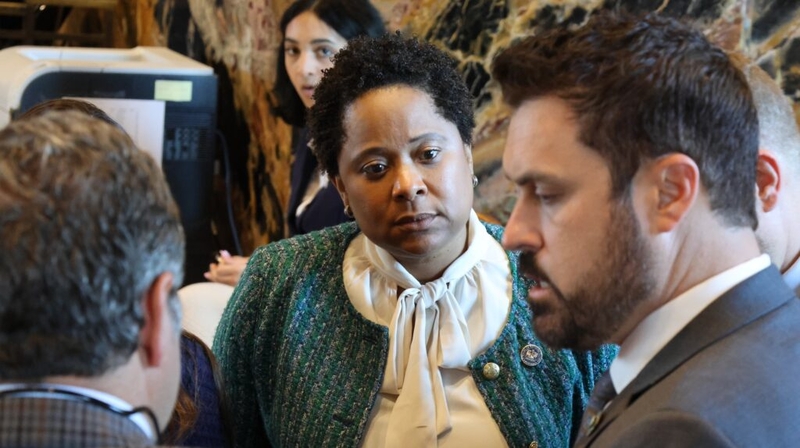
State Rep. Vanessa LaFleur confers with state Sen. Blake Miguez and other lawmakers in the Louisiana House of Representative on May 27, 2025. (Wes Muller/Louisiana Illuminator)
In 1936, Doris Lindsey Holland became the first woman to serve in the Louisiana Legislature. Nearly four decades later, in 1973, Lindy Boggs became the first woman elected to the U.S. House of Representatives from Louisiana. Another generation passed before Mary Landrieu became the first woman elected to the U.S. Senate from Louisiana, in 1996.
These milestones mark important progress and demonstrate that Louisiana women have long contributed to public leadership. Yet they also reveal how slowly representation has changed despite nearly a century of women’s public leadership.
The Newcomb Institute, in collaboration with Ellevate, recently examined women’s representation in the Louisiana Legislature over the past 50 years as part of our reflection on the 250th anniversary of the signing of the Declaration of Independence. The data tell a more complicated story.
Women have steadily increased their presence in both chambers over the past half century, but progress has been gradual. Today, women comprise 51% of Louisiana’s population and 55% of registered voters, yet they hold only 22% of seats in the House of Representatives and 14% of seats in the Senate.
Nearly a century after the election of Louisiana’s first woman legislator, women remain substantially underrepresented in the institution responsible for writing the state’s laws.
Our analysis also revealed an encouraging finding. While women overall remain underrepresented in elected office, Black women’s relative gains are notable, aligning with Louisiana demographics.
Black lawmakers constitute 25% of all state legislators, trailing their population share of nearly one-third of Louisiana. However, Black women constitute 31% of women seatholders in the House and 40% in the Senate. These gains reflect generations of civic leadership, political engagement and successful pathways into elected office.
Louisiana’s challenge is not only to ensure that women of all backgrounds have equitable opportunities to seek elected office, but also to cultivate greater interest, encouragement and support for women from all communities to pursue public leadership.
Representation is shaped not only by elections but also by public attitudes toward leadership. Recent statewide survey data from Newcomb Institute found 34% of men and 16% of women agreed that men make better political leaders than women. Another 35% of men and 34% of women were neutral or unsure. Only 49% of women and 31% of men disagreed with the statement.
These findings suggest confidence in women’s political leadership is far from universal. It influences who imagines themselves as a candidate, who is encouraged to run, who is recruited by political parties and community leaders, who receives financial and political support, and ultimately who appears on the ballot.
If Louisiana hopes to see more women in elected office, changing these perceptions may be just as important as expanding opportunities to serve. These attitudes matter because representation begins long before an inauguration.
Why does women’s representation matter? Because Louisiana women continue to face some of the greatest health and economic challenges in the nation. Louisiana ranks last among states for women’s and children’s health and for women’s economic and social well-being. These rankings reflect persistent challenges in maternal and infant health, economic opportunity, educational attainment and safety.
Greater representation alone will not solve these problems, but it can help ensure policy decisions are informed by a broader range of lived experiences.
Representative government is strengthened when decision-makers draw upon the experiences and perspectives of the people they serve. A legislature that more closely reflects Louisiana’s population is better positioned to understand the challenges facing women, children, families, and communities across our state.
When women are half the population, more than half the electorate and only account for one in five legislators, we should ask whether we are doing enough to inspire, encourage and support the next generation of women leaders.
Louisiana has never lacked talented women. Our challenge now is to ensure that more of them see elected office as a place where they belong, and that our legislature more fully reflects the people it serves.
Baton Rouge, LA