Bad ads, lots of spending and the candidate who got off easy: post-primary observations
Jul 08, 2026 | 7:00 am ET
Description
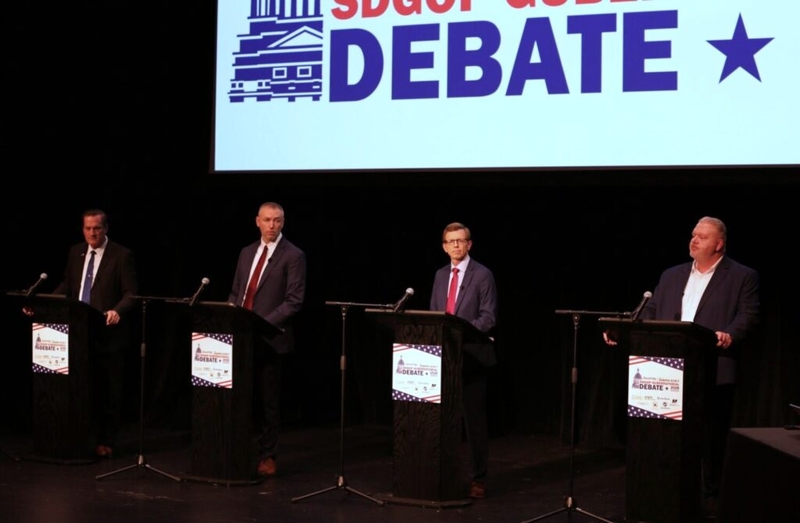
From left, Gov. Larry Rhoden, state House Speaker Jon Hansen, U.S. Rep. Dusty Johnson and businessman Toby Doeden participate in a Republican gubernatorial debate on April 27, 2026, at the Washington Pavilion in Sioux Falls. (Photo by Joshua Haiar/South Dakota Searchlight)
The outcome of June’s Republican gubernatorial primary raised plenty of questions and provided few answers. When the dust settled, Aberdeen businessman Toby Doeden and Gov. Larry Rhoden were heading for a July 28 runoff and U.S. Rep. Dusty Johnson and state Speaker of the House Jon Hansen were looking for work.
Among the questions raised by the outcome:
- How does an early frontrunner end up finishing in third place?
- How does a man with no political experience finish ahead of an incumbent governor and a sitting congressman?
- What was it about this year’s race that caused the state’s Republican Party to have its first-ever runoff election for a statewide office?
These are compelling questions. The best I can do is some post-primary observations:
Johnson should sue his advertising advisers
The commercials featuring Johnson’s sons had a dated sitcom feel that was out of place in the current political climate. They were as superficial as a boy band and had all the sophistication of a school play.
The creator of the commercials obviously didn’t consider that some of us don’t relish getting political advice from teenagers. The steady diet of Johnson’s sons constantly proclaiming “Hey, our dad is great!” got to be wearing.
Part of Johnson’s message was too good
When the Johnson siblings weren’t shilling for their father, the congressman’s commercials were busy attacking the property tax relief plans touted by Rhoden and Hansen. Whenever he had the opportunity, Johnson noted that their property tax relief plan was really a sales tax increase. This was unique in the shady history of political advertising in that Johnson’s message happened to be true.
Some voters may have thanked Johnson for pointing that out by voting for him. However, it looks like voters concerned about that issue were loyal to Doeden because of his promise to eliminate property taxes entirely.
It’s a bad time to be from Washington, D.C.
An astute student of politics, in an interview with South Dakota Searchlight, Johnson noted all of his congressional colleagues who were defeated recently when seeking higher office. The few times that Johnson wandered away from the Trump party line caused his candidacy to suffer the effects of attack ads.
In contrast, Doeden was able to wrap himself in all things Trump, having never had to cast a legislative vote.
In the ad war, Doeden got off easy
In a South Dakota Searchlight podcast, long-time political observer Pat Powers noted that the other three candidates did not go after Doeden with the vigor with which they went after each other. Powers ascribed this tactic to the notion that Doeden was the preferred runoff opponent for the other three candidates.
That makes sense because each could see a runoff against Doeden as a matchup offering a clear choice between a seasoned political veteran with a legislative track record and a newcomer with big ideas about how to shake things up in Pierre.
A similar scenario played out in 1994 in a Republican primary featuring former Gov. Bill Janklow and Lt. Gov. Walter Dale Miller. Janklow ran on a platform of drastically cutting state government while Miller promised a continuation of the policies of the late Gov. George Mickelson.
In the primary, Republican voters in Hughes and Stanley counties, with their concentration of state employees, went for Miller over Janklow better than two to one. After winning the governor’s office for a record third time, Janklow was fond of reminding his constituents in Pierre and Fort Pierre about his poor local showing in the primary.
A similar scenario played out in the recently completed primary in Hughes and Stanley counties with Doeden finishing third in both counties behind Rhoden and Johnson.
Money for politics, but not for policy
Republican gubernatorial candidates spent more than $10 million through mid-May. There’s sure to have been more spent up to the election in June and another bundle likely to be dropped prior to the runoff election July 28.
The irony here is that the candidates spent so much money to be elected governor of a state that is so poor. This year, Gov. Larry Rhoden, while knowing that he wanted to keep his job, had to present a budget that didn’t include funding increases for healthcare, education or state employee salaries. That leads to the competing images of Rhoden pleading poverty during his budget address while dumping more than $1 million into his election campaign.
Doeden was a far bigger spender during the campaign, racking up bills in the neighborhood of $4 million. No matter who wins the runoff election, the next governor of South Dakota will at some point, probably in his December budget address, have to tell the Legislature that there is not enough money for all the state’s priorities.
Imagine what a state like South Dakota could do with an extra $10 million. Imagine that kind of money pumped into healthcare, schools or state employee salaries. Yet for all the millions that have been pumped into election advertising, all we’ll be left with is a governor who will be forced to tell us there just isn’t enough money to go around.

Pierre, SD