Why Vermont’s housing shortage can’t be explained by population size alone
Aug 25, 2026 | 5:15 am ET
Description
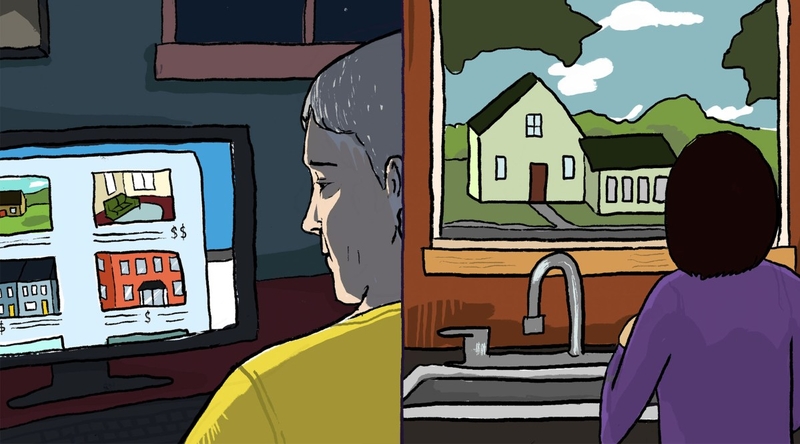
A mismatch between Vermont’s home sizes and household sizes is one factor in Vermont’s current housing crunch.
Laura Nakasaka / Vermont Public
Carly Berlin covers housing and infrastructure for Vermont Public, in partnership with VTDigger.
For two decades, Dave Felcan had a full house. He and his wife bought their three-bedroom Burlington home with red shutters on a quiet neighborhood street in the early 2000s. The house felt like just the right place to raise their two young kids.
But fast-forward 20 years, and Felcan, a 57-year-old retired software engineer, wound up living in this roomy house alone. Around the time his younger child left for college, he and his wife divorced. On a balmy July morning, Felcan gestured to the spaces he no longer touches – like his daughter’s bedroom, preserved like a “shrine” with her posters still on the wall, and a sunny sitting area off the living room.
“This is a beautiful screened-in porch, which I now never use,” Felcan said. “It’s a lot of house for one person.”

Felcan may live alone, but in Vermont, he’s in good company. A majority of Vermont households – roughly 70% – consist of just one or two people. In fact, the average number of people living in each year-round home in Vermont has been on a steady decline for decades.
In a country of fewer nuclear families and more people living alone, Vermont now has one of the nation’s smallest average household sizes: 2.2 people.
This data point is key to understanding Vermont’s current housing squeeze. It helps answer a common question: If the latest estimates show Vermont’s population is declining after a momentary pandemic-era spike, why is it still so hard to find housing?
Even without more people moving into the state, the same population is taking up more homes – and Vermont has not built enough new ones to keep up.
2.2 people live here
What does it mean that “2.2” people live in each home in Vermont? To understand that phenomenon, let’s first zoom in to the scale of one family.
Consider Felcan’s case. For many years, his home housed four people. Now, his ex-wife occupies a different house, and his two children have left Vermont to pursue opportunities elsewhere, Felcan said. But had they chosen to stay, they would be searching for their own homes, too. One large household becomes four small ones.

This dynamic is particularly common in Vermont because of our older population, said Maura Collins, executive director of the Vermont Housing Finance Agency. A greater share of Vermonters are 55 and older than a decade ago, and those older residents are more likely to live on their own. The number of single-person households in the state is increasing faster than any other size of household, according to the Vermont Housing Finance Agency’s latest Housing Needs Assessment.
“I hear this all the time, where middle-aged, later-life folks will say, ‘Yeah, I’m still in the three-bedroom, four-bedroom family home, because my kids only moved out however many years ago, and what if they come back?’” Collins said. “Or, what I hear most often is: ‘I’m locked into a 3% mortgage and I can’t afford to move somewhere else and start over with a new mortgage at current interest rates.’”
Small household sizes are also more common in places with whiter populations, Collins said. Vermont’s low birth rate plays a role, too. And across America, people are choosing to marry later or live independently.
So how does a shrinking household size impact the overall need for homes in Vermont? Let’s zoom out to the scale of one town.
In 2015, Vermont’s average household size was 2.36. Consider a hypothetical town with 5,000 people. Nearly a decade later, after household sizes shrank to 2.18, that same community needed 175 more homes to house the same number of people.
Statewide, Vermont needed to add nearly 22,000 homes between 2015 and 2024 to account for declining household sizes within the existing population, according to an analysis by the Vermont Housing Finance Agency. Previous generations did a better job of building enough new homes for new households. But over the last few decades Vermont has not added enough housing to keep pace.
Vermont’s rising number of households – driven in large part by shrinking household size – is considered to be the single largest contributor to Vermont’s near-term housing need, according to VHFA. This long-simmering dynamic boiled over when Vermont saw a brief influx of new residents during the COVID-19 pandemic.
Other major factors that continue to drive the need for additional homes include the state’s low vacancy rates, its high rate of homelessness, and the loss of homes from the market, typically from disrepair.
One analysis of national housing supply from the Federal Reserve Bank of St. Louis put the dynamic this way: “As average household sizes shrink and the desire for independent living grows, a ‘static’ housing stock effectively becomes a shrinking one.”
‘I do not need this much home’
Not only are Vermont’s households getting smaller, but homes in the state tend to be large.
While the majority of Vermont’s year-round homes are occupied by just one or two people, most homes in the state – nearly 60% – have three or more bedrooms. Vermont has one of the oldest housing stocks in the country, and most homes here were built for an era when larger families were the norm. The data suggests a mismatch: today, many Vermonters are living in houses with considerable extra space.
William Dido’s parents bought their three-bedroom Victorian in Proctor in 1985. It was walking distance from local schools and had enough space for a swing set and sandbox in the backyard. Dido, a 46-year-old accounting specialist, moved back into his childhood bedroom during the pandemic to help take care of his parents. They both died in 2021, and he ended up with the house.
“I am single. I am child-free by choice. I do not need this much home,” Dido said. Every once in a while he scrolls through Zillow to see if any listings better suit his needs. “But finding some place that doesn’t need a ton of work and isn’t too far out of the way and I can also afford… It’s just one of those situations where it seems like you might be able to find two out of three.”
Read the story on VTDigger here: Why Vermont’s housing shortage can’t be explained by population size alone.
Montpelier, VT