When it comes to early voting, North Carolinians won’t be fooled
Aug 25, 2026 | 6:00 am ET
Description
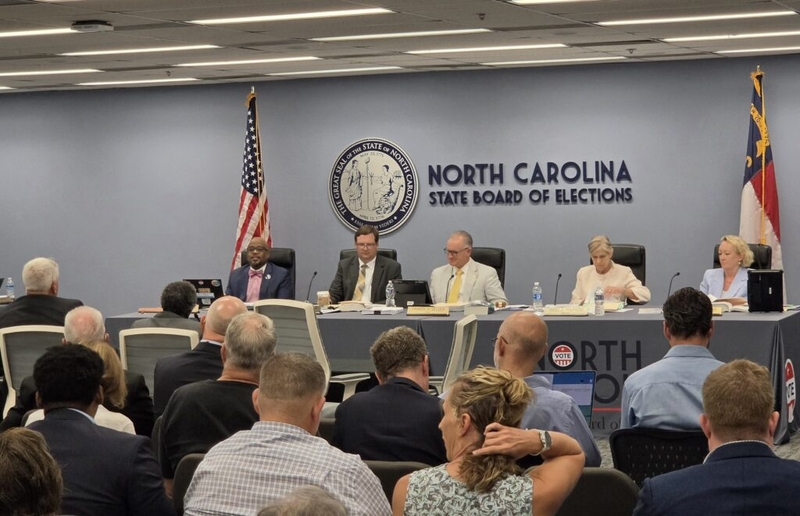
State Board of Elections members meet to discuss early voting sites at their August 20, 2026 meeting. (Photo: Clayton Henkel/NC Newsline)
When North Carolina’s State Board of Elections met August 20 to decide early voting options for 20 counties where local boards couldn’t agree, it surprised no one that Auditor Dave Boliek’s GOP majority largely chose plans crafted by Republicans.
What was surprising, was the immediacy of the campaign to rehabilitate Boliek’s reputation by couching 2026 early voting plans as a victory for all voters after local whistleblowers revealed Boliek’s office, including former “elections liaison,” Dallas Woodhouse, pressured county elections chairs to pass plans favoring Republicans.
Attempting to distance himself from the elephant in the room, State Board Chair Francis DeLuca kicked off the marathon meeting admitting, “I hope we never hear the name Dallas Woodhouse in here again.”
But if Boliek and DeLuca think they can fool voters into believing this summer’s efforts haven’t hurt voters, Woodhouse provided a taste of how they’d try.
First, Woodhouse suggested that the Auditor’s board may tout overall increases in sites or hours compared to 2022.
But registered voters in North Carolina have grown by 6% since 2022. Adding handfuls of sites or a few percentage points in hours this year doesn’t keep up.
Even in the 80 unanimous counties decided locally, analysis from political scientist Chris Cooper shows that while the total number of sites increased by five (+1.8%) since the last midterm, sites available per 10,000 voters actually dropped (-3.2%), signaling a shift away from where voters actually live.
Simply put, many of the sites and hours approved under Boliek’s watch meet his demands, not voters’.
The Auditor might argue that while he meddled in county options, it prevented bigger early voting cuts.
Preventing “bigger cuts” doesn’t mean chosen sites work for all voters.
Public records show the Auditor’s effort to add or protect sites that may help certain Republican candidates. Woodhouse’s texts focused on what sites and hours “GOP voters need” in counties like Columbus and Anson. These partisan add-ons may pad the State Board’s stats, but they distract from devastating site closures, including the site serving the poorest part of Columbus, multiple sites in Lenoir where 40% of voters are Black, and the most popular site for Black (and all) voters in Granville.
The Auditor could repeat tired excuses that unprecedented cuts to Sunday voting address poll worker fatigue, religious preferences, or costs.
But when the Auditor’s appointees cut Sunday access in 23 North Carolina counties that had it in 2022, they failed to mention their true motives.
Fortunately, Lee County Board of Elections member Jay DeLancy did it for them.
DeLancy’s testimony to the State Board revealed that Woodhouse told him to slash Sunday voting because the US Supreme Court’s 2026 Callais decision, gutting the Voting Rights Act, greenlit Republican cuts to options used by Black voters.
“I had not thought about getting rid of Sunday until [Woodhouse] planted that seed,” DeLancy told the Board.
Woodhouse started planting seeds a decade ago when, as state GOP chair, he sent a memo to GOP elections chairs in every county demanding they eliminate Sunday voting. His ultimately unsuccessful loyalty test followed a federal ruling that struck down legislative efforts to cut Sundays because doing so targeted African-American voters “with surgical precision.”
Thanks to the Auditor, the surgeons are back. And their amputations of Sunday voting will be felt throughout the state.
The Auditor’s State Board might try to justify their decisions by saying campus voting largely survived.
But campuses with some of the largest and most diverse populations likely disagree.
Public records show State Board Member Angela Hawkins worked with Woodhouse to make sure Wake County moved its NC State site off of the main campus. Woodhouse approved moving Pasquotank’s site to its under-renovation elections office rather than keep it on a historically-Black college or university (HBCU). In Guilford, none of the 168 public comments to the State Board supported the plan it ultimately approved, leaving no site at NC A&T, the nation’s largest HBCU.
Finally, the Auditor may try to say with a straight face that 2026 early voting planning was a transparent process, full of compromise.
But his partisan manipulations were only revealed after threats of litigation over unfulfilled public records requests —he has since admitted Woodhouse deleted many of those conversations.
If you “read the documents and check the record,” as Woodhouse suggests, the only thing in public view is the Auditor’s staff pressuring counties to adopt plans that led to some of the most toxic local debates over early voting in recent history and forcing only the voters to compromise.
These controversial changes so conflicted with community interests that even GOP elections board members in counties like Cabarrus, Jackson, Moore, and Randolph pushed back.
Like them, North Carolinians won’t be fooled.
Sailor Jones is state director of Common Cause North Carolina.
Raleigh, NC