Whatever the motivation, Republican’s endorsement of Democrat deserves points for facts and reason
Oct 03, 2026 | 11:00 am ET
Description
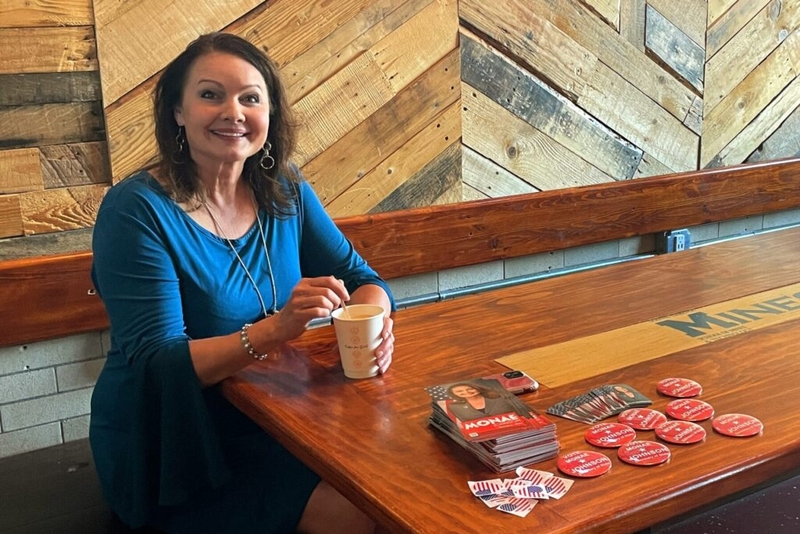
Monae Johnson waits to welcome potential voters at an October 2022 meet-and-great in a Rapid City coffee shop, during her campaign to become South Dakota's secretary of state. (Photo by Seth Tupper/South Dakota Searchlight)
Since South Dakota’s Republican lame-duck Secretary of State Monae Johnson oddly endorsed the Democrat campaigning to replace her, voters reasonably might wonder: Is she for real?
Even though she has been viewed at times during her tenure as just politically eccentric and confounding, this partisan betrayal was a core taboo, akin to political treason.
Instead of taking this act of apparent partisan infidelity at face value, the current toxic divisiveness in American politics leads us to wonder whether Johnson’s decision was a genuine, evidence-based reversal of her previous MAGA-centric stances, an act of political revenge, or a calculated tactic to undergird an unstated future political ambition.
South Dakota’s top election official, a Republican, endorses a Democrat to succeed her
After all, like proverbial rats fleeing a sinking ship, more and more Republican candidates in the midterm elections this fall — and non-candidates like Johnson — seem to be running full speed away from the hard-core MAGA base and its election-denying messiah, President Donald Trump, to whom they’ve heretofore slavishly stuck like glue.
Even our own junior Sen. Mike Rounds, R-South Dakota — a sometime MAGA critic, to be fair — who is up for reelection to a six-year term in November, purposely decided to forgo the unusual 2026 Republican Midterm Convention on Sept. 9 in Dallas to instead confer with voters at coffees and meet-and-greets in 14 different South Dakota counties, according to The Hill, an influential Washington, D.C.,-based political news organ.
The Hill article noted that Rounds, “who may face a tougher-than-expected challenge in a Republican-leaning state, said his time is better spent meeting with constituents in South Dakota” than gracing the vanity convention.
Still, questions abound about Johnson’s apparent stark betrayal of her political party.
Whereas she campaigned for secretary of state in 2022 refusing to clearly admit Joe Biden won the presidential election in 2020, making the conspiracy-theory concept “election integrity” a centerpiece of her platform, and releasing information that “revealed whether those on the state’s voter rolls were seeking government assistance such as food aid” (she apologized for that “accident”), she now says she’s changed her tune.
After the state Republican convention in June, where MAGA-aligned, hand-ballot-counting proponent Heather Baxter defeated her for the secretary of state nomination, Johnson announced in September she was endorsing the Democrats’ candidate, Terrence Davis, over Baxter. She stressed, “I cannot remain silent when I believe the integrity, stability, and professionalism of this office is at stake.”
Johnson wrote in a Sept. 19 letter published by South Dakota War College, a Republican blog, that she now believes:
“South Dakota deserves a Secretary of State who will strengthen confidence through performance rather than provocation; who will support election officials rather than burden them for political effect; who will protect voter access and election security without pretending those goals are enemies; and who will treat the office’s employees, voters, candidates, and business owners with dignity.”
In other words, much the opposite of what she originally ran on.
Whatever her real motivations, she gets points even at this awkward late stage for seeming to apply facts and reason to the 2026 election equation. Indeed, rather than parroting partisan political gospel, whether or not it actually makes any sense, the sacred motivator of every candidate and elected official should be identifying truth and presenting it fairly to voters. Which is to say public officials should always apply thoughtful, objective skepticism with good faith to societal problems, instead of knee-jerk, visceral bias.
“How tightly should you hold your beliefs?” Massimo Pigliucci, the K D Irani Professor of Philosophy at City College of New York, recently asked in Aeon, a digital magazine of ideas, philosophy and culture. “You face the question several times a week without noticing. Hold them too loosely and you don’t stand for anything, hold them too tightly and you become the sort of person no argument can reach.”
“Most of us swing between the two and have no vocabulary for the ground in between,” he added in his fascinating essay. “A Roman lawyer [Marcus Tullius Cicero, 106-43 BCE] worked one out … and it is still the best answer available.”
Pigliucci noted that uber-skeptic Cicero believed, “a genuine sceptic, confronted with compelling new evidence, updates (beliefs) — whereas the contrarian does not: they shift goalposts, raise new objections, or ignore what they cannot explain.”
Monae Johnson’s intent in her political about-face might be noble. But who can really be sure in American politics these days?

Pierre, SD