Local code and utility tariffs are tools Alaska can use to fix the housing shortage
Oct 02, 2026 | 6:00 pm ET
Description
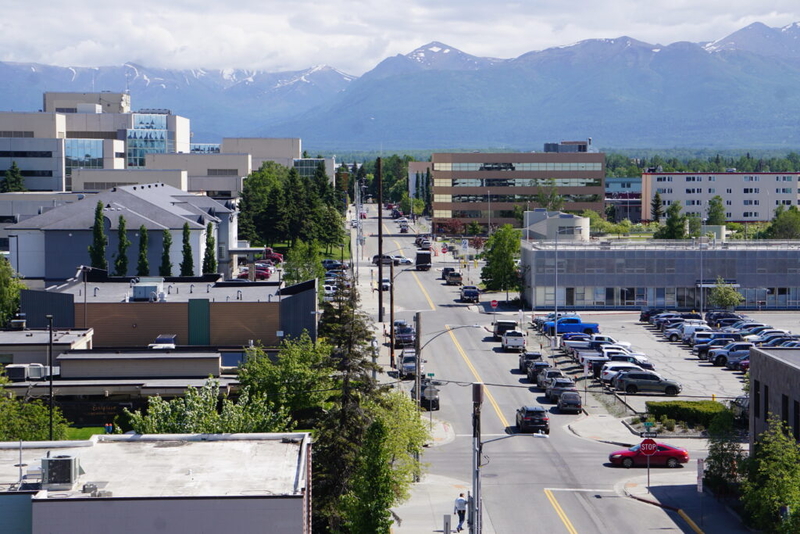
Cars travel at midday on 7th Avenue in downtown Anchorage on June 17, 2026. (Photo by Yereth Rosen/Alaska Beacon)
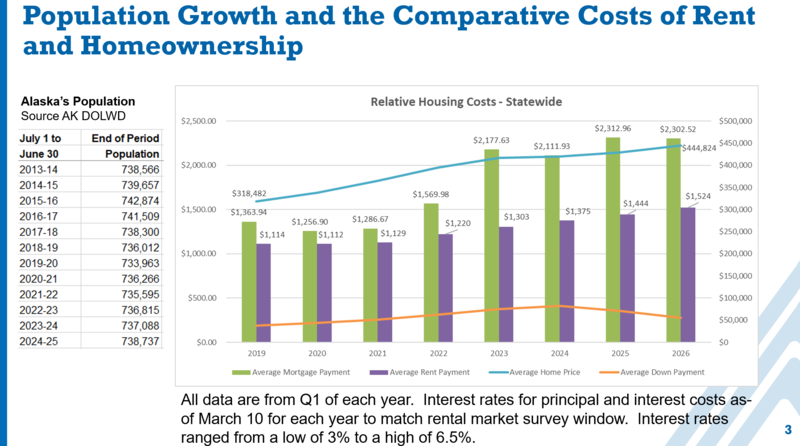
Alaska has roughly the population it had in 2013. What little growth the state has seen in the past three years came from residents over 65, while the working-age population shrank. A state that is not growing should not have a housing shortage.
It has one anyway.
Rental vacancy in March was 4.9% in Anchorage, 3.5% in Mat-Su and 4.1% in Juneau, according to the Department of Labor’s spring survey. Affordable housing from the Alaska Housing Finance Corporation had a statewide median rent that reached $1,450 a month, up about 30% over the past 7 years, and a two-bedroom in Anchorage, utilities included, now runs $1,720. It took 1.37 average Alaska wage earners to afford a median-value home last year, close to the record high. If population is not driving the squeeze, something else is, and at a Commonwealth North forum on August 27, six practitioners spent an afternoon exploring the causes.
Four explanations came through clearly.
The first is interest rates. Anyone who bought or refinanced in 2020 or 2021 locked in a mortgage near 3%. Moving today means trading that for 6.25%, last year’s median, or closer to 6.7%, where national rates stood in July. So the retiree who might downsize and the family that might trade up stay put. The house exists. It just never comes to market. The state’s figures show the freeze: a typical new mortgage payment in Alaska is $2,044 a month, 84% higher than in 2019, and new mortgages have fallen 21% statewide and 25% in Anchorage. Daniel Delfino, Director of Planning and Program Development at the Alaska Housing Finance Corporation, called it an open question whether the thin inventory is a real estate problem or a rate-lock problem.
The second is what it costs to build. Utility economist Mark Foster put construction at roughly $300 to $450 per square foot in urban Alaska and as high as $2,500 in rural multi-unit projects. A 2×4 costs about $13 by the time it reaches a village. The ground itself charges a premium: Anchorage water lines sit ten feet down to stay below frost, which means digging twelve.
The third is how we live. Thirty-nine percent of Alaska renters now live alone, up from about 34% in the 2010s. The same number of people needs more doors. Nobody at the forum raised this one. The Department of Labor did, in its September report.
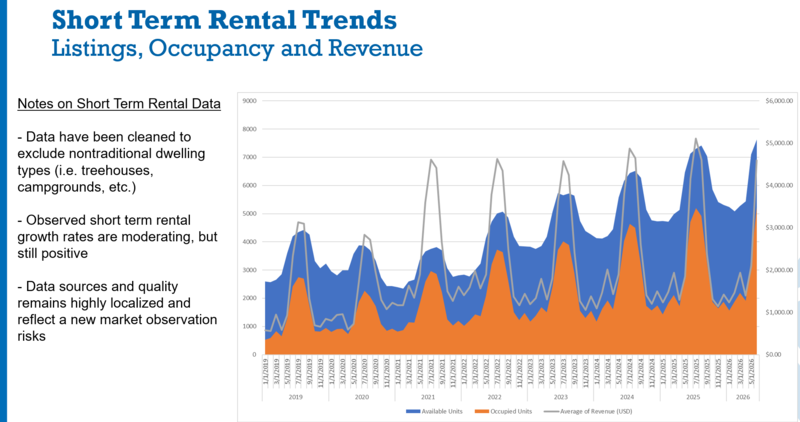
The fourth is newer, and Delfino was careful to present it as arithmetic rather than accusation. Short-term rentals in the surveyed markets swing from about 1,500 occupied units in slow months to more than 5,000 at peak tourism, earning anywhere from $1,200 to $5,100 a month. Against a $1,450 long-term rent, a unit can earn three times as much housing a tourist in July as it earns housing a neighbor all year. The revenue is volatile and dips below a lease in winter. But for some owners the spreadsheet decides, and thousands of units now sit on that fence. “The numbers are pointing them in certain directions,” Delfino observed.
Add the costs no one in Alaska sets. Congress has not reauthorized the federal law governing tribal housing since 2008, and the Indian Housing Block Grant has lost more than 30% of its purchasing power since 2000. Rate-regulated utilities cannot bank reserves to extend water and sewer, and Alaska never inherited the infrastructure older states got for free. Heating oil costs more than 30% more than it did a year ago, and Tyler Robinson of Cook Inlet Housing Authority, which sponsored the forum and also sat on the panel, told the room he is not sure his affordable portfolio can absorb the natural gas prices ahead: “I don’t know that we’re going to be in this business.”
That is the inherited column. It is long. What follows is more encouraging than most Alaskans probably expect.
What has been done
There are things outside our control, but in Anchorage we’ve seen how municipal code and utility tariffs can spur an increase to housing. Bob Doehl, who runs Anchorage’s Office of Community and Economic Development, brought a ledger. Anchorage’s land use, development and zoning laws, known collectively as Title 21, are shrinking for the first time. A multifamily tax incentive, expanded in 2025 to run longer and reach more of the city, lets projects pencil out that otherwise would not. A design mandate that applied to apartments but not hotels is paused, with a possible return in 2028. Builder Shaun Debenham of Debenham LLC estimates it added about 15% to construction cost. A rebuilt Title 23 allows single-stair buildings up to six stories.
The list runs past city hall. Enstar now credits new customers half the cost of a typical service line, and the Interior Gas Utility credits 90%. Rural housing authorities went after logistics instead: a 2024 military training airlift moved 39 tons of building material to the North Slope and saved roughly a million dollars.
The effect
Permitted dwellings in Anchorage grew 33% from 2024 to 2025, and 2026 passed last year’s total by August. The state’s count agrees. Anchorage permitted 234 multifamily units last year, the most in eight years, and Alaska as a whole recorded 2,261 new homes, the most since 2016. Doehl credits the multifamily incentive with 386 units in two years. Robinson said two Cook Inlet Housing Association developments are underway a year early because of the design-mandate pause. Block 96 became the first market-rate apartment building downtown in more than 15 years.
One detail worth pausing on. A city official, a nonprofit and a private builder each independently named tax abatement as the tool that made their projects feasible. Abatement was the one response all three said is working.
Two caveats. Mat-Su built 949 homes last year to Anchorage’s 404, and it is Mat-Su and the Kenai Peninsula, the two boroughs still gaining people, where rents jumped 13% and 11% this spring while Anchorage rose 2%. Statewide the picture is flat. The pressure is moving to wherever Alaskans are moving. And inventory has not caught up anywhere. Spokane, a regional hub Anchorage used to outpace in listings, now has 1,375 more homes on the market than we do. The pipeline improved. The shortage has not yet.
What presenters said could be done
Debenham asked for a setback analysis of Title 21 and a fire code review benchmarked against cities that do not require 38- and 44-foot fire lanes. On his 58-unit South Anchorage project, the fire lane alone consumed 7,520 square feet of asphalt. By his count, that is 15 homes.
Foster proposed extending a pricing rule Alaska already allows for industrial customers to houses: credit a new home, up front, for the fixed costs it will pay the utility over its first seven years. His preliminary math puts the combined water, sewer, electric and gas credit near $13,800 per home, roughly the effect of cutting a mortgage rate by three points. None of it needs the Legislature. Enstar did it with a tariff filing to the Regulatory Commission of Alaska in 2025; water, sewer and electric could follow the same route.
Debenham, whose last permit took nine months, wants the review outsourced to local professionals. Doehl’s answer is a new municipal permit system arriving in the first quarter of next year, plus a proposal to let the planning director resolve trivial variances without a hearing.
Each carries a tradeoff. Narrower fire lanes are a fire safety question. Hookup credits shift initial costs to existing ratepayers or the utility. The forum resolved none of them, and Commonwealth North does not endorse a specific policy.
What it established is a map. Rates, freight, frost and Congress will stay where they are. Local code and utility tariffs are ours, and the last two years show that rewriting them produces buildings.
Debenham, who has built in Anchorage for twenty years, told the room what changed for him. For most of that time, when a project hit a wall at the municipality, there was no one to call. Now there is. He called it revolutionary, which is a big word for a returned phone call, and a fair measure of where the bar had been.
Juneau