What races to watch in Pennsylvania on Election Day
Oct 29, 2026 | 1:35 pm ET
Description
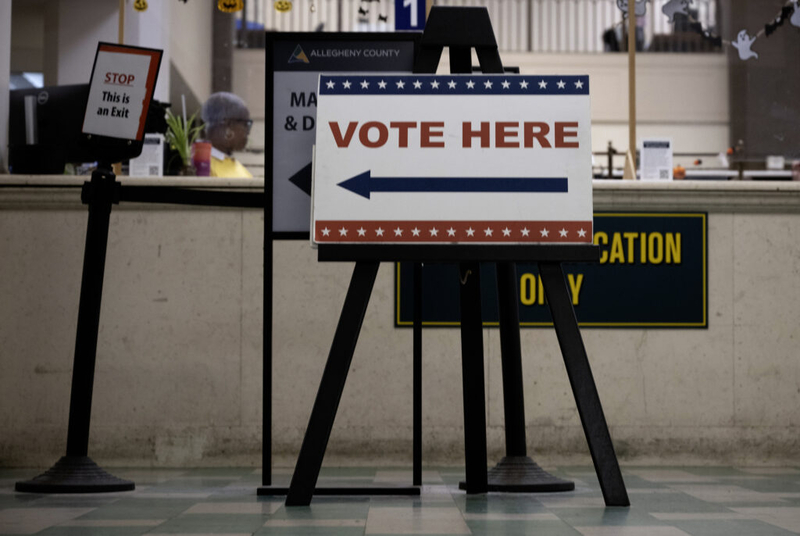
A sign directs voters to where they can cast their ballots at Allegheny County Election office in Pittsburgh on Oct. 19, 2026. (Photo by John Beale/Pennsylvania Capital-Star)
The airwaves, streaming services and your mailbox will be politics-free after voters finish casting their ballots on Nov. 3.
With nearly 250 races across Pennsylvania that will determine party control of the governor’s office, General Assembly and, potentially, the U.S. House, the commonwealth is back in the national spotlight this election season.
The majority of state and federal legislative seats are considered to be safely Democratic or Republican. But flipping just a few in any chamber could change the balance of power, and midterm elections traditionally favor the minority party. Combined with low presidential approval ratings and economic concerns, some experts theorize there could be a “blue wave” next week.
So what are the top races to watch in the state on election night?
Garrity challenges Shapiro
At the top of the ticket, Gov. Josh Shapiro is pitching his vision for a state government led by Democrats as he seeks a second term and tries to help his party expand its footprint in both Harrisburg and Washington, D.C.
He’s pitching himself as a moderate who knows how to “get stuff done,” even when that involves working with the Trump administration or the GOP majority in the state Senate.

And he’s tried to tie his opponent, Republican state Treasurer Stacy Garrity, to the unpopular decisions of President Donald Trump, who she has staunchly supported since his first term in office.
Garrity, however, is telling a different story. Shapiro, according to her campaign, is more focused on his presidential ambitions than the state of Pennsylvania, and has become too cozy with special interests like data center developers.
When it comes to data centers in particular, she’s repeatedly accused Shapiro of flip-flopping on the issue and called an executive order he signed aimed at reining in new development too little, too late. Garrity herself used to support increased data center development, but has since called for an indefinite pause.
She’s also sought to remind voters about the governor’s past controversies, like a settlement paid out to one of his top advisers after allegations of sexual misconduct surfaced in 2023.
But it’s not clear if her message is getting through. Shapiro, whose relatively high approval rating has held throughout his first term, has maintained a wide lead in the polls, and massively out-fundraised his opponent to boot.
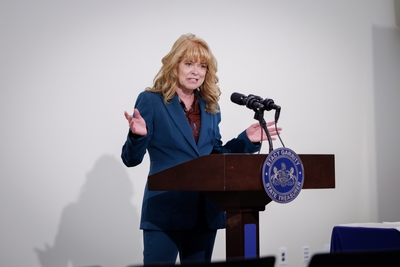
As he campaigns for reelection, Shapiro has also been criss-crossing the state in an attempt to boost Democrats running for both state and federal seats. His big-picture goals include expanding the state’s Democratic congressional coalition, and flipping the state Senate, which has long been held by Republicans.
Since this race is atop the ballot, Democrats are hoping a Shapiro win could impact downballot races. They note the bigger the margin, the better night it would be for their candidates. Shapiro defeated Republican state Sen. Doug Mastriano by nearly 15 points four years ago.
Shapiro dreams of a trifecta
Shapiro’s popularity has emboldened Democrats to pursue what was once unheard of: flipping the Senate, which Republicans have controlled continuously since 1994. A unified legislature which would be more agreeable to his agenda could bolster Shapiro’s credentials if he runs for president in 2028.
Republicans control the upper chamber with 27 seats. In the case of a 50-50 split, Lt. Gov. Austin Davis, a Democrat, would be the tiebreaker.
Half the chamber’s seats are up for election this year, but only a handful are considered to be competitive. Closely watched races are almost all located in the eastern half of the state.
Democrat opportunities:
- Senate District 6 (Bucks): incumbent Sen. Frank Farry, a Republican, is fending off a challenge from Bucks County Clerk of Courts Eileen Hartnett Albillar.
- Senate District 16 (Bucks and Lehigh): In a rematch from 2022, Sen. Jarrett Coleman, A Republican, will face Lehigh County Controller Mark Pinsley.
- Senate District 24 (Berks and Montgomery): Chris Thomas, a former middle school teacher and construction worker, hopes to knock out incumbent Sen. Tracy Pennycuick.
- Senate District 40 (Lackawanna, Monroe and Wayne): Brian Wrightson, a small business owner, is challenging incumbent Sen. Rosemary Brown.
But Senate Majority Leader Joe Pittman (R-Indiana) told reporters in September that he believed Republicans would grow their majority by one member, likely referring to Lancaster County’s Senate District 36.
Sen. James Malone, a Democrat, won the seat in a 2025 special election by 529 votes, and will have to defend it again this year. The slim margin of victory one year ago and the district’s large number of registered Republicans make the seat one of the best opportunities for a Republican pick-up.
Also on the radar for the GOP: Senate District 14 (Lehigh and Northampton), where Omy Maldonado is challenging incumbent Sen. Nick Miller; and Senate District 38 (Allegheny), where incumbent Sen. Lindsey Williams is fending off Thomas West.
The nonpartisan Sabato’s Crystal Ball at the University of Virginia’s Center for Politics put the Pennsylvania Senate as a toss up, meaning both parties have a shot at keeping — or taking — control. Previously, the chamber was considered to be leaning Republican.
With all 203 state House seats up for grabs, and a three-seat Democrat majority following a special election, the parties are eying two dozen seats as potential flips. Sabato’s, however, doesn’t rank the lower chamber as competitive as the Senate, putting it in the “likely Democratic” category.
Three of those races are without an incumbent due to retirements. House District 45 (Allegheny) and House District 121 (Luzerne) are currently held by Democrats, while House District 88 (Cumberland) is currently occupied by a Republican.
In addition to open seats, races on priority lists for both the Republican State Leadership Committee and the House Democratic Campaign Committee include:
- House District 18 (Bucks): Held by Republican Rep. K.C. Tomlinson, with a challenge from Democrat Bryan Allen.
- House District 44 (Allegheny): Held by Republican Rep. Valerie Gaydos, with a challenge from Democrat Hadley Haas.
- House District 72 (Cambria): Held by Democrat Rep. Frank Burns, with a challenge from Republican Phil Rice.
- House District 137 (Northampton): Held by Republican Rep. Joe Emrick, with a challenge from Democrat Jeff Warren.
- House District 142 (Bucks): Held by Republican Rep. Joe Hogan, with a challenge from Democrat Kristin Egan.
- House District 160 (Chester and Delaware): Held by Republican Rep. Craig Williams, with a challenge from Democrat Elizabeth Moro.
Control of the U.S. House may well go through the Keystone State
Just 21 of the nation’s 435 U.S. House districts are considered competitive, and four of those seats are in Pennsylvania. Republicans currently hold a four-seat edge over Democrats in Congress’ lower chamber and a 10-7 edge in the commonwealth’s delegation.
Congressional District 1:
Fifth-term Republican U.S. Rep. Brian Fitzpatrick, who was elected after his brother Mike Fitzpatrick retired in 2017, won his last reelection bid two years ago by a roughly 13% margin.
The 1st Congressional District includes all of Bucks County and a sliver of Montgomery County in the Philadelphia suburbs. It’s the lone Republican holdout, whereas other suburban Philly districts have gone blue in the last decade and are considered safe for Democratic incumbents this election.
That means Democratic challenger Bob Harvie is a long shot to flip the seat this year. Harvie, a Bucks County commissioner, has criticized Fitzpatrick for supporting the Trump administration’s policies and for taking contributions from corporate PACs, while pledging not to accept any himself.
Fitzpatrick, meanwhile, has cast himself as an independent voter; he was one of two GOP representatives to vote against the One Big Beautiful Bill Act (OBBBA). And he touts his role in a bipartisan Problem Solving Caucus that has tackled election reform and accountability in Congress.
His campaign has attacked Harvie as “divisive” and a “hack,” while a PAC aligned with Fitzpatrick ran ads alleging Harvie is the subject of an FBI investigation. Harvie’s campaign sent a cease and desist letter to Fitzpatrick in July stating that the claims are false and defamatory. The following month, Harvie sued the Defending America PAC and Chris Pack, a Republican consultant, for defamation.
The most recent New York Times/Sienna University poll gives Harvie a 2-point advantage after trailing Fitzpatrick most of the year. That’s despite Fitzpatrick’s significant fundraising edge with nearly $8 million collected compared with Harvie’s $3.1 million.
Cook Political Report rates the race as “Leans Republican” and Sabato’s Crystal Ball calls it a toss up.
Congressional District 7:
After ousting Democratic incumbent Susan Wild by a 1% margin in 2024, U.S. Rep. Ryan Mackenzie is running to keep his seat. He’s challenged by Democrat Bob Brooks, a former firefighter and president of the state professional firefighters union.
The 7th District lies in eastern Pennsylvania’s Lehigh Valley, encompassing Carbon, Lehigh and Northampton counties. The latter two counties have been described by political observers as among the most swingy in the nation in the last several presidential elections.
Mackenzie touts his support for the OBBBA and the tax cuts it included as demonstrating his support for working families. He also cites housing initiatives and the House’s passage of the Ratepayer Protection Act, which is designed to insulate consumers from data center costs.
Brooks has attacked Mackenzie as “a career politician who has voted with Trump nearly 100% of the time in Washington” and tells voters it’s time to “send one of us” to Washington to “shake things up.” He says his experience as a union leader will help him hold corporations accountable for high prices and fight corruption.
Polls give Brooks a 4- to 5-point advantage over Mackenzie. And Brooks holds a slight fundraising edge, with nearly $5.3 million raised against Mackenzie’s $5.2 million.
Cook Political Report and Sabato’s Crystal Ball rate the race as “leaning Democratic.”
Congressional District 8:
U.S. Rep. Rob Bresnahan, a first-term Republican congressman, flipped the Scranton-area seat in 2024, snagging the seat from longtime former U.S. Rep. Matt Cartwright, a Democrat.
But he won with less than 51% of the vote, providing an opening for Democratic challenger Paige Cognetti. She won Scranton’s mayoral special election in 2019 as an independent, later changing her party affiliation.
Throughout his freshman term, critics of Bresnahan have hammered him over stock trading, which tracker Quiver Quantitative puts at $8.74 million. The multimillionaire now says he has “consistently” supported banning such activities and appears to have halted the money-making moves.
Bresnahan touts his deep, local roots and business connections., criticizing her ties to Wall Street and actions as mayor that he says threaten local police safety and increased taxes.
Cognetti has raised more than $7.5 million since Jan. 1, 2025, compared to Bresnahan’s $6.5 million. Candidates and outside groups have bought more than $28 million in advertising, making it one of the most expensive national contests.
Cook Political Report ranks the race as a toss up, while Sabato’s Crystal ball changed its rating to “leans Democratic” on Tuesday. The latest New York Times/ Sienna University poll sponsored by the Philadelphia Inquirer gives Cognetti a four-point advantage over Bresnahan.
Congressional District 10:
The race to represent the 10th Congressional District is one of the most competitive in the state. Six-term incumbent Republican Rep. Scott Perry is facing Democrat Janelle Stelson, a former WGAL news anchor.
The race is a rematch. In 2024, a year when Democrats underperformed up and down the ballot. But, while Stelson came within striking distance of unseating Perry, she lost to the incumbent by just over 1% of the vote.
Democrats are hopeful that the momentum on their party’s side driven by Trump’s cratering approval ratings — along with Stelson’s fundraising advantage — can push her over the top this year.
But recent polling has the race locked in a virtual tie. It’s also become the most expensive congressional contest in the state, with nearly $16 million raised between the two campaigns to date.
Stelson has highlighted Perry’s support of unpopular Trump administration policies, like his votes to authorize the war in Iran and cut funding for Medicaid. She’s also sought to remind voters of his role in efforts to overturn the results of the 2020 election. After Trump’s loss to Joe Biden in 2020, Perry was a key ally in Congress as the president fought to block the certification of the election
Perry’s campaign, on the other hand, has largely cast him in advertisements and campaign mailers as a principled conservative focused on cutting government waste, highlighting his multi-decade military record. He’s also tried to paint Stelson, a former Republican, as too liberal for the central Pennsylvania district.
Nearly one million Pennsylvanians have already voted via mail-in and absentee ballots as of Oct. 29, but millions will likely vote in-person on Election Day. State law prevents counties from starting their counts until polls open at 7 a.m. on Nov. 3, so the winner in some races may not be declared on election night.
Harrisburg, PA