What Peggy Flanagan’s Senate victory would mean for Indian Country
Oct 26, 2026 | 8:45 am ET
Description
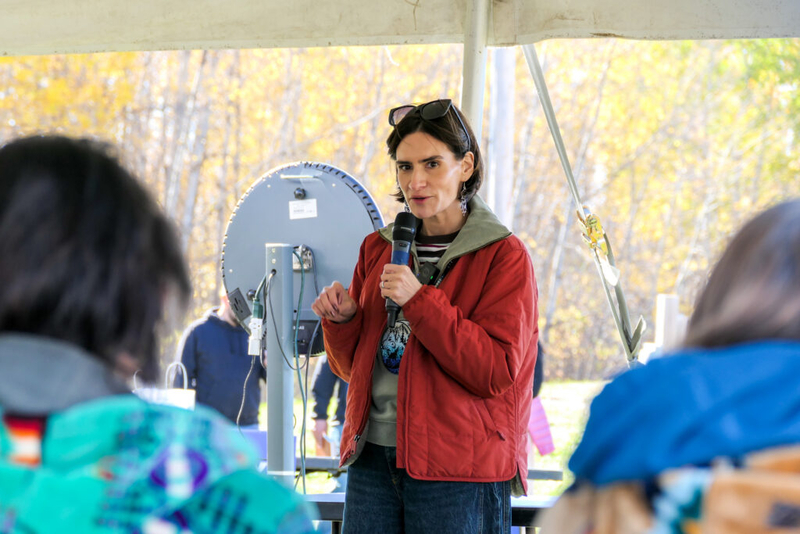
Lt. Gov. Peggy Flanagan addresses voters at a Senate campaign event on the White Earth reservation on Oct. 17, 2026. (Photo by Max Nesterak/Minnesota Reformer)
NAYTAHWAUSH — Peggy Flanagan took the microphone and began, as she always does, in Ojibwe.
“Boozhoo,” she said, giving her name, her tribe and her clan before switching to English. “Thank you for welcoming me home.”
Flanagan, Minnesota’s lieutenant governor and Democratic nominee for U.S. Senate, had traveled hours across prairie, wetland, forest and farmland to reach this town of 504 on the White Earth reservation, where she is an enrolled tribal member.
About 40 people sat in the shade of a large white tent next to the powwow grounds, as smoke wafted over from a grill piled high with hot dogs. Flanagan made her pitch: She knows what it’s like to struggle from a childhood on the margins, she’ll fight to finally raise the federal minimum wage, and she’ll take on President Trump.
The audience hardly needed convincing to vote for Flanagan over Republican Michele Tafoya, a retired sports broadcaster who is giving Republicans their best shot at winning a Senate seat since 2008.
Still, Flanagan showed up, in a commitment to Indian Country and the state’s most remote corners, where people often feel forgotten, to promise them face-to-face that she would take their concerns to Washington.
“I’m not running to make history, but it’s about damn time there was a Native American woman serving in the United States Senate. And she might as well be from White Earth,” Flanagan said to cheers.
Before she left for events at two more reservations, White Earth Chairman Michael Fairbanks gave her wild rice, sage and sweetgrass.
As with former U.S. Rep. Mary Peltola, an Alaska Native and Alaska’s Democratic nominee for U.S. Senate, Flanagan’s victory would be historic. Just four enrolled tribal members have served in the Senate in its 237-year history, all men.
Yet Flanagan’s candidacy has significance beyond just representation.
As lieutenant governor, Flanagan helped reshape state government’s relationship with the 11 tribal nations in Minnesota. Now, she promises to bring that experience to Congress, to work to uphold the federal government’s trust responsibilities to 575 federally recognized tribes and to advocate for a progressive economic agenda that would have an outsized impact for Native Americans, who face extreme rates of poverty and the lowest life expectancy of all racial and ethnic groups.
Her tenure in Minnesota government was not without friction with tribal leaders, however, and similar tensions are likely to follow her to the Senate. Tribal sovereignty and Native interests are often at odds with the federal government where she’ll be serving in the world’s most powerful legislative body.
Early years
Flanagan grew up in the Minneapolis suburbs, raised by her white, Irish Catholic mother and later a stepfather whose name they took. She was estranged from her Native father, Marvin Manypenny, who struggled with addiction through her childhood.
Nevertheless, her mother, Patricia Flanagan, ensured her daughter was connected to her Native identity.
She enrolled her as a citizen of White Earth Nation, which requires proof of an enrolled parent and one-quarter “Minnesota Chippewa Indian blood.” She also sent her to spend time with relatives on her dad’s side in south Minneapolis, close enough to walk to the American Indian Center.
The area has been an epicenter of urban Indian life since Native Americans began migrating to cities in large numbers in the mid-20th century, spurred on by federal policies aimed at moving Native people off reservations and dissolving tribal governments. Today the vast majority of Native Americans live in urban areas.
It was in south Minneapolis where the American Indian Movement was founded in the 1960s, followed by the only American Indian-preference Section 8 housing development, one of the first Native-controlled schools, a Native-run health clinic and a Native-run legal rights center.
“She really wanted to make sure that I knew who I was and where I came from,” Flanagan said in an interview.
Flanagan was a poor student in high school with a 1.75 grade-point average, but that changed when she got to the University of Minnesota and had her first Native instructor, Brenda Child.
“It literally changed everything,” Flanagan said. “All of a sudden, I was a sponge, and just threw myself into the work and the community.”
She graduated Phi Beta Kappa with a major in child psychology and a minor in American Indian studies and took a job at the Division of Indian Work in south Minneapolis. Then she joined Wellstone Action, the nonprofit dedicated to carrying on the legacy of Sen. Paul Wellstone by training organizers and candidates.
She served on the Minneapolis School Board and led the Children’s Defense Fund of Minnesota, where she advocated for a higher minimum wage, before winning a seat in the state House in 2015 and being tapped to join Walz’s ticket for governor just a couple of years later.
She often points to her Native identity — as well as her Catholic faith and hardscrabble upbringing — as informing her support for progressive policies such as universal childcare, Medicare for All and raising the federal minimum wage from $7.25 an hour to $17 an hour.
At a campaign stop on the Red Lake reservation, Lindsay Johns said she was moved by Flanagan’s story about watching her mom walk across a graduation stage after returning to school to be a phlebotomist. Flanagan has said that progress was only possible because of the stability provided by safety net programs like Section 8 housing and food assistance.
Johns, a member of Red Lake Nation, raised three sons on her own. She said after years of starts and stops, she just graduated with a four-year degree in child psychology.
“She almost made me cry,” said Johns, a member of Red Lake Nation. “I thought about how my kids were watching me graduate last spring.”
Speaks in a Loud and Clear Voice Woman
When Flanagan introduces herself in Ojibwe, she is doing more than sharing her name, Gizhiiwewidamookwe, or “Speaks in a Loud and Clear Voice Woman,” and her clan, the wolf clan. She is practicing a tradition that represents a triumph over the federal government’s concerted efforts to suppress Indigenous languages and cultures through boarding schools, adoption and relocation policies.

Speaking on a national political stage, Flanagan is also bringing an Indigenous language to many Americans for the first time. Her introduction — and especially her name — has also drawn ridicule, particularly from conservative commentators, some of whom reduce its meaning to the pejorative “loud woman.” (Flanagan herself sometimes tells a version of this joke, saying her husband was the least surprised to learn her name.)
“It’s not surprising to me at all that it gets weaponized, and it’s really painful,” said Crystal Echo Hawk, who founded IllumiNative, an organization that aimed to improve the public’s understanding of Native Americans.
Echo Hawk says the reaction underscores how little most Americans know about contemporary Native Americans. She led a massive public opinion research project on Native Americans that found nearly 80% of the public knows little about Native people and that most schools fail to teach about Native Americans past 1900.
“When we are given our Native names, it is spiritual … It’s such an important part of who we are,” said Echo Hawk, who is Pawnee.
An Ojibwe name is bestowed at a spiritual ceremony, usually by a community elder or relative. That individual becomes the recipient’s “wen’enyag” or namesake.
Flanagan received her name in 2023, at age 43, from Priscilla Day, a retired professor of social work at the University of Minnesota.
Flanagan’s daughter, Siobhan, received her Ojibwe name at the same time.
“My daughter received her Ojibwe name so much earlier than I did, and feel like that’s a real gift,” Flanagan said.
Siobhan has had many opportunities to be immersed in the language and culture. She starred in a production of “Bowwow Powwow,” based on a book by Flanagan’s first Native college instructor. In the play, she spoke and sang in Ojibwe as the lead character Windy Girl.
Her daughter’s experience shows the progress of language and cultural revitalization that Flanagan has worked to reclaim in her own life — and advocated for in policy.
Working from inside the system
Marvin Manypenny, whom Flanagan became close with in adulthood, spent much of his life fighting the government. He was a prominent White Earth treaty rights activist and organizer in the vein of the American Indian Movement, known for its combative protests.

He helped lead an effort aimed at reclaiming thousands of acres of land that had been swindled away from White Earth tribal members through federal policies and illegal land transactions. Manypenny occupied buildings, was arrested, and invited legal battles, such as when he stopped paying federal taxes.
His daughter has pursued change through markedly different means, as a politician rather than an agitator.
Flanagan often recalls her father telling her, “My girl, I want to burn down the system, and you want to get into the system and change it from inside out.”
For many Native people, that system has long been a source of harm rather than help. Generations of broken treaties, land seizures and federal policies aimed at forcing assimilation into the white mainstream have left a deep ambivalence toward state and federal government.
“We’ve had such a massive distrust of state and federal government, even local government, like that wasn’t for us,” Echo Hawk said.
One of the clearest symbols of that fraught relationship is visible from Flanagan’s office: a statue of former Gov. and U.S. Sen. Knute Nelson.
Nelson is widely regarded by Native people as one of the most destructive politicians, having been a principal architect of the Nelson Act of 1889. It opened up much of Ojibwe land to non-Native settlement and logging and aimed to push Ojibwe people onto the White Earth reservation. Tribal members often referred to him as “agongos” — the chipmunk — because he stuffed his mouth with Native lands, according to Anton Treuer, professor of Ojibwe at Bemidji State University.
Flanagan and Nelson’s statue have shared the Capitol grounds for the entirety of her service in the Legislature and as lieutenant governor, despite calls by Native activists to remove it. Another monument, a statue of Christopher Columbus, was never replaced under the Walz administration, however, after Native activists tore it down in 2020.
Working within the system and tolerating its flaws has allowed Flanagan to help forge a new relationship between the state and the 11 tribal governments in Minnesota that strives to respect tribal sovereignty.
Soon after they took office, Walz signed an executive order requiring every agency — from health to natural resources to transportation — to develop tribal consultation policies, designate a tribal liaison and maintain ongoing consultation with tribal governments. The Legislature codified those requirements in state law in 2021.

The aim is to ensure tribal sovereignty is respected while avoiding painful and expensive disputes, such as desecrating a burial ground during road construction or illegally arresting Native people for hunting and fishing on treaty lands.
Walz also created an Office of Tribal State Relations so that tribal leaders would have a direct point of contact in the governor’s office.
“Peggy is why the office was created,” said Patina Park, a member of the Cheyenne River Sioux Tribe who led the office for more than five years after its inception.
Park said the Walz and Flanagan administration followed through on its promise to maintain relationships with tribes by visiting all 11 nations — something no previous administration had done.
When Walz visited the Upper Sioux Community, Park said, the chairman told Walz he was the first governor to visit since Henry Hastings Sibley, Minnesota’s first governor who commanded U.S. forces against the Dakota in 1862 and convened the sham trials that resulted in the federal government hanging 38 Dakota men in Mankato in the largest mass execution in American history.
The relationship between the tribes and state was tested during the COVID-19 pandemic. Minnesota officials joined daily calls with tribal leaders to coordinate the response. That stood in stark contrast to the response in South Dakota, where then-Gov. Kristi Noem was embroiled in an ugly standoff with tribal leaders, who set up coronavirus checkpoints on highways entering their reservations in an effort to limit the spread. Later, the leaders of seven tribes banned Noem from entering their reservations after she accused some of benefiting from drug cartels.
Walz also signed significant legislation favorable to tribes and Native people. For instance, the law legalizing cannabis granted tribes a unique path to opening dispensaries off reservations, which gave them a head start in securing a foothold in the lucrative market.
During Walz’s tenure, Minnesota established the first state office for missing and murdered Indigenous people, created a commission to redesign the state flag and seal, which many Native people found offensive, and increased funding for Indigenous language instruction.
The administration also fostered the return of land to tribal control. In 2021, the Minnesota Historical Society returned 114 acres to the Lower Sioux Indian Community including the site of the start of the Dakota War of 1862. The Department of Natural Resources returned about two square miles that include a burial and prayer site to the Upper Sioux Community in 2024. And earlier this year, Walz signed legislation paving the way for the University of Minnesota to return 3,400 acres of land to the Fond du Lac Band of Ojibwe, which Nelson’s policies enabled to be divided and sold.
Balancing sovereigns
Flanagan’s tenure has not been without conflict with tribes. Even a politician committed to tribal sovereignty can find herself constrained by the government she serves.
“There’s always going to be friction there when two sovereigns are trying to understand the boundaries of their power,” said Bryan Newland, a former assistant secretary of the interior for Indian Affairs under President Biden and a member of Bay Mills Indian Community.
For Flanagan, the hardest test came in her first term during the fight over Enbridge’s Line 3 pipeline. The Canadian energy company sought to replace an aging pipeline with a higher-capacity one carrying Canadian oil across northern Minnesota, including through treaty lands where Native communities hunt, fish and harvest wild rice.

Tribal leaders and environmental activists mounted an aggressive campaign to halt the project, filing numerous lawsuits, protesting at the Capitol and then blockading construction sites.
They appealed to Walz, but he declined to intervene in the permitting process.
Flanagan largely stayed tight-lipped, though she released a statement saying she was opposed to the project but didn’t have the power to stop it.
This brought on a harsh backlash from Native activists, who expected her to use her proximity to power to pressure Walz to halt construction. Some started calling her “Pipeline Peggy.”
Winona LaDuke, a White Earth member and prominent leader of the Line 3 resistance, said the nickname was unfair, but she shared the disappointment behind it.
“It wasn’t enough,” LaDuke said. “Peggy stuck with Tim Walz.”
The criticism exposed the limits of Flanagan’s influence and a tension at the heart of her politics. Working from within the system creates opportunities for change, but it does not guarantee that a Native leader’s priorities will prevail.
Former Interior Secretary Deb Haaland, the first Native American to lead the agency that includes the Bureau of Indian Affairs, faced a similar tension. She was widely hailed as a champion of sovereignty but nevertheless found herself at odds with tribal leaders at times.
LaDuke nevertheless supports Flanagan and her intention to serve as a check on the Trump administration.
“She’s strong,” LaDuke said. “If you’ve survived this long as an Indian politician, you’re a very strong woman.”
Vision for federal office
If elected, Flanagan would carry on a Minnesota Senate tradition that includes Tina Smith, Al Franken and Paul Wellstone, all progressive Democrats who championed Native issues on the Indian Affairs Committee.
She wants a place on that committee — along with assignments on agriculture and health, education, labor and pensions — which would give her oversight and influence over federal funding and policy for Indian Country, from health to gaming to land management.
Flanagan says her vision for the federal government’s relationship with tribes is straightforward: “The federal government needs to honor the treaty rights and uphold trust responsibilities.”
Straightforward, she concedes, is not the same as simple.
The federal government has obligations to tribes to safeguard their natural resources as well as fund health care, education and social services. The federal government, by its own admission, has persistently failed to meet these obligations.
Flanagan’s job would be to fight for how these obligations are interpreted, funded and enforced, as the Trump administration looks to cut spending and expand mining and oil development.
While Flanagan would bring a unique perspective on Native issues to the Senate, she won’t have unique powers to solve the myriad problems facing Indian Country. Tribal leaders know this.
It was only in the decade Flanagan was born that the federal government began embracing tribal self-determination. Through the 1970s, Congress passed a series of laws giving tribes greater control over their schools, health care and other federal programs.
White Earth Chairman Michael Fairbanks said his community is focused on blocking copper-nickel mining near the Boundary Waters and maintaining federal protections for the gray wolf, which is spiritually important to the Ojibwe.
“The wolf is really powerful for us, and it kind of drives along the same lines as tribal policies,” Fairbanks said.
The issues have divided Minnesota’s congressional delegation. Republican U.S. Rep. Pete Stauber, whose district encompasses all seven Ojibwe reservations, has sponsored legislation to open up copper-nickel mining near the Boundary Waters and delist the gray wolf to allow for hunting. Smith has opposed both.
(Walz recently issued an executive order aimed at banning mining near the Boundary Waters, but it’s set to expire after he leaves.)
Leech Lake Chairman Faron Jackson Sr. said his central priority is land. Federal policies divided the Leech Lake reservation into a checkerboard of tribal, federal and non-Native ownership, leaving the tribe with relatively small landholdings within its reservation.
Smith helped secure the return of about 11,000 acres the federal government illegally took from Leech Lake members in the late 1940s and 1950s, but there are thousands more acres that haven’t been returned.
“We want to make sure that we get back what’s rightfully ours,” Jackson said.
It’s clear Native tribes are optimistic about her candidacy. Her campaign has drawn support from scores of tribes across the country: the Oneida Nation in Wisconsin, the Cherokee Nation in Oklahoma, the Muckleshoot Indian Tribe in Washington, the Seminole Tribe of Florida.
At a campaign event on the White Earth reservation, Stella Devine said she can’t wait for Flanagan to be in the “upper leagues” of government.
“The little ones are seeing her as an inspiration. I see her as an inspiration,” said Devine, who serves on the White Earth Elders Commission and said she tries to apply what she hears from Flanagan to her own work.
Later, Devine approached Flanagan to give her a hug and a word of encouragement.
“When are you going to come home and run for tribal council?” she asked.
Flanagan demurred. “One election at a time.”


Saint Paul, MN