What happens when the clock runs out on felony murder legislation?
Jul 24, 2026 | 4:28 pm ET
Description
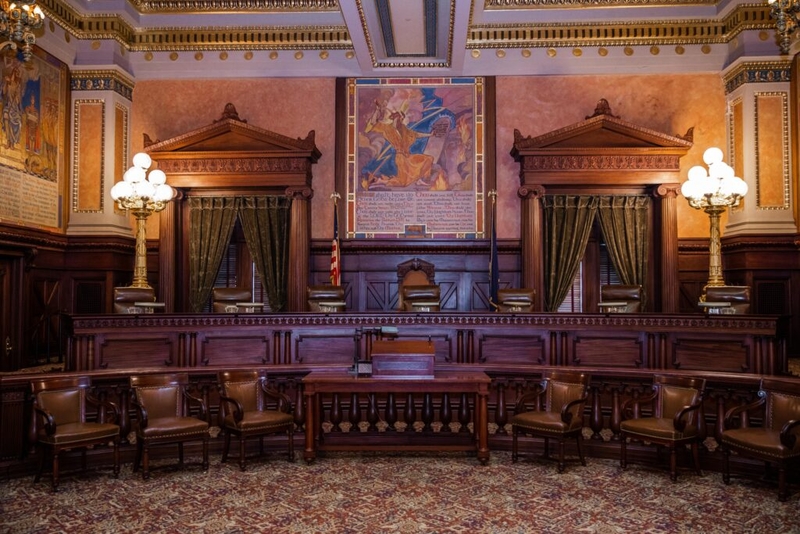
The Supreme Court of Pennsylvania chamber at the Capitol in Harrisburg. Justices ruled in April that mandatory life sentences for second-degree murder were unconstitutional, triggering what might be the largest resentencing effort in commonwealth history. (Photo from the Unified Judicial System of Pennsylvania)
With state lawmakers likely to miss a court-imposed deadline to pass legislation addressing sentencing for second-degree murder, rhetoric about what that means has grown heated.
“There is a chance convicted killers could soon walk free,” Carbon County Republican Rep. Doyle Heffley said in a statement Friday.
The sentiment has been echoed by other GOP lawmakers in the previous weeks. And, in an election year, warnings that murderers could soon be released from prison have worked their way into partisan campaign material.
But when the Friday deadline passes, no one serving time for second-degree murder — a charge brought when someone is killed during the commission of a felony — will be released from jail, or even become immediately eligible for parole.
Instead, it will likely kick off a legal process that will leave those serving life sentences for the charge in limbo, but could ultimately result in the largest resentencing effort in Pennsylvania’s history.
What that means for people serving mandatory life sentences, for the families of victims, and for every other Pennsylvanian, isn’t entirely clear. But experts have pointed to a most likely outcome.
How we got here
Back in March, the Pennsylvania Supreme Court issued a landmark ruling in a case called Pennsylvania vs. Derek Lee.
In 2014, Lee took part in an armed home robbery in Pittsburgh. While he was in a different room, his accomplice shot and killed the victim, Leonard Butler.
Lee was charged with second-degree murder, and sentenced to life in prison without parole — the mandatory charge for anyone found guilty.
For people serving these unconstitutional sentences, they don’t know what’s possible. They don’t know what their fate may be ... All they know is they’re serving a sentence that the Supreme Court said is so cruel it’s unconstitutional.
In 2023, he petitioned the state Supreme Court to review his sentence, arguing it violated a constitutional ban on cruel and unusual punishments.
Ultimately, the state’s high court agreed with him, and found it unconstitutional to require a life sentence in all cases of second-degree murder.
People charged with that crime can have varying degrees of culpability. An example often used by criminal justice advocates is a getaway driver who took part in a robbery they had no intention or knowledge of turning violent.
But the charge can also apply to people who are directly responsible for someone else’s death. Someone who beats someone to death while committing another crime, but had not initially intended to kill them, can also be charged with second-degree murder.
“Life without parole imposes the harshest imprisonment sanction permitted under the law ─ imprisonment until death without the opportunity for consideration of release ─ regardless of culpability,” Chief Justice Debra Todd wrote in the majority opinion. “Due to this scheme’s mandatory nature and its unique severity, it poses a great risk of disproportionate punishment.”
But the court’s ruling was, in a sense, narrow. It did not address what’s known as retroactivity, meaning how it should apply to the roughly 1,100 people currently serving mandatory life sentences without parole for second-degree murder in Pennsylvania
Instead, they stayed their decision for 120 days, giving state lawmakers until July 24 to come up with a legislative solution.
In that time, both the Democratic-controlled state House and GOP-majority state Senate passed bills to address retroactivity, but the two chambers couldn’t agree on questions like when convicts should become parole-eligible.
As it stands, lawmakers are set to blow the July 24 deadline. But a last minute petition from Allegheny County District Attorney Stephen Zappala could buy them another 120 days — if it’s granted by the state Supreme Court. Attorneys for Lee filed Friday in opposition to an extension, saying that “the legislative impasse … may remain in place indefinitely.”
So what happens after the deadline if lawmakers don’t act?
Whether or not an extension is granted, what happens if lawmakers blow their deadline will depend on several factors.
But initially: nothing.
However, the door will open for inmates currently serving life without parole to petition the court to review their cases.
According to Sara Jacobson, the executive director of the Public Defender Association of Pennsylvania, there are a couple things that could happen next.
A case, or a series of cases, could work its way through the state judicial system and up to the Supreme Court. Or the state’s high court could grant what’s known as a King’s Bench petition.
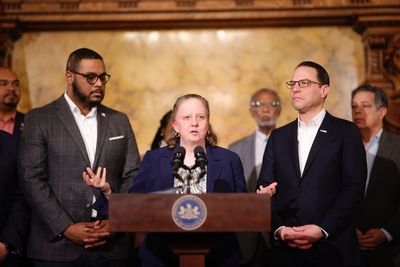
“The King’s Bench petition goes straight to the Supreme Court. It says, ‘take all of these cases together. This issue is so serious, it applies to so many people and there’s so much uncertainty that, Supreme Court, please act now to give us guidance.’”
Jacobson expects such a petition to be filed. But, importantly, she notes that the process would take time.
“That doesn’t happen Monday,” she said. “In fact, nobody gets resentenced on Monday. There’s still more than work that has to be done with the courts.”
From there, assuming the Supreme Court sides with the detainees and finds all mandatory life sentences for second-degree murder unconstitutional, another long process will begin: resentencing.
Essentially, everyone serving a now-unconstitutional sentence will have to go before a court and explain to a judge why they think they deserve a shorter sentence. But without guidance from lawmakers, that could result in vastly different outcomes depending on the presiding judge. And life without parole would remain an option.
That means people serving time for similar circumstances could theoretically wind up with vastly different sentences depending on how sympathetic the judge they come before is to their argument.
A sentence may also be affected by the petitioner’s quality of representation. The Public Defender Association of Pennsylvania and the Defender Association of Philadelphia estimate that it will cost between $34 million and $36 million to adequately represent all 1,100 Pennsylvanians who would have their cases reviewed.
It could also take a long time to get through all those cases.
Roxanne Horrell, a campaign director with the advocacy group Straight Ahead, previously pointed to the fallout after a 2012 U.S. Supreme Court ruling in a case called Miller vs. Alabama to explain. That decision found life sentences for juveniles were illegal in all but exceptional cases.
The Pennsylvania legislature then rewrote juvenile sentencing guidelines in the state to comply, but did not address the question of what should happen to those already serving life sentences.
That was the basis of a 2016 state court ruling, but the way the decision was written meant those affected by it would have to go to court individually.
Because of that, 10 years later, there are still some people in Pennsylvania serving life sentences for crimes they committed as juveniles who have not yet gone through resentencing.
What if lawmakers do act?
Despite disagreements over what sentencing guidelines should look like for second-degree murder, there is broad agreement among lawmakers that it would be best to avoid forcing courts to take up all 1,100 cases individually.
Even with the deadline passed, lawmakers could still pass a bill that would allow those serving life sentences to petition the parole board instead of the courts to decide when or if they should be allowed out of prison.
It would be far cheaper and more efficient.
But that would require lawmakers agreeing on broad guidelines for judges and the parole board to consider, such as when those already charged should become parole eligible, and whether there should be a minimum or maximum sentence moving forward. The divide over those questions is at the heart of why they have been unable to pass legislation for 120 days.
An initial bill championed by House Democrats, public defenders and criminal justice advocates would have made those already charged with second-degree murder eligible for parole after 25 years, but it was never brought before the full chamber
The bill also would have instituted a 50-year maximum sentence for adults going forward, and a maximum sentence between 30 and 40 years for juveniles depending on their age at the time of offense.
Republicans decried the proposal as overly lenient, and balked at the idea of a maximum sentence.
The GOP-majority Senate managed to pass an alternative measure with a handful of Democrats supporting it.
It would institute a minimum 35 year sentence in almost all cases. Though if a defendant were to meet a strict set of criteria, they could receive a mitigated sentence of between 10 and 40 years.
Defendants would have to prove by a preponderance of evidence that they meet six requirements, including that they were not the only participant in the underlying felony; did not cause or intend to cause the victim’s death, nor solicit or conspire in the underlying felony; did not brandish, use or threaten to use a deadly weapon; have no reason to believe another participant would use a deadly weapon; and did not cause serious bodily injury to another.
Criminal justice advocates pointed out that very few people currently serving felony murder sentences would have met that criteria, including Derek Lee, whose case kicked off this debate.
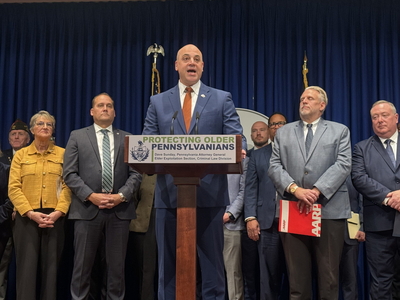
But the measure was supported by Republican state Attorney General Dave Sunday, and a number of county district attorneys.
A press release from Sunday’s office said the proposal’s “framework provides an important structure that distinguishes between the most and least culpable, provides the proper input and protections for victims, ensures that courts won’t be burdened with resentencing hearings, and ultimately ensures an orderly process for those currently serving life sentences for felony murder.”
With the deadline approaching, Democrats in the House took a stab at a compromise.
On Thursday, the chamber passed a bill on largely partisan lines that would have allowed those currently serving life sentences to seek parole after 30 years in most cases. It also punted the question of how those charged in the future should be sentenced, instead tasking the sentencing commission with establishing new guidelines.
Republican leaders in the Senate derided the bill, particularly assailing a provision they called overly-broad that would allow ailing detainees to apply for what’s called medical release even if their sentence was not up.
“House Democrats delivered a soft-on-crime, criminal-friendly bill that will give violent second-degree murder convicts an immediate opportunity for release,” said Senate President Pro Tempore Kim Ward (R-Westmoreland).
Whether or not lawmakers continue to work to find agreement, or allow the courts to decide next steps is yet to be determined.
One influential House Democrat, Judiciary Committee Chair Tim Briggs (D-Montgomery) told the Capital-Star last month that he would rather kick the question to the courts than pass an overly punitive bill.
Jacobson, the head of the Public Defender Association of Pennsylvania, still hopes lawmakers act.
“For people serving these unconstitutional sentences, they don’t know what’s possible. They don’t know what their fate may be,” she said. “All they know is they’re serving a sentence that the Supreme Court said is so cruel it’s unconstitutional.”
Sunday, the state’s top law enforcement officer, who has prosecuted felony murder cases before, agrees.
“We do not have the time left, and the price of inaction is far too great,” he told reporters at a press conference last month. “Because the price of inaction is a violation of the 120 days that was given … And when and if that would happen, guess what, there are no sentencing structures for these cases.”

Harrisburg, PA