Judge asked to approve settlement fining Arkansas paper mill $1.5M over air pollution
Jul 24, 2026 | 6:09 pm ET
Description
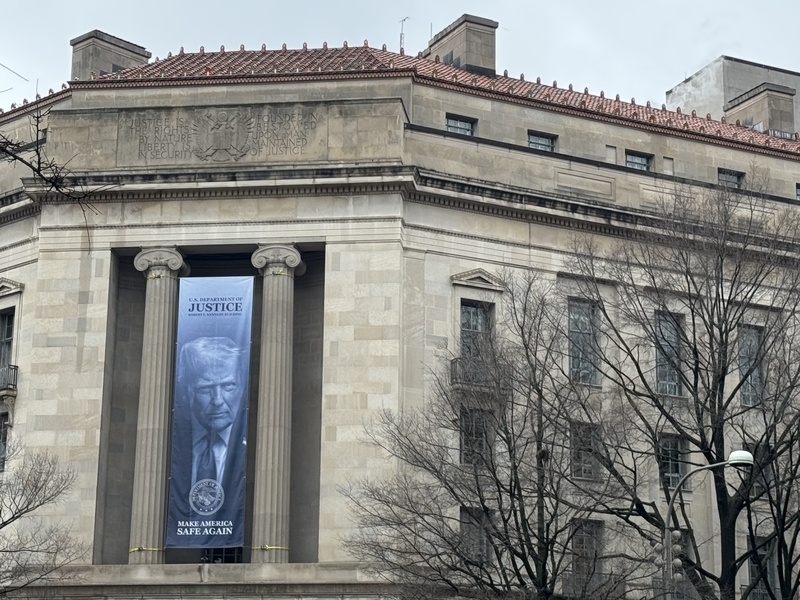
A banner showing President Donald Trump hangs on the Department of Justice on Feb. 20, 2026. (Photo by Shauneen Miranda/States Newsroom)
The Department of Justice, Environmental Protection Agency and the Arkansas Division of Environmental Quality asked a federal judge Friday to approve a settlement that would require an Ashdown paper mill to pay $1.5 million for air pollution violations.
The kraft paper mill, which first opened in 1968, has produced “fluff pulp”, which is used in products such as diapers, since 2016 and employs around 580 people. Just over 2,000 people live within a 3-mile radius of the mill, according to EPA data, though only 162 live within a mile.
According to the legal complaint and proposed consent decree, inspectors with the EPA and DEQ inspected the Domtar A.W. mill in 2019. While inspecting a part of the mill’s equipment called a brown stock washer system, there were visible emissions coming from the system, and hydrogen sulfide monitors worn by members of the inspection team were set off.
The mill also was not inspecting and monitoring its equipment for leaks as required by the federal Clean Air Act. As a result, the mill “failed to detect a leaking valve (that) emitted uncontrolled and illegal amounts of pollutants,” a press release from the Justice Department stated.
“Without proper monitoring and performance testing, the extent of the excess hazardous air pollutants (HAPs) that Domtar emitted into the air are unknown,” the release said.
South Carolina-based Domtar did not immediately respond to a request for comment Friday afternoon.
Melony Martinez, DEQ’s spokesperson, said the agreement was “an important step for improving air quality and protecting the environment.” She declined to comment on whether the issues causing the pollution emissions had been fixed, saying the division would “allow the terms of the agreement to stand on their own.”
According to court filings, the Domtar mill’s permit “emits or has the potential to emit” hazardous air pollutants such as volatile organic compounds, methanol and chlorinated compounds including chlorine dioxide and hydrochloric acid.
The public comment period for the proposed settlement will close in 30 days.
If the judge signs off on the consent decree, it will go into effect the same day. The agreement can be terminated after Domtar maintains compliance with all of the agreement’s requirements, including for fixing equipment and creating better leak detection policies, for two years.
A third party not employed by the paper mill will be responsible for reviewing and revising the existing leak detection procedures, according to the consent decree.
“Domtar is moving in the right direction to resolve its Clean Air Act violations by committing to properly control pollution and monitor for leaks and substandard facility performance,” said Adam Gustafson, a deputy assistant attorney general who leads the Department of Justice’s Energy and Natural Resources Division.
The move comes as the EPA has drawn back its enforcement of environmental laws. It also comes as DEQ has largely stopped bringing state-level enforcement cases before the Arkansas Pollution Control and Ecology Commission in recent years. The state has instead opted to settle alleged violations through agreements called consent administrative orders.
The $1.5 million fine, of which DEQ would get 50%, is significantly larger than most fines levied on Arkansas facilities that violate their air permits, eclipsing the total amount of air pollution permit violation fines imposed in the state between 2022 and 2025, according to EPA data. The median fine related to air permits was $2,665 in 2025, less than a third of the national average fine of $9,000.
Little Rock