What girls hear when a Pennsylvania lawmaker calls women ‘more costly to hire’
Oct 13, 2026 | 5:00 am ET
Description
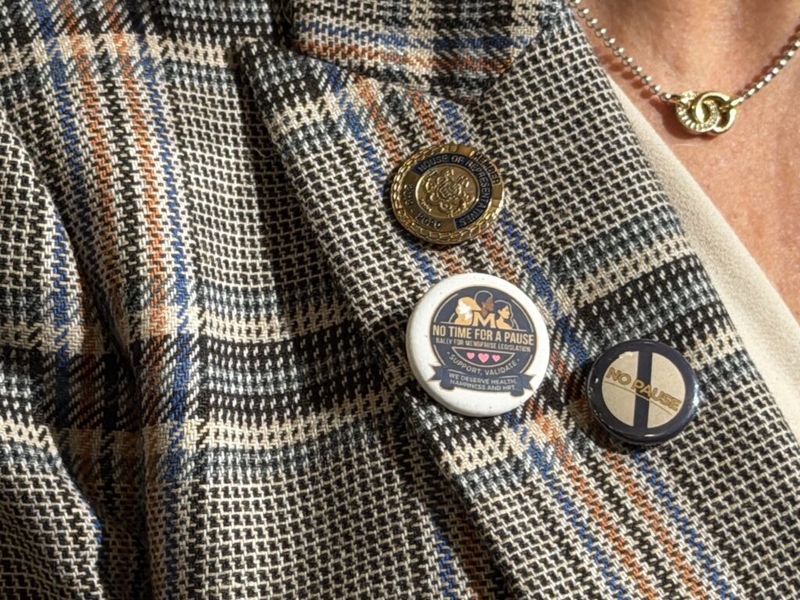
Rep. Melissa Shusterman (D-Chester) wears pins claiming there's "No Time for a Pause" on menopause legislation. (Photo by Whitney Downard/Pennsylvania Capital-Star)
While hanging out in the social media universe the other day, I grazed over a clip with a short shelf life. It spread through X posts and outlets like Jezebel. I happened to see it on Instagram, and the feed moved on.
The logic behind the post should not.
When a Pennsylvania lawmaker said he would choose a mid-40s man over an equally qualified woman to avoid possible menopause accommodations, he revealed more than just hiring bias.
He exposed a social bargain: Women may enter the workforce, excel and build expertise, but their bodies can be used to strip them of economic independence.
That is why the debate over Pennsylvania House Bill 2135 matters beyond the state. The bill would require reasonable accommodations for pregnancy and menopause related conditions. At a Sept. 29 House Labor and Industry Committee meeting, Republican Rep. Scott Barger put it in dollars and cents, “Speaking as someone who’s signed the front side of a paycheck, I think that this bill is going to make women more costly to hire.”
Employers, he argued, would compare a mid-40s woman and a mid-40s man and “find reason not to hire the woman.” He added, “I would.”
Pregnancy accommodations are not new to the workplace. The federal Pregnant Workers Fairness Act has been in effect since June 2023. Menopause accommodations are already available in Pennsylvania.
Starting Jan. 1, 2027, a Philadelphia ordinance will require employers to reasonably accommodate perimenopausal and menopausal symptoms that substantially interfere with their jobs. Barger’s “hassle” may soon become routine in Philadelphia, too.
Menopause is not a professional defect, and an accommodation is not proof that a woman cannot do her job. But when a normal bodily process is framed as a cost, complication or “problem,” it can become a weapon, another excuse to deny women jobs, promotions, income and the autonomy that income makes possible.
Untreated symptoms already cost money. A Mayo Clinic study estimated that $1.8 billion was lost in work time in the US, not counting lost jobs or early retirement. When an employer passes on the woman, that cost does not disappear. It moves on to her.
This should concern every young woman deciding what kind of future she can build.
A woman in her mid-40s is not old. For women, these are the years when their accolades and financial stability should increase. This is true for careers that require long preparation. By the time a woman has completed her training and gained the experience to lead, she may be in her late 30s or 40s.
What does a high school girl aspiring to be an astronaut hear when a lawmaker suggests that women her age may be troublesome to hire? What do college students preparing for medicine, law or engineering hear?
She hears that even after studying, training, persevering and excelling, her body may be used as evidence against her. She hears that ambition has an invisible expiry date. Girls absorb these messages early. Researchers Lin Bian, Sarah-Jane Leslie and Andrei Cimpian found that at ages 6 and 7, girls were significantly less likely than boys to associate being “really, really smart” with their own gender.
Laws are not created in a vacuum; when lawmakers consider a bill, they respond to the visible demands of their constituents. Rep. Morgan Cephas, the bill’s sponsor, told the Capital-Star that the Pennsylvania Human Relations Commission had received menopause-related complaints.
The House voted 159–44 to have the Joint State Government Commission study menopause-related workplace policies. The Pennsylvania bill does not establish that every employer views midlife women as being unreliable. Yet, it reveals a conflict in our culture.
One position states that a woman who needs an individualized, reasonable workplace adjustment should be able to request it without risking her livelihood. The other treats the possibility of an accommodation as a reason to view her as a liability before she is even hired.
No one has to say that women belong back in the home for workplace practices to push them toward dependence. It is sufficient to make their employment conditional and their request for ordinary support a reason to choose a man instead.
The consequences extend beyond a paycheck. A paycheck shapes where a woman lives, with whom, and when she leaves. Being shut out of work costs a woman more than her salary. Work exclusion can mean loss for career women. Independence does not guarantee safety, nor does unemployment destine women for abuse or crime.
However, financial strain, employment sabotage, and economic abuse can restrict a survivor’s ability to leave an abusive relationship. In a study of survivors, Rutgers researcher Judy Postmus found that 78% experienced employment sabotage.
The lesson is not that women must hide their menopause to remain employable. A humane workplace should make room for women at this stage of their working lives.
Girls deserve to know that their dreams will not be crushed in the future. They deserve a workforce that views menopause not as a hiring problem but as a normal part of life.
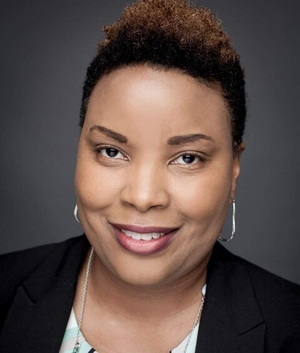
Andrea Hagan is a criminologist, an adjunct instructor of criminology and justice at Loyola University New Orleans, and the founder of Pattern Hunters, LLC, a public scholarship and accountability research platform.
Harrisburg, PA