‘We remember the sorrow’: The Key Bridge collapse, two years later
Mar 26, 2026 | 10:58 pm ET
Description
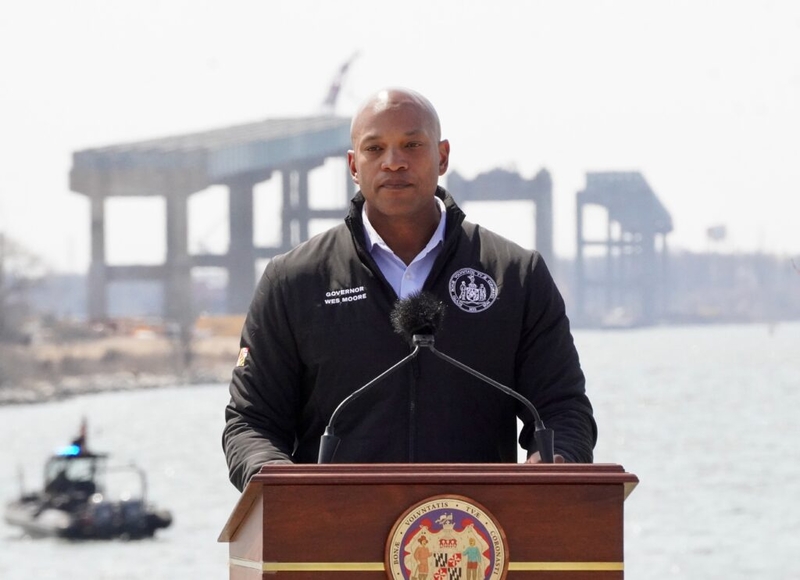
Gov. Wes Moore (D) speaks Thursday on the second anniversary of the Francis Scott Key Bridge collapse. (Photo by Christine Condon/Maryland Matters)
As an early morning haze dissipated over the Patapsco River on Thursday, a metallic drumbeat punctuated the crisp March air.
Bang. Bang. Bang.
It is the sound of progress. Or more specifically, a hammer driving a towering steel pile into the riverbed — one of more than a thousand that will make up the foundation of the new Francis Scott Key Bridge.
Two years ago, this place on the Patapsco River was a horrific melee of mangled steel and concrete, with a giant container ship at the center of it all.
“We remember the shock, we remember the sorrow, we remember the prayers that echoed all across the state of Maryland when our state woke up and realized the tragedy that had just taken place,” Gov. Wes Moore (D) said during a commemoration on the Dundalk side of the bridge Thursday. “And most of all, this morning we remember six patriots, people who worked while we slept.”
On that cold day in March 2024, what started as a rescue mission quickly turned into a recovery effort. In the weeks that followed, dive teams pulled six men from the murky depths, some still inside their bright red work trucks: José Mynor López, Alejandro Hernandez Fuentes, Dorlian Ronial Castillo Cabrera, Maynor Yasir Suazo-Sandoval, Carlos Daniel Hernandez Estrella and Miguel Angel Luna Gonzalez.
The men, all immigrants from Latin America, were working on the bridge that night, and didn’t receive word that a ship almost three football fields long, laden with shipping containers, had lost control as it approached the bridge due to an electrical blackout.
“I want to make sure that we always remember what happened on that day, and that we remember the six men who lost their lives, and that we embrace their families,” said Anne Arundel County Executive Steuart Pittman (D).
Anne Arundel County, which sits on the south side of the bridge, is making plans for a more permanent memorial, Pittman said Thursday. A temporary memorial erected in the days after the collapse, featuring crosses and artwork honoring the fallen workers, remains on the Anne Arundel side of the bridge.
Family members joined Moore for a private wreath-laying ceremony at the bridge site on Thursday morning, a Moore official said.
“Nothing can bring back these fathers, brothers and sons, and their families continue to grieve,” said Ama Frimpong, legal director at We Are CASA and one of the attorneys for some of the family members, in a statement Thursday. “But two years later, no one has been held accountable for their unacceptable loss.”
One loose wire caused ship blackout that toppled the Key Bridge, took six lives, NTSB says
Work is well underway to replace the destroyed bridge, using federal funds appropriated by Congress. Much of the old one has been removed from the construction site, including all of the decks on which cars and trucks once traveled.
Several sections of the old bridge piers remain in the water. Those may not be removed for years, said Jim Harkness, chief engineer at the Maryland Transportation Authority, as construction crews wait for the proper time, when the right equipment is on site.
Though the new bridge isn’t fully designed — that milestone is expected in June — the construction effort is moving ahead, beginning with the installation of the steel piles in the riverbed, some of which are 8 feet wide and 200 feet long.
“Getting to a 70% design-build can take up to 5 to 7 years,” Moore said. “This extraordinary team got it done in 14 months. And so, there’s been a historic speed that we’ve been able to move at, but we have not at all had to compromise safety.”
President Donald Trump’s (R) administration has locked horns with Moore over the new bridge, arguing that cost estimates have ballooned, and criticizing the state’s rules for a certain amount of minority contractors to be included in the project.
Initial estimates for a new bridge, produced in the weeks after the collapse, sat just south of $2 billion. Recent estimates place the cost between $4.3 billion and $5.2 billion.
Thursday, Moore aimed to dispel notions of conflict between Maryland and the federal government over the bridge. Moore noted that he met with U.S. Transportation Secretary Sean Duffy in January and discussed the project.
US DOT calls for end to race- and sex-conscious programs in Key bridge rebuild
“We’ve been very grateful that Secretary Duffy and the Department of Transportation have been wonderful partners throughout this,” Moore said. “And it’s Secretary Duffy who has indicated that this is the fastest large project that is taking place in the United States of America.”
Maryland officials are expecting to complete negotiations with the state’s contractor to determine the final cost in the coming months. Officials are aiming to open the new bridge to traffic in 2030.
“This will be Maryland’s first cable-stayed bridge,” Lt. Gov. Aruna Miller (D) said Thursday. “Over 2 miles long, designed higher, stronger, safer, with 230-foot clearance to support modern shipping.”
Massive cranes dominate the bridge site today, one carrying a hammer capable of pounding the piles deep into the mud. The first 60 to 90 feet of the Patapsco bottom is a soupy muck, Harkness said. The piles must be lodged in a deeper layer of clay, he said.
It will take about a year to drive all of the piles, Harkness said. After that, crews can begin installing concrete footers, and the bridge will begin to rise out of the water.
“I plan on being the governor who cuts the ribbon to reopen the Francis Scott Key Bridge,” Moore said on Thursday.
Annapolis, MD