Voters reject most big tax overhauls, with a few notable exceptions
Nov 04, 2026 | 3:34 pm ET
Description
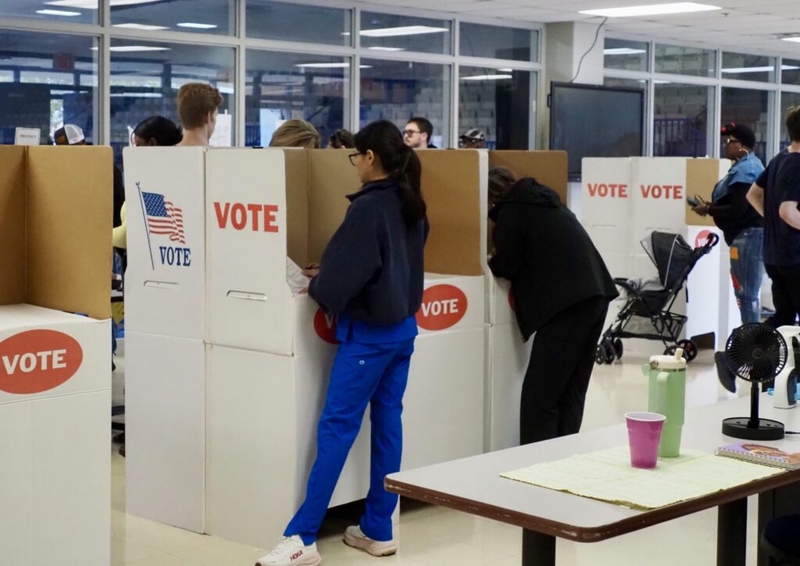
Voters fill out ballots for the midterm election at the Millwood Field House on Tuesday in Oklahoma City. Oklahoma voters rejected measure that would have capped annual increases in property taxes, one of a number of tax-related measures that were on the ballot in multiple states. (Photo by Emma Murphy/Oklahoma Voice)
Despite the blue wave that swept the nation on Tuesday, voters were more cautious about making sweeping changes to their taxes.
Most states with tax policy on the ballot saw voters reject large-scale change, though some passed smaller changes or reined in officials’ ability to make changes.
“Even though there are big political shifts on the federal level, people are generally feeling the same about taxes as they always have,” said Janelle Fritts, senior policy analyst at the Tax Foundation, a nonpartisan analysis and research organization.
One of the biggest examples: California’s much-discussed billionaire wealth tax looked likely to fail, with a ‘no’ vote of more than 55% by Wednesday morning. Proposition 40 is a measure no other state has tried: a one-time 5% tax on billionaires’ net worth to raise tens of billions to close budget holes in the state’s Medicaid, food assistance, education and other programs.
Opposition, led by California billionaires including Google co-founder Sergey Brin, raised more than $379 million to defeat the measure, outspending its supporters more than 250-1, The Washington Post reported.
But the campaign spending alone may not have fully accounted for its failure, Fritts said.
“The specific proposal had a lot of really strange structural issues,” she said, noting that it would have retroactively applied to any California resident who was a billionaire as of Jan. 1, 2026, and that it taxed everything a billionaire owned — from cars and yachts to art and collectibles — some of which could be difficult to place a value on.
“When people started understanding what was really in the bill, I think that was a deterrent,” she said. She expects it could influence similar efforts in other states to tax the wealthy.
Proponents of California’s billionaire wealth tax have already promised to try again.
Washington state voters appeared to be choosing to keep the state’s new millionaire tax, as a ballot initiative to repeal it was failing 58% to 42% by Wednesday morning. Earlier this year, Washington’s Democratic-led state legislature created a 9.9% tax on annual incomes above $1 million. The repeal measure, which failed to garner support in the state’s population centers, was a political victory for its champion, Democratic Gov. Bob Ferguson, according to the Washington State Standard.
“Washingtonians understood one thing,” Ferguson told a gathering hosted by a campaign opposing the measure, the Washington State Standard reported. “We’re not going to give tax breaks to millionaires when we can use those dollars to make life more affordable for working families all across the state.”
In Colorado, a sweeping income tax change remained too close to call Wednesday, though ‘yes’ votes had a slight lead. Amendment 87, if it passes, would hike taxes on the state’s highest-income households, and cut taxes for nearly everyone else by replacing the state’s flat 4.4% tax.
A ballot measure that would block Amendment 87 appeared short of the majority needed to pass, while a legislatively-referred measure to raise the revenue the state is allowed to keep appeared likely to pass.
Property tax wins, losses
Voters in Florida showed an appetite for change, overwhelmingly approving a constitutional amendment that will make one of the most significant alterations to their property taxes in decades.
Amendment 3 will gradually reduce Floridians’ property taxes — aside from those that benefit public schools — by increasing the state’s homestead exemption. That will let homeowners cut their property tax bills by exempting a bigger share of their home’s value from taxation.
The state GOP endorsed the amendment, but other groups — including law enforcement, child welfare advocates and municipal government officials — say it would blow a massive hole in local governments’ budgets. Florida’s state and local coffers could take a hit of up to $12 billion each year beginning in 2031, according to state projections.
“It will be a pretty big challenge for local governments,” Fritts said. “They’re going to have to shift a lot of things around.
“Not a lot of other states were willing to take as big a swing on property taxes as Florida,” she said.
Oklahoma voters rejected a measure that would have capped annual increases in property taxes. The state legislature proposed the initiative to address rising costs, but critics said it would hurt funding for public schools and other services. The state estimated local governments would have lost nearly $46 million in property tax revenue in the first year, had it passed.
Oklahoma House Speaker Kyle Hilbert, a Republican, said Tuesday night that the vote showed that Oklahomans “don’t want to see changes to property taxes, and so moving forward, we’ll take that into consideration,” the Oklahoma Voice reported.
In Wyoming, voters defeated a property tax cut initiative that would have exempted half of a primary residence’s assessed value from being taxed. Had it passed, Proposition 1 could have decreased the state’s annual property tax revenues up to $124.8 million, WyoFile reported. The initiative was opposed by a variety of groups including state hospital and education associations, as well as some Republican and Democratic officials.
Reining in government power
In North Carolina, voters approved both tax-related constitutional amendments.
The most controversial, which passed with 60% of the vote, will cap how much cities and other local governments can grow their revenue. It was a priority for Republican leadership focused on addressing constituent complaints over rising prices.
But critics say the new limits could torpedo local budgets, forcing local governments to cut services including public safety, libraries, parks and education, NC Newsline reported.
North Carolinians also approved a new maximum state income tax rate of 3.5% in a Republican-backed constitutional amendment that caps the rate for personal and corporate income taxes. Critics have said it will cement tax cuts that mainly benefit the wealthy and corporations.
An Iowa constitutional amendment to make it harder for state legislators to tinker with taxes looked as though it would pass. The GOP-backed measure would require a two-thirds supermajority of state lawmakers to raise personal or corporate income taxes.
The Iowa Capital Dispatch reported that Republican supporters argued the restriction was needed to preserve tax policies including 2025’s 3.8% flat-rate income tax.
But critics said it would lock in unsustainable tax cuts that mostly benefit Iowa’s wealthier households and could push the state to raise other taxes when it needs revenue, such as sales tax increases that have a bigger impact on low- and middle-income families.
In Massachusetts, a ballot measure that would change how the state’s tax revenue limit is calculated was still too close to call as of Wednesday morning. Current state law caps how much tax revenue the state can keep each year, and any extra beyond the cap is refunded to taxpayers as credits. But if voters approve the ballot measure, taxpayers would be more likely to get money back in a given year. Proponents say it would slow down state spending, while opponents have said it leaves less money available for public services.
Stateline reporter Anna Claire Vollers can be reached at [email protected].