Democrats won Congress. Now they have to figure out how to deal with Trump.
Nov 04, 2026 | 4:38 pm ET
Description
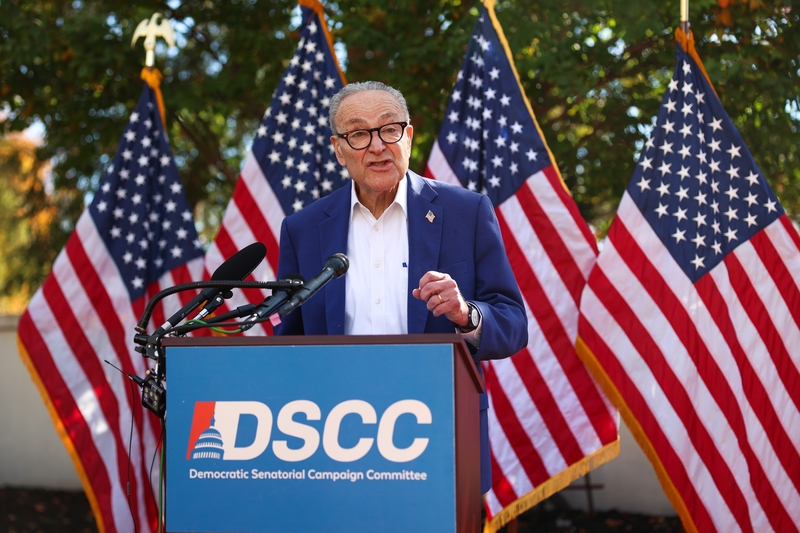
U.S. Senate Minority Leader Chuck Schumer, D-N.Y., speaks during a press conference at the Democratic Senatorial Campaign Committee headquarters on Nov. 4, 2026 in Washington, D.C. (Photo by Tom Brenner/Getty Images)
WASHINGTON — Democratic leaders in Congress have just a couple months to decide how they want to balance investigations into President Donald Trump and his administration with securing his signature on major bills to address the cost of living, a top concern for voters.
While Democrats gained control of the House and Senate in this year’s midterm elections, the party won’t hold veto-proof margins when the new session of Congress begins in early January. That will require congressional leaders and the president to find compromise on legislation.
Failure to do so would block any bills that could improve the lives of Americans from becoming law and potentially lead to more shutdowns, since Congress must fund the government every year.
House Democratic Leader Hakeem Jeffries, who will very likely become speaker in January, and Senate Democratic Leader Chuck Schumer, will set the tone for that relationship, though committee chairs will play a significant role as well.
Trump said during an impromptu press conference Wednesday in the construction zone for his White House ballroom that he will “get along, probably, with the Democrats unless they want to be destructive. But I have the power of the veto.”
Trump said he wasn’t concerned about Democrats potentially trying to impeach him for a third time.
“I think it would destroy the Democrat Party if they did that,” he said.
‘Trump’s supplicant Senate’
Schumer said earlier in the morning his top priorities will be to address the rising cost of living, to “clean up corruption in government” and act as a check on “Trump’s chaos at home and abroad.”
“This war must end,” he said. “And make no mistake, whenever Trump defies the will of the American people or the law, we will launch investigations, take him to court and entangle him in legislative razor wire. The days of Trump’s supplicant Senate are over.”
Trump said during his press conference that the war in Iran will continue until “whenever” he wants to end it.
Schumer said he’d share more details in the weeks ahead about what the Democratic majority will do come January, but added he hadn’t yet spoken to the president about how the two separate but equal branches of government might work together.
Democrats, he said, will use must-pass government funding bills to place guardrails on the administration and the war in Iran, though he didn’t say how he’d get the president to sign those bills.
“We are going to end the war,” he said. “We have some Republicans already who have joined us in ending the war and the founding fathers had the power of the purse as one of the ways of deterring a president who does war without the consent of the American people.”
Schumer sidestepped a question about whether he would try to eliminate the legislative filibuster, which has forced bipartisanship in that chamber for decades. The rule requires at least 60 senators vote to advance a bill before it can move onto final passage.
“The first thing we’re going to do is reduce people’s costs and work the legislative process so it does,” he said in response to the reporter’s question.
Schumer also declined to say directly whether Democrats will seek to impeach Defense Secretary Pete Hegseth, a process that would start in the House.
“Everyone will make their own interpretation of what it meant in terms of Hegseth,” he said, responding to a question about the election results.
Schumer intends to seek the role of majority leader, according to his office. No Democrats have announced they plan to challenge him, making the race unopposed.
Medicaid cuts targeted
Jeffries said during an afternoon press conference that Democrats “are ready, willing and able to find bipartisan common ground with the other side of the aisle as long as we can bring about meaningful change on the issues that matter. And that begins with decisively addressing the affordability crisis.”
But he also made clear House Democrats’ to-do list will begin with reversing changes and cuts to Medicaid, the state-federal health program for lower-income people, that Republicans included in their “big, beautiful” bill, as well as restoring the enhanced Affordable Care Act tax credits that lapsed at the end of last year.
Jeffries did seem to brush aside the possibility of impeaching Trump or Hegseth, responding to questions by asking if Hegseth was actually still around.
“I haven't had a single member of the House Democratic Caucus talk to me about impeachment,” he said. “We've been relentlessly focused on affordability and on accountability because the House is a separate and co-equal branch of government.”
House Democrats are likely to reverse Republicans' “hands off” approach to artificial intelligence and data centers with their majority.
California Democratic Rep. Ted Lieu said during the same press conference that it was a “bad decision” for Republicans to “let the AI industry run wild.”
“Two things will change next term,” he said. “We will hold public hearings on AI. We will pass legislation, reasonable guardrails on AI, and specifically data centers. You see huge pushback from the American people for the out-of-control AI industry.”
Republican leadership battle ahead
Republican leaders will play a role in brokering deals with Democrats, though Senate GOP lawmakers will have more influence than their House counterparts.
House Democrats will be able to pass most legislation with a simple majority vote. But in the Senate, Democratic leaders will still need to garner some level of bipartisan support to advance bills unless they eliminate the procedural step that requires at least 60 senators to vote to move toward final passage.
Senate Republican Leader John Thune, R-S.D., plans to run for another term heading up his party in that chamber, though this time as minority leader, according to a spokesperson.
Thune, first elected to the Senate in 2004, rose through the ranks of Senate GOP leadership before taking over as majority leader this Congress. That gives him two years of experience negotiating floor schedules and amendment debate with Schumer.
In the House, Speaker Mike Johnson, R-La., plans to step down from leadership rather than try to stay in the top spot, which will be minority leader for the GOP next year, according to a spokesperson.
Louisiana Rep. Steve Scalise, currently the majority leader, and Ohio Rep. Jim Jordan, chairman of the Judiciary Committee, are both running for that role.
An individual familiar with Scalise’s plans told States Newsroom his “number one goal will be to lead the conference back into the majority. He is a proven and tested leader who is ready on day one. He’s spent his career unifying Republicans, and he is prepared for the big legislative and oversight battles ahead. The conference knows him, how he fights, and that he’s a trusted leader.”
Jordan wrote in a letter to his fellow House Republicans that the party “must learn” from the results of this year’s election as it looks forward.
“I am battle-tested on the oversight front and I know the Democrats' playbook. I know what it will take to lead our Conference in the minority, to stay unified, and to coordinate and calibrate our response to the Democrats' tactics,” he wrote.” We need a Leadership team that is active and engaged, forward-thinking and straight-shooting.”
Scalise has been a member of the House since May 2008 and a member of House GOP leadership since 2013, first as whip then as leader.
Jordan was first sworn in as a member in January 2007. He became chairman of the Judiciary Committee four years ago.
Trump said he planned to “stay out” of that race and that he didn’t ask Johnson to step aside as the leader of House Republicans.
Those elections are expected in mid-November. Whoever House Republicans elect will set the tone for when to negotiate legislation with Democrats and when to try to block bills from passing that chamber.
All States Newsroom content is free to republish. Read our republishing policy for more information.