Colorado voters reject measures requiring mail-ballot ID numbers, ICE cooperation
Nov 04, 2026 | 4:15 pm ET
Description
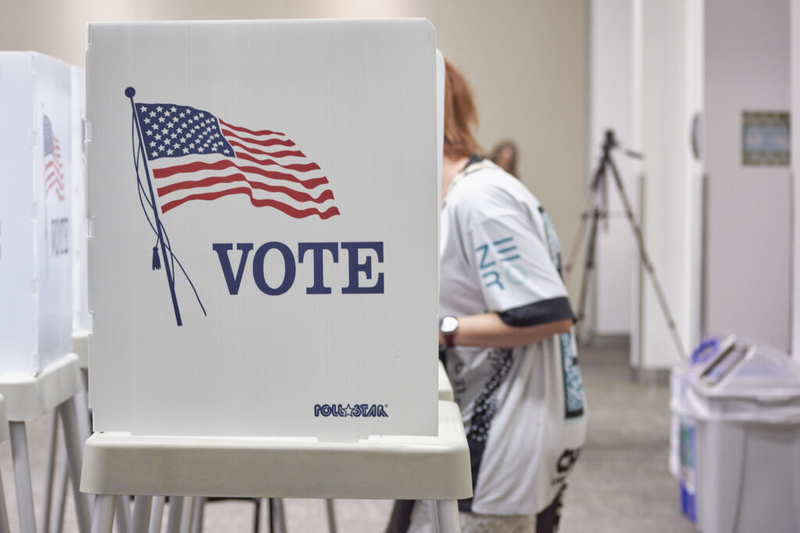
Voters cast ballots in the Adams County Government Center, Brighton on Tuesday. (Photo by Andrew Fraieli/Colorado Newsline)
Colorado voters on Tuesday rejected a ballot measure that would have required them to put part of their Social Security number or other identifying information on mail-in ballots.
The Associated Press said at 10:18 p.m. on Election Night that Amendment 84 failed. As of midday Wednesday, 63.4% of voters were against the measure. The numbers in this story are current as of 1:20 p.m. on Wednesday.
Colorado voters would have needed to write the last four digits of their Social Security number, Colorado driver’s license or identification card on their mail-in ballot envelopes under the constitutional amendment. It was backed by the Coalition for American Prosperity and Growth, and supporters said it would encourage election security by making sure every ballot belongs to the right voter.
But groups including the League of Women Voters and Colorado Common Cause said it wasn’t necessary for voter verification, and people could be wary of having their ID numbers so visible.
It is 1 of 6 measures with definite results so far as counties continue processing ballots. Voters also approved Proposition 133 to require life sentences for child sex trafficking crimes and Proposition NN to redirect more tax revenue to public education, according to The Associated Press.
They rejected other constitutional amendments to require coordination with immigration enforcement, enshrine the right to buy and sell natural gas, and create a new right to hunt and fish in the state.
Colorado voters had 14 ballot measures to decide this year, one of the highest number of questions put to voters in the last five decades. Nearly all were citizen-led initiatives that garnered enough petition signatures to make it onto the ballot.
A handful of this year’s measures were brought by Advance Colorado, a conservative “dark money” group that doesn’t disclose its donors. Republicans have increasingly relied on ballot measures to promote policy ideas in the state, as their influence in statewide offices and at the state Legislature dwindles under Democratic control.
Most of the Advance Colorado measures are on the path to defeat.
A right-leaning group, Protect Kids Colorado, pushed three ballot measures this year. The group was founded by an anti-trans activist from Larimer County, and this is the first election cycle it ran propositions. All three of those measures were winning as of Wednesday at noon.
Constitutional amendments require 55% of the vote to pass, while statutory measures need a simple majority.
Amendment 81
Amendment 81 was backed mainly by Advance Colorado. It would have expanded Colorado’s local law enforcement’s role in immigration enforcement and require local police to notify U.S. Department of Homeland Security if they charge someone known to be “not lawfully present” in the country, or if “the status of the person’s lawful presence is unknown” and the person has a previous violent criminal conviction or felony conviction.
Colorado’s Democratic-led Legislature has passed a handful of laws limiting state and local law enforcement’s cooperation with federal immigration enforcement.
The amendment was opposed by a coalition of district attorneys in the state.
The AP said at about 1 p.m. Wednesday it failed, when 55% of voters were against it.
Amendment 82
Amendment 82 would have enshrined the right to buy and sell natural gas in the state’s constitution, and it came amid growing state policies that limit the use of natural gas. Phasing out natural gas aligns with Colorado’s climate goals, and some cities like Denver have passed ordinances requiring new commercial buildings to use electric space and water heating.
This was an Advance Colorado ballot measure.
The AP said the amendment failed when 53.9% of voters were opposed.
Amendment 84
Under Amendment 84, Colorado voters would have needed to write the last four digits of their Social Security number, Colorado driver’s license or identification card on their mail-in ballot envelopes under the constitutional amendment.
The AP said the amendment failed.
Amendment 83
Amendment 83 proposed a constitutional right to hunt and fish in the state. Proponents said it would protect hunting from wildlife advocacy efforts, while opponents worried the language could undo bans against such methods as steel leghold traps and luring bears. The amendment was championed by the out-of-state organization International Order of T. Roosevelt in Wisconsin.
The Colorado Parks and Wildlife is in charge of regulating hunting in the state. It has 11 members appointed by the governor and confirmed by the state Senate.
Twenty-four states have a similar constitutional amendment, with Florida voters most recently approving the language in 2024.
Voters rejected it, and the AP declared it defeated when 55.2% of the vote was against it.
Amendment 85
Amendment 85 seeks to make Colorado’s ballots easier to read by requiring questions to be written at an eighth-grade reading level. It was put on the ballot by Advance Colorado, and supporters said it would increase understanding in elections.
The amendment did not define what an eighth-grade reading level actually means, so stakeholders worried that vagueness would make it difficult to actually implement.
There are about 50.8% of the votes in favor of Amendment 85 so far, below the required 55% threshold.
Amendment 86
Amendment 86 was a response to the rush of states that redrew their congressional district lines this year to give one political party an advantage. It would require any mid-decade redistricting to be approved by the state’s independent redistricting commission and the Colorado Supreme Court. Redistricting typically happens the year following a census.
Earlier this year, a Democratic-aligned group tried to get a ballot measure approved to allow mid-decade gerrymandering, but a court blocked it. Advance Colorado backed Amendment 86 in response to that attempt.
About 53.4% of the vote so far is against the amendment.
Amendment 87
Amendment 87 would amend the Taxpayer’s Bill of Rights to create graduated income tax rates, so the rate increases with income levels. Individuals and companies making more than $500,000 per year would see their income tax rate rise, maxing out at 8.4% for people making over $1 million, while those making less will see it drop. It was backed by Protecting Colorado’s Future, a coalition of progressive and liberal advocacy groups.
The amendment faced a last-minute court challenge by a person who claimed paid signature gatherers did not properly register with the state. Denver District Court and the Colorado Supreme Court both decided it should stay on the ballot.
A bit over 50% of voters approved the amendment so far.
Proposition NN
Proposition NN asked voters to raise the limit the state can keep under TABOR and send that money to public K-12 education. It was the only ballot measure referred to voters by the state Legislature. The Colorado Education Association led the campaign for Proposition NN and argued that while it wouldn’t fully close the state’s education funding gap, it would get spending closer to the true cost of educating students today.
Conservatives were against the proposition and saw it as an attack on TABOR.
According to the AP, it passed with 55.4% of the vote.
Proposition 132
Proposition 132 would make it a felony to manufacture, distribute or sell a list of synthetic opiates, including fentanyl, and imposed an eight-year mandatory minimum sentence. That would be a significant increase of current criminal penalties. It also would remove a provision in state law that gives immunity to felony prosecution for those offenses to people who report an overdose to authorities.
It was backed by Advance Colorado and other conservative activists and politicians, including Republican District Attorney George Brauchler. A coalition with groups like ACLU of Colorado, Colorado Criminal Justice Reform Coalition and the Signal Behavioral Health Network were opposed to the proposition.
It is currently passing with 52.7% of the vote.
Proposition 133
People convicted of child sex trafficking will receive a life sentence without parole under Proposition 133. Child sex trafficking is already a felony in Colorado. The AP called the race around 9 p.m. on Election Day. About 62% of voters were in favor of the measure.
The proposition also expands the definition of human trafficking of a minor for sexual servitude to include trading anything of monetary value to buy or sell sexual activity with a minor.
The measure was backed by Protect Kids Colorado. Supporters saw the stronger penalty as a deterrent. Opponents, such as the Colorado Coalition Against Sexual Assault and the Colorado Organization for Victim Assistance, said the measure could inadvertently imprison victims who can be pressured into helping their own traffickers target more people.
Proposition 134
Protect Kids Colorado backed Proposition 134 to require student athletes to play on sports teams that correspond to their sex assigned at birth, so a transgender girl would be excluded from playing on a girls sports team. Schools would need to adopt a policy that classifies teams as male, female or co-ed. Transgender students would be able to play on co-ed teams.
There are 27 states that ban trans girls from competing in girls sports.
But Colorado is generally considered one of the most trans-friendly states. Groups like One Colorado, the Bread and Roses Legal Center and Rocky Mountain Equality campaigned against the proposition.
Around 52.4% of votes approve the measure so far.
Proposition 135
The third measure backed by Protect Kids Colorado would ban surgeries on minors “for the purpose of altering biological sex characteristics.” It defines those surgeries as treatment related to the child’s “perception” of sex or gender.
Those surgeries are rare for transgender youth in Colorado and across the country and Children’s Hospital Colorado and UCHealth, two major providers of gender-affirming care in the state, have never performed surgeries for transgender minors. It is more common for those patients to undergo gender-affirming care like puberty blockers, counseling and social transition.
The proposition is passing so far with 51.9% of the vote.
Proposition 136
Proposition 136 was Advance Colorado’s answer to Amendment 87, the graduated income tax measure. It would cap the state’s income tax at the current 4.4%. It was losing with 52.7% of votes against it as of Wednesday afternoon.
Proposition 137
Proposition 137 would divert some existing sales tax revenue from sporting goods to wildlife mitigation and land protection. The measure would reduce taxpayer refunds in some years. The race is still very close with 50.3% in favor.
Denver, CO