Voters to decide if Montana judiciary needs to be more political
Oct 06, 2026 | 2:13 pm ET
Description
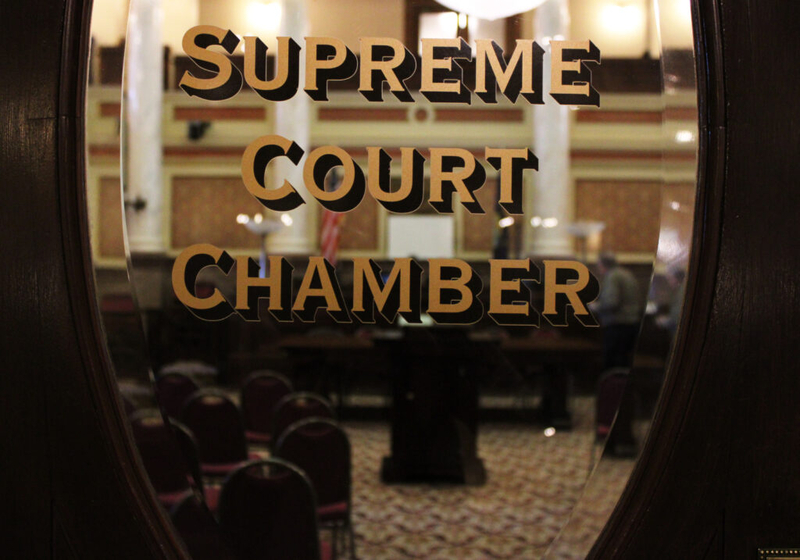
The door to the old Supreme Court Chamber at the Montana Capitol. (Micah Drew/Daily Montanan)
Barely a month after the 2025 Legislature, multiple organizations began efforts to put nonpartisan judicial elections in Montana’s Constitution.
The groups, which eventually folded together to bring a unified nonpartisan judicial initiative to November’s ballots, were responding to a push by conservative Republicans in the state Legislature, as well as Gov. Greg Gianforte, to make elections for district and supreme court justices partisan by having district judge and supreme court justice candidates state their political parties in elections.”
Eight states in the U.S. elect Supreme Court justices in partisan elections, and nine do so for at least one lower level court, but 13 other states prohibit judges from having a political affiliation on the ballot.
Montanans for Nonpartisan Courts seeks to preserve the status quo in the state with Constitutional Initiative No. 132 which would add the following to Article VII of the state constitution:
Nonpartisan Judicial Elections. Judicial elections shall remain nonpartisan.
In Montana, elections for district and state supreme court seats have been nonpartisan since 1936.
During the 2025 Legislature, more than a half dozen bills were debated adding degrees of political identification into the judicial process — including several that sought to change the entire process to a partisan election.
Only one bill became law, now allowing political parties to donate directly to a candidate.
At the end of the session, Republican leaders said they laid the groundwork for further action in 2027.
Proponents of letting judges run with a Republican or Democratic party affiliation say that the races are already partisan, and judges have their own biases; aligning with a political party gives voters more transparency and information about what are typically low-profile elected positions.
Those supporting keeping the status quo of nonpartisan elections argue that courtrooms should focus on the law and the constitution, and politics should not enter the equation, at the risk of coloring every decision.
In his State of the State address to the Legislature in 2025, Gianforte encouraged legislators to send a bill to his desk that “empowers Montana voters to know a judicial candidate’s political party.”
“Montanans have a right to know the values and principles of the judges they elect,” he said. “Let’s bring light to this darkness.”
At the same legislative address, Montana Supreme Court Chief Justice Cory Swanson, one of the more conservative voices on the bench, defended the nonpartisan judicial process, saying he believed a judge’s commitment should be to decide “every case based on the facts and the law of the case, not based on the party of the affiliations of the litigants.”
He said the three branches of government by necessity need to remain independent and separate to properly balance the others; and most judicial work has nothing to do with party affiliation.
The Kalispell Chamber of Commerce recently endorsed the initiative, citing the need for businesses to have “fair, impartial and consistent” rulings.
“Business owners depend on the consistent application of the law so they can operate in a predictable environment that helps them create jobs and keep costs down,” Chamber CEO Lorrain Clarno said. “We need to keep politics out of our courts so our businesses can continue to contribute to the economic prosperity and sustainability of our community.”
The Montana Republican Party officially opposes the initiative and passed a resolution earlier this year formalizing its stance that the current process serves “only to obscure politics.”
Montanans for Nonpartisan Courts has earned endorsements from nine former Supreme Court justices and three dozen former district court judges.
The organization has received support from state organizations including Wild Montana, Montana Conservation Voters, the Montana Trial Lawyers Association and the Montana Federation of Public Employees, which also has donated more than $100,000 to the effort.
National groups have also poured money into backing the initiative, including the American Civil Liberties Union ($1,500,000); a democratic-leaning nonprofit organization American Opportunity Action ($700,000); National Education Association ($825,000) and others.
The Secretary of State publishes the Montana Voter Information Pamphlet, which allows proponents and opponents of ballot initiatives to share their perspectives.
In it, opponents of CI-132, including Derek Oestreicher with the Montana Family Foundation, and constitutional scholar Rob Natelson, pan the money coming from “out-of-state special interests” as trying to pull a fast one on Montanans.
They say that judges are human, likely have political party preferences, and putting those in the open will help voters understand the candidates better, instead of voting “with a blindfold on.”
Proponents of the measure point out that judges handle civil and criminal cases such as traffic, family, property or employment disputes. Proponents of the measure argue mixing politics will “hurt Montanans who just want an unbiased, fair hearing.”
Constitutional Initiative No. 132 would amend the Montana Constitution to add the following to Article VII:
Nonpartisan Judicial Elections. Judicial elections shall remain nonpartisan.
Voting YES on the initiative will add that section to the state constitution. Voting NO on the initiative will not add it to the constitution, but will not change how elections for judicial seats take place.
Helena, MT