Jonanthan Nez bets on ‘buyer’s remorse’ in rematch against Eli Crane in rural Arizona
Oct 06, 2026 | 12:45 pm ET
Description
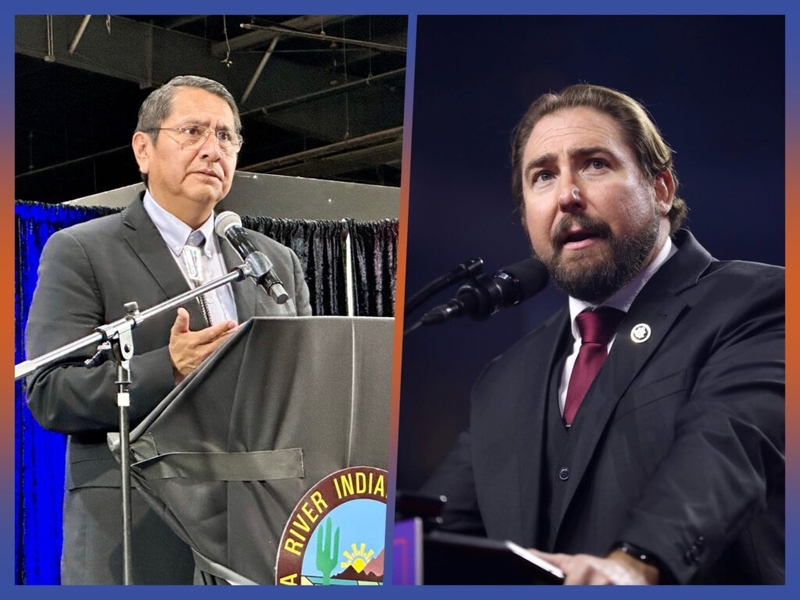
Democrat Jonathan Nez (left) and Republican U.S. Rep. Eli Crane (right) are vying to represent Congressional District 2. Photos by Shondiin Silversmith/Arizona Mirror and Gage Skidmore/Flickr via CC BY-SA 2.0
Republican incumbent U.S. Rep. Eli Crane, a member of the far-right House Freedom Caucus, handily won a second term in his rural congressional district in 2024. He’s remained loyal to President Donald Trump, even as his approval ratings have been in a freefall for much of the past year.
But Jonathan Nez, the Democrat and former president of the Navajo Nation who Crane defeated by nine percentage points two years ago, Crane won’t be so fortunate in this year’s rematch.
“In the last cycle, the independents went for Trump and Crane and the Republicans,” Nez told the Arizona Mirror in an interview. “So, there is a lot of buyer’s remorse.”
Voter attitudes about Trump and the Republican Party have cratered in the past two years, according to public polling. The Nez campaign is leaning into that, focusing on Crane’s votes to continue the Iran War, give tax breaks to companies that build data centers and cut food assistance and healthcare programs.
“My opponent has made some very bad decisions in supporting legislation that is negatively impacting the quality of life in our district,” Nez said.
Crane voted last year for President Donald Trump’s “One Big Beautiful Bill Act,” which made massive cuts to the Supplemental Nutritional Assistance Program and to Medicaid. But even with those spending reductions, the cost of the tax cuts in the bill is expected to increase the national debt by $4.7 trillion.
Crane has repeatedly voted to allow Trump to unilaterally go to war with Iran — a conflict now in its eighth month — and has scrubbed his website of his previous opposition to spending money on foreign “forever wars.”
Crane’s campaign did not respond to multiple requests for interviews.
“Instead of funding forever wars and throwing away money we don’t have, Eli believes we should be focused on taking care of those who risked it all for our freedom,” Crane’s site said as recently as July under the heading “fighting for those who fought for us.”
The site was changed this summer, and deleted his opposition to “forever wars” in favor of promising to fight “fraud-ridden nongovernmental organizations” and declaring that “we should be focused on taking care of those who risked it all for our freedom.”
A former Navy SEAL, Crane has spoken against spending money to fund overseas wars during his time in Congress.
Nez described this change as another example of a politician courting rural voters during election season and then ignoring them after taking office.
“The frustration is that they have been lied to and ignored for way too long,” Nez said. “Last election, there was a big campaign about America First. And I ask people, ‘Do you all feel like America’s first right now?’ A supermajority of the people say ‘no’. And they feel it. Look at the gas prices right now.”
Gas prices in Arizona have shot up by about 45% since the start of the war in February, and now sit at an average of about $4.75 per gallon.
Promises to deliver affordability were tenets of many successful Republican campaigns in 2024, but Trump’s tariffs, along with the Iran War, have only driven up costs further.
“You see those high gas prices throughout the state and this district,” Nez said. “And people are feeling the negative impact on our economy. And it goes back to people that are in office.”
This country is really divided. The loud ones are the far right, the far left. I think the quiet ones are right in the middle. And the majority is right in the middle, where people want everyone to work together to get things done.
While Nez still faces an uphill battle in his campaign to win a district where Republicans have an 11-percentage point voter registration advantage, a poll commissioned by his campaign in August showed him in a statistical tie with Crane. The poll of 500 likely voters in CD2 found that 46% favored Crane to Nez’s 44%, with 10% undecided.
The poll gave Nez a 22-point edge with independent voters, whose support he needs to win the race.
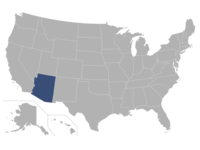
The district is the Grand Canyon State’s largest, stretching from south of Phoenix to the borders of New Mexico in the east and Utah in the north, encompassing much of eastern and northern Arizona.
It covers about 60% of Arizona, and tribal land makes up a large portion of it. The district includes 14 tribes in northern, eastern, and central Arizona, and those tribal members make up about 20% of the district’s total population.
Crane’s campaign is working to appeal to Native voters by touting his accomplishments, including the introduction of the Yavapai Apache Water Rights Act last December, which he sponsored alongside mirroring legislation in the U.S. Senate that was introduced by Democrats Mark Kelly and Ruben Gallego.
If Nez ekes out a win in November, he’ll be the first Native American to represent Arizona in Congress. Nez grew up on the Navajo Nation and was elected to three terms as a delegate to the Navajo Nation Council before a successful run for Navajo County supervisor. In 2018, he was elected president of the Navajo Nation, but lost his reelection bid in 2022 to Buu Nygren.
His 20 years in public office have helped him form connections with bureaucrats and local government officials that Nez said will help him accomplish things for the people of his district even if Republicans maintain control of Congress, and with Trump in the White House.
“I wouldn’t start the day that I get sworn in,” Nez said. “I would start after we win this election by bringing federal agencies together and to start talking with the local elected leaders.”
Some solutions don’t necessarily require legislation, he said, including ensuring protecting Arizona’s share of Colorado River water and working with the Bureau of Land Management to protect public lands from wildfires.
Crane grew up in Yuma and dropped out of the University of Arizona to join the U.S. Navy shortly after the Sept. 11 terrorist attacks. After 13 years in the Navy and six deployments, Crane co-founded Bottle Breacher, a company that sells bottle openers made from used bullet casings. Crane and his wife took the business on the TV show “Shark Tank” in 2014, and sold the business in 2022.
During his time in office, Crane has introduced legislation focused on veterans, the military, public lands, natural resources and immigration.
Crane has accused Democratic Gov. Katie Hobbs of failing to protect the state’s Colorado River water allocation and criticized Nez for “standing alongside her.” The fight for the Colorado River is a legal battle that’s been going on for more than 100 years, based on complicated historical legal agreements that divides the water among seven states, numerous Indigenous tribes and Mexico, and hundreds of individual users within those.
Nez accused Crane of failing to do enough to bring federal money into his district, pointing out that Crane lives in Oro Valley, which is in Congressional District 6. Nez said that Crane was too extreme for most Arizonans, and promised to listen to the needs of rural and Indigenous Arizonans.
“This country is really divided,” Nez said. “The loud ones are the far right, the far left. I think the quiet ones are right in the middle. And the majority is right in the middle, where people want everyone to work together to get things done.”
Phoenix, AZ