Vantage points. The view from where a NC county election director sits.
Oct 26, 2026 | 2:25 pm ET
Description
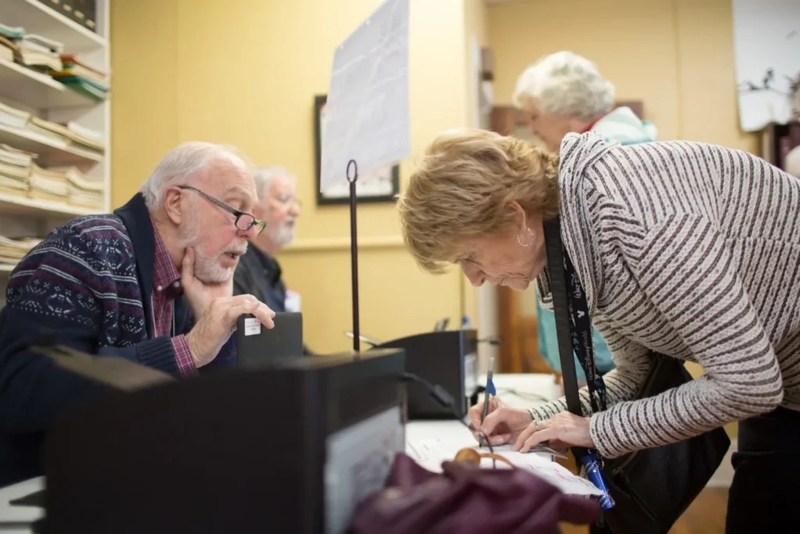
Gay Ferguson, right, speaks with election official Carter Blaisdell prior to voting at the First Baptist Church of Black Mountain polling place on March 3, 2020, in Buncombe County. (Photo: Colby Rabon / Carolina Public Press)
In the first eight days of early voting, Wake County Election Director Olivia McCall has seen 70% higher turnout than in the 2022 midterm election.
It’s “unprecedented,” she said. But it’s too early to tell whether the higher turnout foreshadows record-breaking overall turnout or excitement around early voting, she added.
That’s the story across the state. In Mecklenburg County, turnout is about 45% higher than at the same point in the 2022 election, according to Election Director Michael Dickerson. He said he expects Election Day voting to go down as a result.
In Cabarrus County, turnout is up “significantly,” said Election Director Carol Soles. There’s record-breaking turnout in Buncombe County — a nearly 60% increase from 2022 and a 23% increase from the previous 2018 record, as of Friday, Oct. 23.
In Jackson County, turnout topped 15% by Friday.
“Everybody seems to be pretty steady,” Election Director Amanda Allen said. “Not in a presidential kind of year where we would have lines of people waiting back to back, but it has been pretty consistent at most of our sites.”
According to State Board of Elections data, it’s not just the raw numbers that are up. Through the second Sunday of early voting in 2022, 15.7% of registered voters had cast ballots. This cycle, it’s increased to 20.1%.
Election directors on absentee voting
While early voting numbers are high across North Carolina, absentee voting is down 34%.
In Buncombe County, there were only 6,700 absentee ballot requests; in 2022, about 7,500 voters returned ballots. Election Director Corinne Duncan attributed the shift to getting further away from the COVID pandemic years.
“2020 was gigantic,” she said. “Everyone figured out that absentee was an option, and then it’s been kind of dropping since then.”
While President Donald Trump’s calls to change the mail-in voting process have failed thus far, some voters may be avoiding absentee voting because of the resulting uncertainty. Absentee votes also may take longer to get from voters to their county election boards due to the USPS’ transition to centralized regional processing and distribution centers. North Carolina does not have a grace period; all non-military and overseas ballots must be returned by 7:30 p.m. on Election Day to count.
Another factor potentially contributing to lower absentee voting may be new North Carolina State Board of Elections guidance concerning how to count mail-in ballots.
When voters get an absentee ballot, there are two envelopes. They are supposed to place their ballot in an inner, container return envelope, attach their photo ID photocopy to an attached sleeve, and place that all in an outer return envelope. Both envelopes should be sealed. Before this year, the State Board advised county boards to count ballots when only one of these envelopes was sealed, as long as the ballot was inside a sealed envelope.
But after a lawsuit and much debate, the State Board changed its guidance this cycle. Now, if either envelope is unsealed, regardless of whether the ballot is inside a sealed envelope, the absentee ballot must be spoiled and reissued.
McCall said they’ve spoiled 277 ballots, or 3.5% of all absentee ballots, as of their last board meeting on Tuesday, Oct. 20. Of those spoiled ballots, 147 were related to the new guidance, and 53 of those voters either decided to vote in person instead or already returned their replacement ballots.
Dickerson said they’ve spoiled 260 ballots based on envelope sealing, and about 60 have returned replacement ballots or voted in person. Duncan said the Buncombe County election board has spoiled 24 ballots based on envelope issues. In other, smaller counties, election directors reported that the envelope sealing guidance change had little to no effect.
Early voting drama
State and county election boards made several changes to early voting plans this cycle, following the mid-2025 shift of election boards from majority Democratic to majority Republican. Many counties axed Sunday voting, shifted weekend hours to Saturdays and moved around early voting sites.
Under current North Carolina law, the state auditor appoints members of the State Board of Elections and the chairs of county election boards. He also hired an election liaison, Dallas Woodhouse, to communicate with local boards.
However, Woodhouse caught flack for allegedly pressuring election officials in several counties to select certain early voting plans, according to public records. Woodhouse resigned after the issue got widespread news media attention.
In Jackson County, Republican board member Jay Pavey spoke out about pressure from “Raleigh” during an early voting planning meeting. Fellow Republican board member Wes Hanemayer resigned over the issue. During the primary, the board removed a long-standing early voting site from Western Carolina University. Pavey said he was pressured to also exclude a WCU site from the general election, but he did not agree with that plan.
The county board ultimately voted 3-1 to keep an early voting site on WCU’s campus, with Republican chair Bill Thompson preferring a plan using the Cullowhee Recreational Center instead of the WCU site. The State Board ultimately found a middle ground, and included both sites in Jackson County’s final plan.
Director Allen said they were anticipating four sites, not five sites, but that they always leave a little budgeting room for unexpected changes.
“You never know if those plans will change, if things will get more expensive,” she said. “We’ve had years where we’ve had to reprint ballots, so there is some flexibility in our budget.”
The WCU site — which is located on the outskirts of campus at the Health and Human Services building, compared to the more centrally located WCU early voting site in 2022 — has been widely popular, according to an analysis by WCU political scientist Chris Cooper.
In 2022, the WCU site had 448 voters through the first week of early voting; this year, it had 1,200. The county’s other early voting sites have only small shifts from the last midterm election, including the Cullowhee Recreation Center, whose turnout numbers are slightly down from 2022.
While Wake County had a unanimous early voting plan, board members disagreed over where to place a North Carolina State University early voting site. Democrats wanted the site to remain at the NC State Talley Student Union, in the center of campus, while Republicans preferred the Western Boulevard Business Services site, which is further away from central campus but has more parking.
According to Wake County election data, the new site has had higher turnout than the student union site, but that may be due to overall higher turnout. The Western Boulevard site has the 14th-highest turnout of the county’s 18 early voting sites.
Students at North Carolina Agricultural & Technical State University and University of North Carolina-Greensboro have been marching to the nearest polling site after election boards denied their request to add early voting sites on their campuses.
While both universities have hosted early voting during presidential elections, they have never had midterm early voting sites.
The closest site to both campuses is Union Square, a new site suggested by the county election board. For a site they’ve never used before, Election Director Charlie Collicutt said, it’s experiencing decent turnout.
After a Thursday march to the polls, 369 people voted at the site, he said.
“It doesn’t seem like a lot, but what I think is important is a lot of them were students,” Collicutt said. “And of that, nearly 100 did a same-day registration, and about 47 did an address change.”
Collicutt said election workers — and even county commissioners, who are not involved in election decisions — have been fielding calls and emails about the early voting decision after videos of the students’ marches have gone viral.
“I’ve seen a lot of different area codes I don’t recognize, and people from all over the place,” he said.
He wants to remind students that while there are no campus early voting sites, there will be campus Election Day sites they can utilize.
How does 2026 feel different?
Voters this cycle are “extremely friendly,” but feel “a little more determined” than in previous years, said Haywood County election director Robert Inman.
McCall noted that voters seem more informed, particularly about the need to bring a photo ID to vote.
Most election directors said they hadn’t noticed much misinformation circulating so far, but expected it to come soon.
Inman said some voters expressed concerns about voting technology after Dolly Parton’s sister, Tennessean Stella Parton, claimed her voting machine switched her vote.
“I just take people at their word,” Inman said. “What I’ve done is gone through our equipment. We properly tested our equipment, and the functionality was doing exactly what it was supposed to do during testing, and up until now has not been an issue.”
Putting on an election is “like putting on the Olympics or the Super Bowl,” Inman said. It requires year-round preparation to pull off a twice-a-year event.
One of the biggest pieces of the puzzle is staffing enough poll workers to run early voting and Election Day sites. Every cycle, that gets harder and harder, Inman said. Generally, the pool of workers is older, which is becoming an issue. Inman said they need younger people to start signing up.
“It’s time for them to step up,” he said. “Not just students, but younger professionals, younger people. You can take a day off for this kind of work, and then the more of you who do that, the conspiracy theories will kind of diminish and go away because you actually know what’s happening.”
In Mecklenburg County, Dickerson said, they have between 800 and 900 people trained to run early voting sites, and 3,400 lined up for Election Day.
In Jackson County, Allen said they go from about four full-time election workers to 150 employees during election season. The majority of the workforce is retired people, who are beginning to encounter health issues and caregiving needs, she said. However, they recruited 30 new workers this year, which Allen said was “exceptional.”
Election director turnover is common in North Carolina.
Jones County interim election director Sheila Garner started her job this September. The previous director, Jessica Taylor, started the September before the 2024 election.
Once a week, a State Board employee comes in to help Garner, who said Taylor and the county board members are also supportive. But she is in a one-person office right now. She said her biggest obstacle is trying to learn everything she doesn’t know, from what precincts they need on Election Day to how to navigate the software system.
Pasquotank County Election Director Janae Hedgepeth also started shortly before the 2024 election. Now, this will be her sixth election. She said everything is running smoothly.
“Elections, you learn something new every day,” she said. “What you thought you knew, you didn’t know. Now that part doesn’t change, but I feel more comfortable.”
While every election has its “pet issues,” Duncan said she feels like Buncombe County election administration has hit its groove. Right now, they’re dealing with more attention on election changes and more changes to voter registrations in between cycles. But change is normal in the election world, Duncan said. She said voters should feel comfortable coming to them.
“Election officials are your neighbors,” she said. “They’re the people that you see at the grocery store. You can come to the office and see us. If you have any questions, we’re here for you.”
Collicutt also feels the heightened attention on elections in Guilford County, particularly for a midterm year.
“There’s more pressure that I feel from voters, from the people watching, from the people that are more invested in watching the behind the scenes mechanisms of how things work that I don’t normally get in a midterm election, and so that can feel a little bit more like a presidential year,” he said.
This article first appeared on Carolina Public Press and is republished here under a Creative Commons Attribution-NoDerivatives 4.0 International License.

Raleigh, NC