Utah Supreme Court Justice Jill Pohlman on track to keep her place on the bench
Nov 03, 2026 | 11:16 pm ET

Description
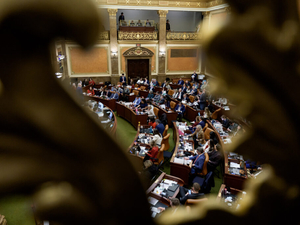
Jay Jorgensen (left) greets Utah Supreme Court Associate Chief Justice Jill Pohlman after a news conference announcing Cox's appointment of Jorgensen and Stephen Dent to the Utah Supreme Court at the Utah Capitol in Salt Lake City on June 2, 2026. (Katie McKellar/Utah News Dispatch)
Preliminary election night results show Utah Supreme Court Associate Chief Justice Jill Pohlman got about 78% of the vote, putting her on track to keep her seat on the state’s highest court.
Of the 51 judges up for retention this year, nearly all were on track to keep their jobs in the courts — but one, Weber County Justice Court Judge Trent Nelson, was denied another term, according to unofficial election night results. Nearly 55% voted against retaining him, while about 45% voted in favor.
Nelson was the only judge who did not pass the Utah Judicial Performance Evaluation Commission’s assessment, and he was the only one the commission recommended not be retained.
Pohlman, first appointed in 2022 by Utah Gov. Spencer Cox, was the only Utah Supreme Court justice up for retention election this year after former Justice Diana Hagen resigned amid controversy earlier this year.
Pohlman is also one of two remaining women on the court — which flipped from a female majority to a minority after the Utah Legislature revamped it, expanding it from five to seven seats.
The court has also seen dramatic turnover in the past year, not only due to Hagen’s resignation but also because of the retirements of former Chief Justice Matthew Durrant and former Associate Chief Justice John Pearce.
Senate confirms 2 more Utah Supreme Court justices, capping off era of change for the court
Utah Gov. Spencer Cox and the Republican-supermajority Utah Senate filled all of those openings on the bench — plus the two expanded seats — with five men.
Pohlman was targeted by the Utah Republican Party and other conservative organizations this election season for joining in rulings against the GOP-controlled Legislature in two high-profile cases over redistricting and abortion.
One was an anti-gerrymandering lawsuit over Utah’s 2018 voter-approved ballot initiative that banned partisan gerrymandering and created an independent redistricting process. That case has resulted in this year’s court-ordered congressional map.
The other, brought by Planned Parenthood Association of Utah, has so far blocked the state’s near-total abortion ban from taking effect.
During the Utah GOP’s nominating convention in April, party Chair Rob Axson urged state delegates to vote against retaining both Pohlman and Hagen — before Hagen resigned while under pressure from state leaders calling for an independent investigation into previously dismissed allegations that she had an affair with an attorney representing plaintiffs in the redistricting lawsuit.
“We’re coming for you,” Axson said during the convention in April. “Justice Hagen and Justice Pohlman, go find a job in the private sector. We don’t want you anymore.”
Ex-Utah Supreme Court justice urges voters to retain judges amid push to unseat her former colleague
Axson told Utah News Dispatch after results posted Tuesday night that he wasn’t surprised that Pohlman kept her seat, saying judges losing in retention elections is extremely rare in Utah.
“It’s very difficult to do,” he said, adding that whenever it does happen it’s because of “absolute negligence.”
While Axson said he “adamantly” disagrees with some of Pohlman’s decisions, “that was always going to be an uphill battle.” He said he hopes this year acts as somewhat of a wake up call for Utah’s judiciary.
“My hope is that all members of the judiciary take very seriously not the will of the people, not the public opinion — because they should be separate from that,” he said. “But they should be grounded in textual, original perspectives, because our Constitution means something.”
Axson also acknowledged that Hagen’s resignation relieved some of the pressure from the GOP’s campaign against Pohlman.
“Between the two, Hagen was the person who unfortunately just was out of step with what would be the appropriate role of the judiciary and herself,” he said. “So she removed herself from the conversation, and more power to her. Wish her the best in the private sector.”
The July 2024 Utah Supreme Court opinion in the redistricting case that has caught Republican legislators’ ire remanded the previously dismissed lawsuit back to district court, making clear that the Legislature’s power to change “government reform” ballot initiatives has limits.
That 2024 opinion was unanimous, with all five justices, including Pohlman, ruling against the Legislature.
Earlier this month, on Oct. 20, the conservative Utah Eagle Forum — which advocates against abortions — sent an email urging supporters to vote against Pohlman due to how she ruled in the lawsuit brought by the Planned Parenthood Association of Utah.
After Roe v. Wade (the landmark U.S. Supreme Court decision that established a constitutional right to an abortion) was overturned, the Utah Legislature’s “trigger” near-total abortion ban became law — until Planned Parenthood sued and a district court judge issued an order that temporarily blocked it from taking effect while the lawsuit played out in court. Since then, abortion in Utah has remained legal up to 18 weeks gestation.
“When the case reached the Utah Supreme Court, the Justices, including Jill Pohlman, voted to uphold the injunction, and babies continued to die,” the Utah Eagle Forum email said. “JUDGE POHLMAN AGREED WITH PLANNED PARENTHOOD.”
In that 4-1 opinion in the abortion case issued in July 2024, Pohlman and three other justices affirmed the district court’s decision to block enforcement of the ban while the challenge was litigated. Former Chief Justice Matthew Durrant authored a dissenting opinion.

In the face of campaigns against her, Pohlman has stayed silent. Utah judicial rules prohibit judges from campaigning for themselves.
But Hagen, in the weeks leading up to the election, spoke out on social media urging voters to retain judges in order to preserve an “independent, non-political judiciary.”
“Some people want judges to behave like politicians,” Hagen said in a video posted on LinkedIn. “They want them to make decisions based on their political views instead of based on the law. And those people are going to vote ‘no’ on the judges on their ballot, in the hopes that the next judge who’s appointed will do what they want them to do rather than what the law requires.”
The Utah State Bar earlier this year issued a statement urging Utah voters to rely on evaluations from the Utah Judicial Performance Evaluation Commission, noting the state’s judges operate in a “merit-based” rather than political system.
“Judges are bound by ethical obligations to apply the law as written, even when doing so may be unpopular,” Bar Executive Director Elizabeth Wright said in a statement in April. “Disagreement with a specific ruling should not be the basis for removal. A fair court system depends on judges who apply the law consistently for all, without being swayed by public or political pressure.”
Is Utah’s new 3-judge panel unconstitutional? Utah Supreme Court hears arguments
Pohlman’s retention election comes during a time of ongoing tension between the judiciary and the GOP-controlled Utah Legislature, which reached boiling point in the wake of the abortion and redistricting rulings and prompted the Legislature to pass several laws to make changes to the courts.
In addition to expanding the Utah Supreme Court from five to seven seats, lawmakers have removed justices’ ability to choose their own chief justice and instead put that decision in the hands of the governor and the Utah Senate.
The Legislature also created a new three-judge panel meant specifically to hear constitutional challenges to state laws — leading to legal fights over whether that court structure itself is unconstitutional.
That question is being tested in three cases — over redistricting, abortion and fossil fuel development. Earlier this month, the newly expanded Utah Supreme Court heard arguments in those cases over the three-judge panel. It has not yet issued a decision.
Salt Lake City, UT