Utah Senate confirms 2 new Utah Supreme Court justices despite concerns over one’s residency
Jun 17, 2026 | 9:48 pm ET
Description
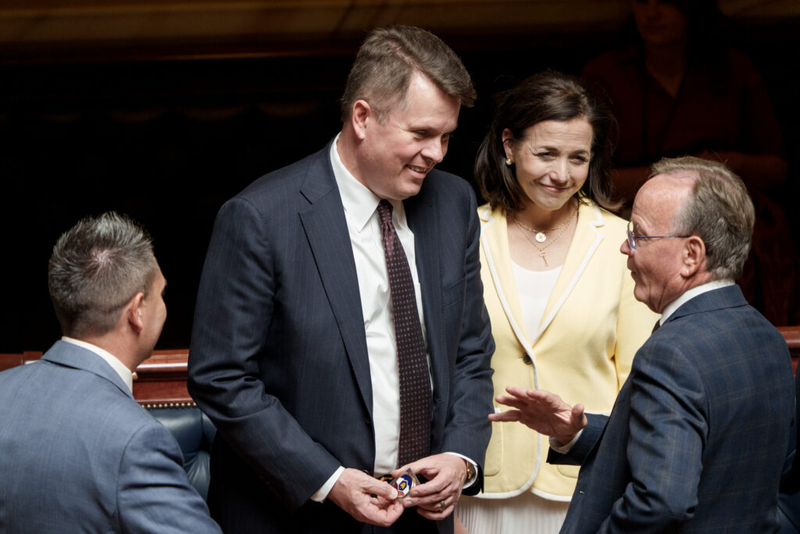
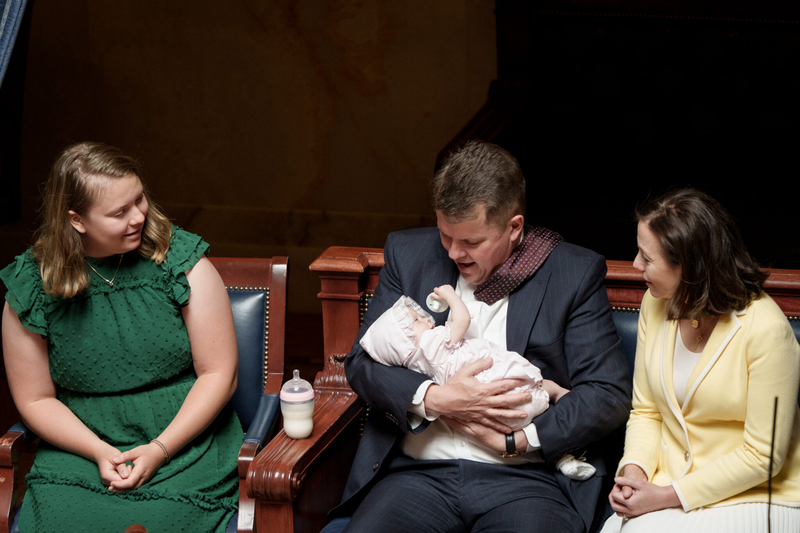
Jay Jorgensen and his wife Melissa talk with Senate President Stuart Adams, R-Layton, before Jorgensen was confirmed as a Utah Supreme Court Justice during a special legislative session at the Capitol in Salt Lake City on Wednesday, June 17, 2026. (Photo by Spenser Heaps for Utah News Dispatch)
The Utah Senate voted on Wednesday to approve the appointments of both of Utah Gov. Spencer Cox’s nominees to fill two new seats on the newly expanded Utah Supreme Court.
Senators voted to confirm both Stephen Dent, a federal prosecutor, and Jay Jorgensen — who most recently worked as an attorney for the state’s predominant faith, The Church of Jesus Christ of Latter-day Saints — to the bench.
Judicial confirmation committee endorses Gov. Cox’s 2 Utah Supreme Court picks
Dent and Jorgensen’s appointments come after the Utah Legislature earlier this year expanded the Utah Supreme Court from five to seven justices. The expansion drew controversy from the state’s legal professionals, including the Utah State Bar, which warned against moves to infringe on judicial independence. Republican lawmakers have expressed frustration with recent rulings on redistricting and abortion access by the previous five-member court.
The 24-5 vote for Dent and 22-7 vote for Jorgensen came mostly along party lines, with Democrats questioning whether Jorgensen meets the five-year constitutional residency requirement to qualify for the post. The Republican supermajority, however, argued the two men were qualified for the post, and the residency concerns weren’t warranted.
Jorgensen served a mission for The Church of Jesus Christ of Latter-day Saints in Chile for three years, from July 2022 to July 2025. Before that, he spent more than two decades living outside of Utah while he worked as executive vice president of Walmart in Arkansas and as a counsel for the e-commerce and technology company Coupang while living in South Korea. He moved back to Provo in 2020.
The Utah Constitution says Utah Supreme Court justices shall be “Utah residents for five years preceding selection.”
Sen. Stephanie Pitcher, D-Salt Lake City, who also works as an attorney, voted against Jorgensen’s confirmation, saying the questions of whether his out-of-state service could prompt a legal challenge to his appointment as a justice.
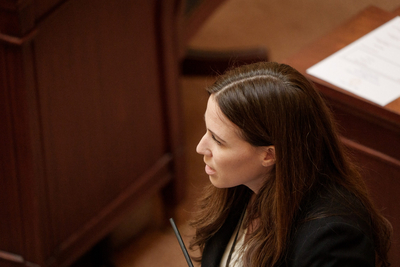
“Thoroughly working out the question of residency is important, because a challenge against (Jorgensen’s) confirmation would disrupt the work of the Utah Supreme Court and it would cost Utah taxpayers money to defend his eligibility in court,” Pitcher said. “Regardless of how a court would rule, more practically, I don’t know that I’m comfortable confirming someone … who has built their entire career outside (the state).”
Pitcher said Senate Democrats’ legal staff was unsure about how a court would interpret the residency requirement if Jorgensen’s confirmation were challenged.
“Given these unsettled issues involving residency, I’m voting no,” she said.
Sen. Todd Weiler, R-Woods Cross, who also works as an attorney and chairs the Senate Judicial Confirmation Committee — which endorsed Dent’s and Jorgensen’s appointments earlier this week — pushed back against Pitcher’s comments.
He said the Utah Constitution doesn’t require Utah Supreme Court justices to live in the state five years “immediately” preceding their appointment, which creates “some ambiguity” in that requirement.
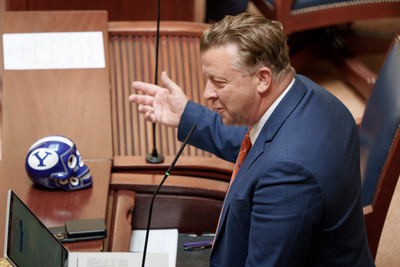
“Regardless of that,” Weiler said, “he testified under oath that he’s lived here since December of 2020. I don’t know why this is an issue.”
In his confirmation hearing Monday, Jorgensen told lawmakers the question of residency boils down to whether it was a permanent move or only temporary, and that he and his wife “always intended to return” to Utah after the mission. They also owned a home in Provo during their time abroad.
After the Senate voted to confirm him to be the Utah Supreme Court’s newest justice, Jorgensen gave a speech thanking lawmakers and his family, especially his wife, who watched from the sidelines of the Senate floor. He said he “never imagined” he would serve on the Utah Supreme Court.
During his speech, Jorgensen said Utahns have a “wonderful tradition” of sending their kids abroad to learn about other places in the world, then bringing them back home to share what they learned.
He also said the “lawyer in me can’t let a lawyer thing go,” while he pulled out his phone to read the qualifications for elected state officials listed in the Utah Constitution. He noted the constitution requires the governor, the lieutenant governor and the attorney general to be a resident of the state for five years “next preceding” the election. He noted the courts have interpreted that to mean “immediately” preceding.
However, he noted the part of the Utah Constitution that lists requirements for Utah Supreme Court justices does not include the word “next” in front of the word “preceding.”
“Not ‘next preceding,'” he said. “‘Preceding.’ And so that was the comment that I made and wish to have understood in the (committee hearing). Who decides? You decide. The constitution has entrusted in you, the senators, whether a person is qualified for this role.”
Gov. Cox says his Utah Supreme Court picks were the most qualified. Critics disagree
Dent’s confirmation wasn’t as controversial as Jorgensen’s, with some Democrats voting in favor of his confirmation. But some Democrats, including Sen. Jen Plumb of Salt Lake City voted against Dent, while questioning whether he was the most qualified candidate because he has no experience working as a judge.
Sen. Brady Brammer, R-Pleasant Grove, argued Dent and Jorgensen are “at the top of their legal field,” and there have been several Utah Supreme Court and U.S. Supreme Court justices who were appointed without previous judicial experience.
“There is no settling here,” Brammer said, urging lawmakers to look at the culmination of their legal careers and “measure these people for what they do bring, as opposed to a made up qualification that is helpful but not essential to this job.”
After the vote, Senate Democrats issued a statement expressing concern with Jorgensen’s residency qualifications and whether it could result in “costly litigation” for Utah — but also emphasizing they have “consistently opposed” the expansion to the Utah Supreme Court.
“We do not believe it is a coincidence that these appointments are being made as the Supreme Court prepares to hear major cases involving redistricting, reproductive rights, and other fundamental civil rights,” Senate Democrats said. “We see this as a deliberate effort to inject partisanship into our Supreme Court and undermine the independence of Utah’s judicial branch. This action follows a broader pattern of decisions and legislation aimed at influencing, weakening, and retaliating against our judiciary.”
Salt Lake City, UT