Behind locked doors, AG candidates keep it civil
Aug 06, 2026 | 5:31 pm ET

Description
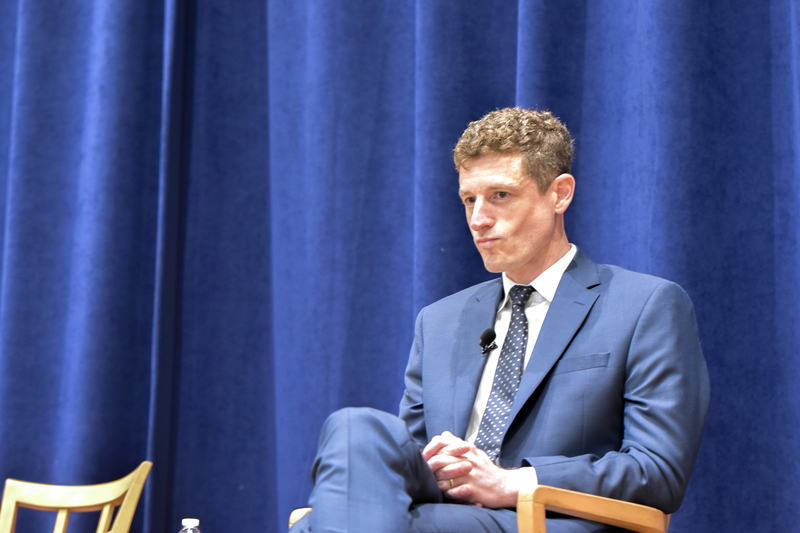
Rep. Jason Knight, a Barrington Democrat running for Attorney General of Rhode Island (right), speaks during a candidates forum hosted by the Jewish Alliance of Greater Rhode Island on Aug. 5, 2026. From left: Democrat Kim Ahern, Republican Alan Gordon, and Democrat Keith Hoffmann. (Photo by Christopher Shea/Rhode Island Current)
“Man, I sure wish this was a debate,” one candidate running to be Rhode Island’s next attorney general remarked during a two-hour forum Thursday night at the Dwares Jewish Community Center in Providence.
It was by design. Organizers at the Jewish Alliance of Greater Rhode Island asked four of the candidates vying for the office to avoid direct exchanges to maintain a level of “model civil discourse” amid a time of growing polarization.
“Tonight, let us model the kind of community and democracy that we all want to be part of — one in which we can disagree strongly on policy and principle, while remaining committed to respectful dialogue across differences,” Emily Gaudreau, director of community advocacy and engagement, said when laying the ground rules of the forum.
Democrats Kim Ahern, Keith Hoffmann and Rep. Jason Knight, along with Republican Alan Gordon, upheld that decorum as they outlined how they would respond to rising hate crimes, and whether to regulate the growing use of Flock cameras by police departments, among other issues presented.
Rep. Joseph Solomon, a Warwick Democrat, was not present for Wednesday’s discussion. Solomon was also absent from a July candidate forum hosted by Sojourner House, which centered on issues such as domestic violence prevention.
Shastery Gonzalez Pena, a spokesperson for Solomon’s campaign, said in an email Thursday that Solomon had instead attended North Providence’s National Night Out at the invitation of the town’s police department. She noted Solomon will appear on upcoming televised debates on WPRI and WJAR.
“He is prioritizing the events where every Rhode Islander can tune in,” Gonzalez Pena said.
No place for hate
The first question posed to the candidates Wednesday was how they would combat growing antisemitism to ensure Jewish Rhode Islanders remain safe and supported. All four condemned antisemitism and pledged to prosecute hate crimes aggressively.
Ahern used the setting of the forum to underscore the issue in her opening statement, noting the discussion was being held behind locked doors with an armed Providence police SWAT team member present.
“People do not feel safe in their own communities right now,” she said.
Ahern pointed to her previous work with the Attorney General’s Office’s Civil Rights Unit — where she helped train hundreds of police officers on antisemitism, civil rights and hate crimes — and pledged to double down on those efforts if elected.
Hoffmann too highlighted his record at the AG’s office training officers, along with setting up Rhode Island’s first statewide hate crime summit where local departments designated hate crime liaison officers.
“It is critically important that we keep up this work, that we help faith communities and others who are at risk of bigoted attacks have security in place so that they can feel safe,” Hoffmann said.
Knight said combating antisemitism requires a deeper commitment from state prosecutors to recognize the fear and harm that hate crimes create beyond the individual victim. He said prosecutors should prioritize seeking tougher sentences in cases where they can prove hate was a primary motivator when before a judge.
“That is only one way to make sure that the signal is sent through the community that we take it seriously and that the AG’s office is up to the job,” Knight said.
Gordon said he would use subpoena power, civil asset forfeiture, anti-money-laundering laws, and referrals to federal prosecutors to target what he described as the organized roots of antisemitism.
The four also agreed Rhode Island’s hate crime laws and reporting systems need more dedicated attention, but differed on how to address those gaps to better assist the state’s marginalized populations.
Ahern called for a comprehensive review of why prosecutions are failing and whether the 1998 law should be modernized. Knight similarly supported modernizing the statute, along with creating alternative pathways for victims to report when they feel ignored by local police.
“I can’t tell you how many times in my 20 years of experience doing criminal law where I’ve heard the complaint that I went to the cops and they didn’t do anything,” Knight, a former prosecutor who now works as a criminal defense attorney, said.
Hoffmann noted he previously drafted legislation to clarify the scope of the sentencing enhancement for hate crimes and proposed expanding protected categories to include gender identity and expression.
Gordon said accurately tracking hate crimes will require more training for police and prosecutors, legislative changes and better public education about what qualifies as a hate crime.
“Nobody’s immune from misunderstanding the law,” he said.

Who will shepherd the flock?
Candidates also touched on the growing national conversation over law enforcement’s use of Flock surveillance cameras and the privacy concerns citizens have raised. Communities including South Kingstown and Narragansett recently ended contracts with Flock because of those concerns,
All four largely agreed that license plate reader technology has legitimate public safety uses but should be subject to stronger rules statewide.
“If a criminal is after me, I want the police to have a Flock to track that criminal,” Gordon said.
Hoffmann too saw the merit of license plate readers as a “public safety benefit.” But he also called for a statewide regulatory framework police departments can use modeled after Rhode Island’s body camera policies.
Among Hoffmann’s suggestions were that the data collected by the cameras be destroyed in a “timely fashion,” and that nothing be shared with federal immigration authorities “under any circumstance.”
“All technology in our modern world can be misused terribly, and we have to have safeguards in place,” he said.
Ahern similarly said automated license plate readers should be accompanied by clear safeguards with restrictions on sharing information with federal immigration authorities. But she said prosecutors would be reluctant to give up a tool that has helped solve violent crimes, pointing to how Flock cameras were used to find the man suspected of committing the campus shooting at Brown University last December.
“You need to balance those critical, transparent and retention policies at the same time of recognizing that these serve a purpose — a critical public safety purpose,” Ahern said.
Knight also backed a uniform statewide policy administered by the AG’s office, though he argued companies such as Flock should not be allowed to monetize Rhode Islanders’ data collected from the cameras.
“The data is ours. Period,” he said.
The four AG hopefuls also provided how they would ensure Rhode Island’s elections remain safe under ongoing threats from the federal government. The three Democratic candidates framed the office as a shield against potential federal interference, while Gordon argued the state should focus on stricter election rules and greater scrutiny of voter rolls.
Gordon’s remarks elicited Knight’s wish for the discussion to have been a debate instead.
“Sorry to burst everyone’s bubble, but,” Gaudreau reminded the crowd and candidates.
Early voting begins Aug. 20 ahead of the Sept. 9 primary.

Providence, RI