US Senate Dems block bill curbing congressional stock trading, calling it too weak
Sep 30, 2026 | 6:10 pm ET
Description
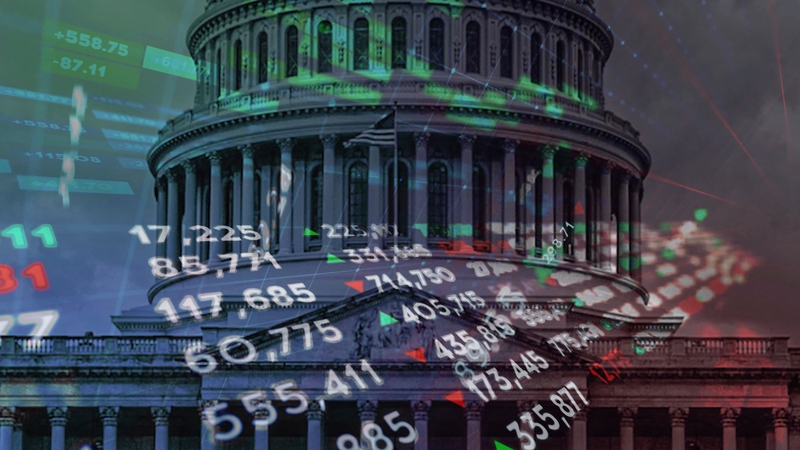
A Republican-led bill to curb congressional stock trading panned by Democrats as too weak failed to advance in the U.S. Senate on Sept. 30, 2026, when lawmakers stayed solidly within party lines for a procedural vote. (Photo by Douglas Rissing/Getty Photos)
WASHINGTON — U.S. Senate Republicans did not gain any support Wednesday from Democrats as they attempted to advance a bill that mashed together two hot-button midterm issues: requiring voter ID in federal elections and limiting stock trading for members of Congress.
The Republican-led bill, titled the Stop Insider Trading Act, failed 53-47 when lawmakers stayed solidly within party lines for the procedural vote. Most legislation requires 60 votes, or three-fifths of the Senate, to advance.
The House-passed measure attached a voter ID requirement onto a base bill prohibiting members of Congress and their spouses and close family members from purchasing certain stocks, and requiring a public notice and waiting period prior to selling stocks.
House lawmakers approved the legislative package by a 232-192 margin.
While 13 House Democrats supported the bill, sponsored by Rep. Bryan Steil, R-Wis., despite plenty of criticism, Senate Democrats did not bite.
“The Senate GOP let their counterparts in the House take out all of the ban’s teeth and fill it with poison pills so it could never pass. This bill has no reform, no accountability, no substance,” Minority Leader Chuck Schumer, D-N.Y., said on the Senate floor prior to the vote Wednesday.
House and Senate Democrats panned the legislation for being a weaker version of other bipartisan bills aimed at stopping members of Congress from potentially profiting off insider knowledge while trading stocks. The issue has drawn support from both parties over the past several years.
“Under (the) Republican bill, members would still get to own and sell stocks. And most importantly, this bill doesn’t do anything – anything – to stop Donald Trump from trading stocks. I guess Republicans forgot that Trump has made nearly 30,000 stock trades in the past year and raked in billions – more than all of Congress combined,” Schumer continued.
The New York Democrat also said the measure “would make voting more difficult in every state than it is now” and described it as “some of the most twisted, radical schemes Trump has ever dreamed up to rig our election.”
ID for voting
Under the measure, a voter would be required to present a current state-issued driver’s license or identification card, passport, valid military or veteran ID, or tribal government-issued ID card to be able to vote.
If a voter doesn’t have one of the listed physical forms of identification, state election officials could issue a provisional ballot. The voter would then have three days to provide the accepted ID or an affidavit that the voter doesn’t have one because of religious objections to being photographed.
Additionally, state officials would be prohibited from accepting absentee ballots unless the voter attaches a copy of a valid ID, the last four digits of their Social Security number with an affidavit that they cannot obtain a photo ID, or a notarized statement that the voter personally completed their ballot.
‘Commonsense legislation’
Senate Republicans pushed for the bill ahead of the vote, including Nebraska Republican Sen. Pete Ricketts, who posted Monday on X, “This bill would ban congressional insider trading. We need to pass this commonsense legislation and restore integrity to Congress.”
Sen. Mike Lee, R-Utah, pointed to a Department of Justice indictment announced Wednesday to argue in support of the legislation.
Quoting a post on social media about DOJ allegations that 10 noncitizens voted in a previous election, Lee wrote: “Every Senate Democrat just voted against legislation that would stop this.”
While the DOJ has alleged instances of isolated election-related crimes, widespread voter fraud has never been credibly proven.
A database published in 2024 by the right-leaning Heritage Foundation surveying millions of votes cast in seven states over decades found reported cases of fraud to be less than 1%, according to an analysis of the results by the progressive Brookings Institution.
A comprehensive body of research has found the practice to be exceedingly rare.
All States Newsroom content is free to republish. Read our republishing policy for more information.