URI trustees seek $20.3 million boost in fiscal 2028 budget request
Sep 28, 2026 | 5:51 pm ET
Description
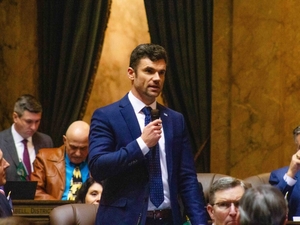
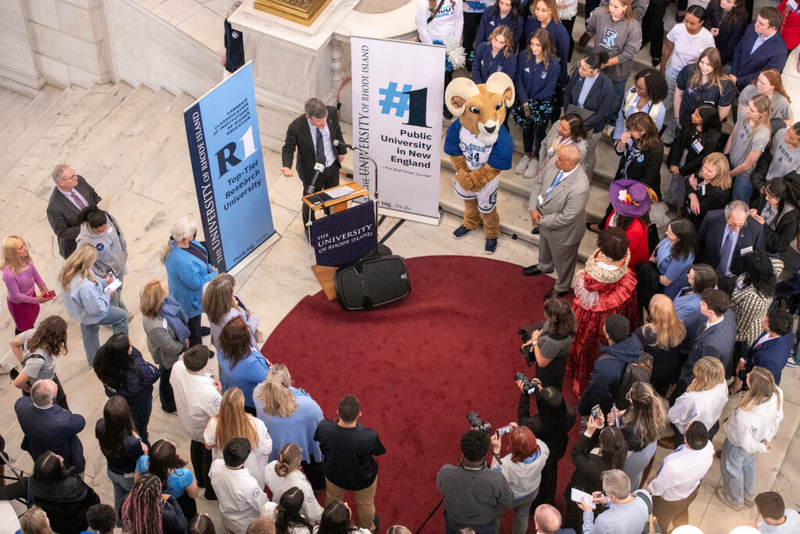
University of Rhode Island President Marc Parlange speaks to lawmakers, students and other URI supporters during URI Day at the Rhode Island State House in April 2025. (Photo by Alexander Castro/Rhode Island Current)
University of Rhode Island (URI) trustees on Friday unanimously approved a request seeking a $20.3 million increase in the university’s 2028 budget amid projections of an $8.1 million shortfall this fiscal year.
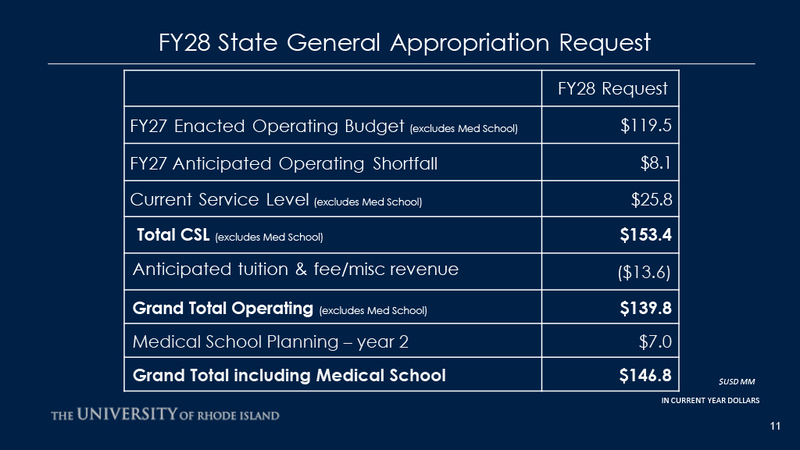
Rising inflation and missed enrollment targets were among the reasons cited for the school’s request of $139.8 million in state support next year, a 17% increase in operating support for the school over this year.
The board’s approval at its first meeting of the fall semester comes ahead of the Sept. 30 deadline for state agencies to submit their budget requests for the upcoming fiscal year.
The full board’s affirmation follows an initial vetting and a unanimous recommendation of approval from the trustees’ Finance and Facilities Committee on Sept. 14. The school ended fiscal year 2026 on June 30 with a $2.2 million shortfall in its unrestricted budget — an improvement from the $3.8 million gap officials had anticipated.
An estimated $153.4 million is needed for URI’s operating needs in the upcoming fiscal year, according to a presentation by Abby Benson, senior vice president and chief financial officer for the school’s Division of Administration and Finance. That includes the school’s current $119.5 million appropriation for fiscal year 2027, plus the projected $8.1 million shortfall and $25.8 million to maintain the current level of services, which includes employee pay, contract costs, utilities, insurance, and athletics.
URI expects $13.6 million in additional revenue from tuition and other fees, which is factored into its budget request and reduces the amount of money the school is asking the state to provide.
Benson told trustees fewer students returned for their next year or semester than expected, reducing tuition revenue, though this decline was somewhat offset by revenue gains from online programs.
The university expects to fall short of its fall 2026 enrollment target. While final student census numbers will not be available until October, Benson said financial concerns were the reason most often cited by prospective students who did not enroll.
Reasons for the enrollment troubles included reduced federal aid opportunities, limits on federal loans and competing financial offers or programs from public colleges and universities within and outside Rhode Island. URI lacks a free tuition program comparable to those available at Rhode Island College and the Community College of Rhode Island.
URI is seeking an additional $8.9 million in its budget request which would be directed toward student aid costs.
The university also plans to cut $5 million through vacancies and tighter hiring practices. Benson said URI is likely to leave some budgeted positions unfilled even though state lawmakers increased the school’s staffing cap by 200 positions earlier this year.
Benson said the school plans to continue a budgetary review of all positions before they’re filled.
As for the $25.8 million increase URI says it needs to maintain existing operations, it includes $13 million for employee pay and contracting, $6 million for utilities and insurance, and $2 million for athletics.
Missing from this year’s funding request is “strategic initiatives,” for which URI requested $14.4 million last year. The money was meant to cover costs for faculty and advisers, IT improvements, and student success programs, Benson said, but the school received nothing for it in the fiscal year 2027 budget.
“We decided not to include them in the budget this year,” Benson told trustees Friday.
Instead, the university wants to focus on its expenses and financial obligations. The strategic initiatives funding tends to get no support from either the governor or the General Assembly. Benson suggested state officials see the school’s existing “unrestricted pool of general appropriation” as a better source to fund such initiatives.
Separate line item for medical school sought
The $139.8 million request does not include the school’s separate ask for $7 million for a second year of planning for a proposed medical school at URI. The General Assembly included $5 million for planning for the medical school in this fiscal year’s budget.
Trustees said they would like to petition state leaders for a distinct budget line for the medical school, instead of having it bundled into the school’s existing state appropriation. Benson agreed that separating funding for medical school planning into its own budget line item would help avoid distorting year-over-year comparisons of the school’s budget. The university treats the medical school money separately in its internal finances.
URI’s budget request now heads to the state Office of Management and Budget. The governor’s proposed budget takes these requests into consideration and emerges in January, after which the state legislature determines a final version of the budget during the legislative session. Rhode Island’s fiscal year begins July 1 each year.
Providence, RI