UA declines to sign Trump compact, submitting its own statement instead
Oct 20, 2025 | 5:39 pm ET
Description
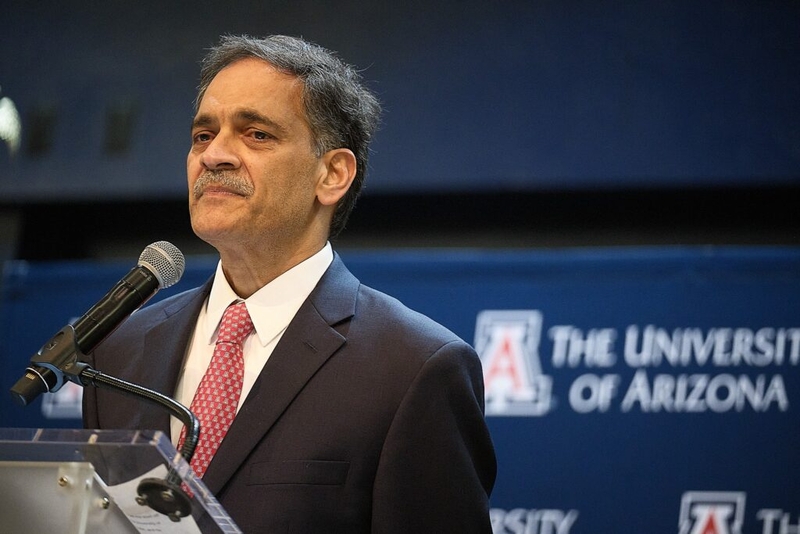
Suresh Garimella speaks at a press conference introducing him as the 23rd president of the University of Arizona on Aug. 9, 2024. Photo by Michael McKisson/Arizona Luminaria
The University of Arizona and President Suresh Garimella stopped short of signing the Trump administration’s proposed compact Monday, instead submitting its own “Statement of Principles” to the U.S. Department of Education.
The compact would have tied preferential federal funding for the school to Trump administration policies.
“The university has not agreed to the terms outlined in the draft proposal,” Garimella wrote in an online statement to campus stakeholders.
He said that the university already shared many of the same values outlined in President Trump’s compact but that funding should be merit-based.
“We have much common ground with the ideas your administration is advancing on changes that would benefit American higher education and our nation at large. At the same time, a federal research funding system based on anything other than merit would weaken the world’s preeminent engine for innovation, advancement of technology, and solutions to many of our nation’s most profound challenges,” Garimella wrote in his response to Linda McMahon, the U.S. Secretary of Education. “We seek no special treatment and believe in our ability to compete for federally funded research strictly on merit.”
Garimella said that rather than agree to the terms outlined in the compact, he submitted the university’s statement of principles.
“A number of the proposed federal recommendations deserve thoughtful consideration as our national higher education system could benefit from reforms that have been much too slow to develop. In fact, many of the proposed ideas are already in place at the U of A,” he wrote in his announcement to the UA community.
“At the same time, principles like academic freedom, merit-based research funding, and institutional independence are foundational and must be preserved.”
Garimella — along with eight other prominent university presidents across the country — received the compact by email on Oct. 1. The message states that signing and abiding by the pledge would result in potential benefits for the university, including higher overhead allowances, substantial federal grants, and other federal partnerships. Seven schools have responded so far, none have signed.
The UA and the Board of Regents had until Nov. 21, the targeted signing date, to decide whether to abide by the compact, and they had until Oct. 20 to provide “limited, targeted feedback, with written comments” to the administration.
At a Faculty Senate meeting Oct. 6, the school’s faculty voted in favor of a resolution urging Garimella not to sign the compact. The school’s labor union, the United Campus Workers of Arizona, released an open letter Oct. 14 urging Garimella to publicly reject the White House “Higher Education Compact,” calling it a partisan “loyalty oath” that would undermine shared governance and academic freedom.
Phoenix, AZ