Senate OKs Bill to create URI medical school, moving it to the House
May 26, 2026 | 5:40 am ET
Description
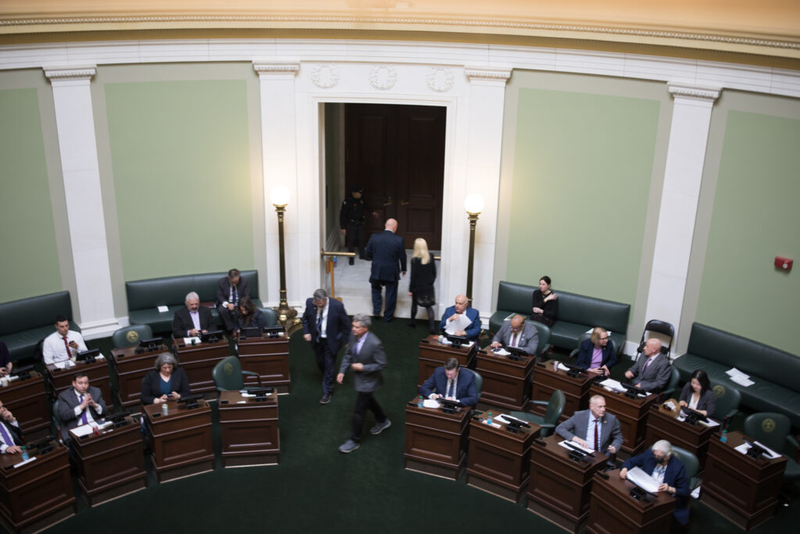
Lawmakers seen in the Rhode Island Senate Chamber on April 7, 2026. (Photo by Alexander Castro/Rhode Island Current)
Rhode Island is one step closer to having a medical school at the University of Rhode Island (URI).
Last week, the state Senate voted 37-0 to approve legislation that would provide an initial appropriation of $5 million — the first part of a multi-year investment — to develop the school which supporters say would ideally help alleviate the state’s physician shortage. Meanwhile, a companion bill is moving through the House.
Sen. V. Susan Sosnowski, a South Kingstown Democrat, sponsored the Senate’s bill for the proposed, public medical school, which would be the only public institution in the state to grant Doctors of Medicine degrees (M.D.s).
“URI has a good, solid foundation for establishing a medical school, and healthcare organizations are eager to partner with URI to create a community-based education model,” Sosnowski said in a statement. “This may be the most important investment the state makes in its future, its communities and its people.”
The seed funding would be used for the initial expenses needed to set up the medical school, and would include the search and hiring of the school’s founding dean, senior leadership, faculty and administration. The costs of seeking accreditation and curriculum planning would also be tied to this initial tranche.
The bill’s proposal and funding plan follow the recommendations of a 21-member special legislative commission that, after meeting for a year and a half, unanimously concluded in January that the state should pursue the plan for an M.D.-granting program. The report had recommended about $20 million in initial state investment. Sosnowski’s bill suggests, but does not require, $7 million and $8 million in fiscal years 2028 and 2029, respectively, to complete the $20 million upfront funding.
The school would still need an estimated $175 million from other sources, with a $22.5 million-per-year line item in the state budget in subsequent years, according to the special panel’s final report.
Legislative commission recommends backing URI medical school
The commission’s suggestions were informed by an independent, $150,000 feasibility study released last year that recommended establishing the public medical school with a four-year, five-phase plan that would ideally see the first class of students enrolled by 2029.
Sosnowski said in her statement that, by 2030, Rhode Island may face a shortage of roughly 100 primary care providers, which a medical school at URI could help.
According to a survey cited in the commission’s final report, more than a third of Rhode Island’s primary care providers are over 60, while about a quarter could retire within the next six years.
Testimony from the United Way of Rhode Island in support of the bill at a March 24 hearing noted that, at the end of 2025, Rhode Island had 17 federally designated primary care Health Professional Shortage Areas, which combined represented 257,218 residents. Only 74.29% of medical needs were met in those areas, and an additional 22 primary care practitioners would be needed to fill the gap.
The bill now heads to the House Committee on Finance. That chamber’s companion bill, led by newly appointed First Assistant Speaker Rep. Kathleen A. Fogarty, a South Kingstown Democrat, was heard and held, as is standard process, in committee on April 30.
Each chamber will need to pass their own version of the bill as well as the other chamber’s, before the legislation could proceed to the governor’s desk.
Providence, RI