U-M student facing disciplinary action over Palestine protests says other movements are next
Aug 05, 2025 | 1:14 pm ET
Description
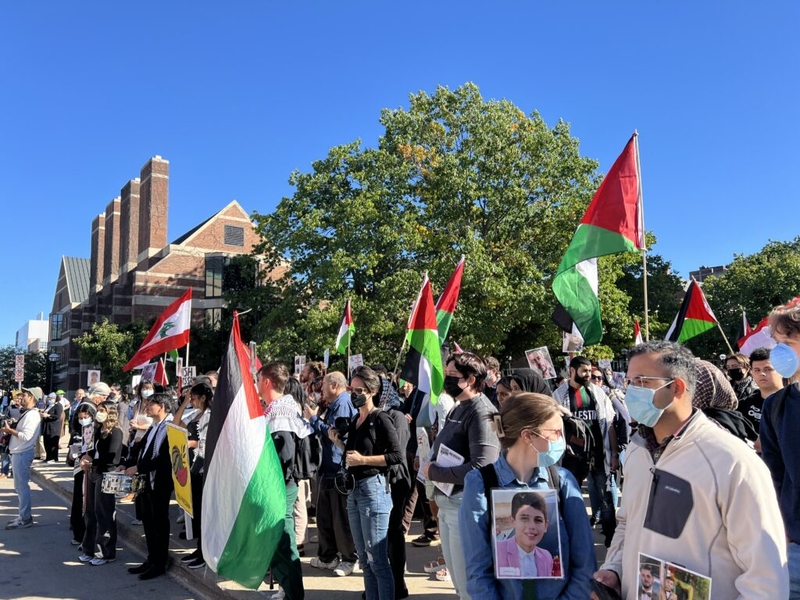
Protestors at the University of Michigan mark the one year anniversary of the Oct. 7 Hamas attack, as they demand the university divest its holdings from Israel. Oct. 7, 2024. Photo by Jon King.
Updated at 4:16 p.m.
Nearly a dozen University of Michigan students and alumni have been brought up on disciplinary charges for their participation in pro-Palestine protests over the last year – a move that has sparked concern for the right of free expression on campus and the over-policing of student protest movements.
The university administration is currently in the process of holding disciplinary hearings against 11 protesters, including leaders from Students Allied for Freedom and Equality, the Muslim Student Association, Arab Students Association, Jewish Voice for Peace, and the Graduate Employees Organization, a branch of AFT Local 3550.
At least four of those individuals faced criminal charges lodged by Michigan Attorney General Dana Nessel for trespassing or resisting arrest when police cleared a protest encampment from the university in May 2024. Those charges were dismissed in May of this year.
University officials, however, are still seeking formal reprimands, disciplinary probation and suspension in abeyance against student protesters. For alumni facing disciplinary action, the university is considering a lifetime ban from all future U of M activity, including reenrollment.
Kathleen Brown is a graduate student and a member of AFT Local 3550. She is one of the current 11 students and alumni facing ongoing disciplinary action through the university’s Office of Student Conflict Resolution. Brown is also among the third round of students facing disciplinary action related to Gaza and Palestinian solidarity protest movements at U of M.
For her, the hearings and potential consequences feel more like punishment for political dissent than the university’s stated goal of protecting students and the larger institution, especially after the state dropped the criminal charges.
“Those did not stick because protesting is not yet a crime, so now, they’re getting us on these disciplinary charges, which have a much lower burden of proof,” Brown said. “The university can allege anything and can basically punish us with anything. There’s no due process in this.”
The university has said that the right to free speech and expression is protected, but claimed the Palestine protests were disruptive, compromised operations and infringed on the rights of others at U of M.
Michigan AG confirms warrant sweep was connected to ‘coordinated criminal acts of vandalism’
In an email to the Advance, Kay Jarvis, U of M’s director of public affairs, added that protests are welcomed as long as those protests do not threaten the safety of the university community.
“The university has been clear that we will enforce our policies related to protests and expressive activity, and that we will hold individuals accountable for their actions in order to ensure a safe and inclusive environment for all,” Jarvis said.
When asked to confirm the current disciplinary action against the 11 students, Jarvis said the university does not comment on individual cases due to confidentiality and privacy concerns.
All disciplinary actions go through the Office of Student Conflict Resolution, detailed in the university’s statement of student rights and responsibilities, and are typically resolved within six months after receiving a formal complaint. That timeframe can be extended, though, to allow resolutions through “external proceedings,” although Jarvis did not say what that might entail.
The proceedings have stemmed from several protests, including a sit-in at a university administration building just a month after the Israeli military assault on Gaza began, which was launched in retaliation to the militant group Hamas’s Oct. 7, 2023 attack in southern Israel that killed more than a thousand Israelis and took more than 250 hostages. The resulting Israeli military response has killed more than 60,000 people according to Gaza’s health ministry, which is part of the Hamas-run government.
Other protests have included an action outside a regents gala and the break up of the encampment in the university’s Diag area, both in May 2024, and a memorial march on the one year anniversary of the latest conflict, which is more frequently being described as a genocide of the Palestinian people.
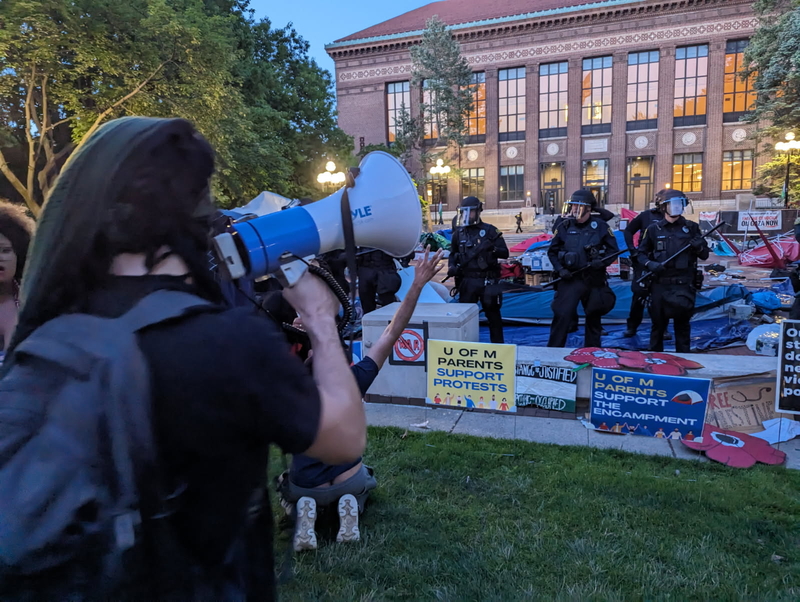
Brown is facing the lighter side of potential consequences with a formal reprimand planned. She said she and others have already been subject to several hearings over the protests and that they will continue for her this month.
In her view, the proceedings are a way to make student protesters pay for standing in solidarity with Palestinians and other oppressed groups.
In previous proceedings with two separate groups of students punished on disciplinary grounds, the Office of Student Conflict Resolution found that the complaints were unsubstantiated, but Brown said the university’s student office overturned that finding and sanctioned the students anyway.
“Any avenue they can pursue, the administration is pursuing, with no respect for our constitutional rights,” Brown said.
Several lawsuits, including one in the U.S. District Court for the Eastern District of Michigan, have been filed against the university as a result of the disciplinary action of student protesters. One is focused on the university’s decision to still seek sanctions against students after the institution cleared them of disciplinary charges.
Brown said the university was making an example of these students due to the politically controversial nature of the Palestinian solidarity movement.
“Anything that has to do with talking about Palestinian freedom and Israeli war crimes and genocide has been like mercilessly persecuted. This is very reminiscent to McCarthyism and anti-communism … because they have used every weapon available to them to try and crush this movement, including police violence,” she said
Activists say U of M building culture of fear against student movements
Beginning last year, the university said it would uphold its commitment to protect student free speech, but that it would not allow disruptive activity and that it was in the process of drafting a policy to address it.
The university also reached an agreement with the U.S. Department of Education’s Office of Civil Rights to enhance its response to situations where free speech actions might “create a hostile environment for others.”
In June of this year, the university noted in a news release that its security strategy now includes using an outside firm to track student activists with plainclothes security personnel. That turned on the university quickly when it came to light that contractors allegedly drove a car at a student, impersonated a person with disabilities when confronted or accused students of robbing them.
“What happened was disturbing, unacceptable, and unethical, and we will not tolerate it,” Interim University President Domenico Grasso said in a statement from June. “Going forward, we are terminating all contracts with external vendors to provide plainclothes security on campus.”
Brown said the escalation of surveillance on student activists was creating a culture of fear to prevent students from exercising their First Amendment rights.
“They have leaned on state repression. Dana Nessel has used the FBI to break down people’s doors,” Brown said. “She’s charging students, who were just on the Diag and got beaten by police, charged with felonies. She tried to put us in a cage for protesting genocide.”
The Michigan Daily, the university’s student-led newspaper, reported that there are concerns the university plans to branch off its Office of Student Conflict Resolution into a subsidiary Office of Student Accountability, which Brown and others have likened to a private court system within the student disciplinary framework. Whereas the current office has a restorative justice aim, the new office would focus more on punitive measures.
In a statement, the TAHRIR Coalition, one of the organizations behind the student protests, said the new office would continue to retaliate against those who fight for university divestment from Israeli-linked companies and an end to the military occupation in Gaza and the West Bank.
“[University police gather] intelligence against students, identifying them through the Michigan State Police Biometrics Database, then sends the information to Student Investigator Donovan Golich, who relies exclusively on police evidence,” TAHRIR said in a news release.
Golich is the program manager for formal conflict resolution at the university. Activists have described his work as both investigatory in nature and with authority to bring disciplinary action against students. Brown said that includes facilitating the very disciplinary processes he initiates.
A university spokesperson did not respond to additional questions from the Advance on the creation of the new office, Golich’s role, and if his work served as a conflict of interest slanting the proceedings.
Brown called the new office a massive expansion of policing on campus. She also fears that the university’s and the state’s crackdowns could extend well beyond the current focus on Palestinian solidarity.
“I’m the former vice president of our labor union, the graduate employees organization, and we have a contract campaign coming up. And what does it mean for us?” Brown said. “We have pickets, we have protests. If those are now violating this statement of student rights and responsibilities, because they disrupt [operations], that means we can’t ever have pickets or protests. … They’re using these like very nit-picky rules that they’ve made, and they’re using the enforcement of that as a means of criminalization.”
This story was updated to reflect that it is the University of Michigan administration which is seeking disciplinary action against selected students.
Lansing, MI