Two Kansas GOP legislative leaders accuse governor of misconduct in Walk of Honor selections
Nov 06, 2026 | 5:04 pm ET
Description
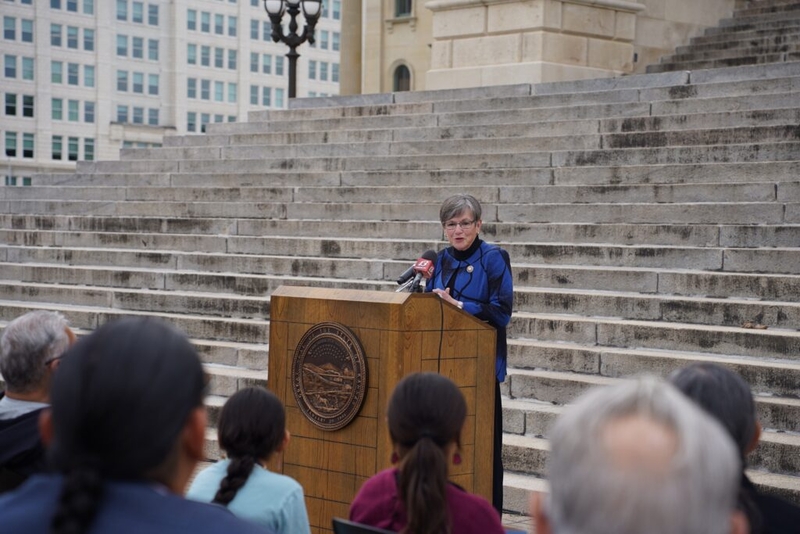
Kansas Gov. Laura Kelly speaks Oct. 29, 2026, during a ceremony at the Capitol honoring eight people added to the Kansas Walk of Honor. Two Republican members of the Kansas Legislature claim she violated state law by unilaterally choosing eight new inductees. (Photo by Kansas Governor's Office)
TOPEKA — The Republican House speaker and Senate majority leader Friday accused Democratic Gov. Laura Kelly of breaking Kansas law by personally selecting a group of people honored with bronze plaques at the Capitol.
Kelly, who completes her second term as governor in January, celebrated Oct. 29 the addition of seven women and one man to the Kansas Walk of Honor. The class included basketball pioneer James Naismith, educator Lucinda Todd, abolitionist Clarina Nichols and Prairie Band Potawatomi Nation Chairwoman Minnie Evans.
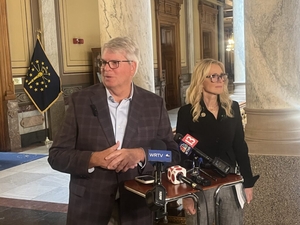
House Speaker Dan Hawkins and Senate Majority Leader Chase Blasi, both Wichita Republicans, said the governor failed to adhere to Kansas statute when she unilaterally chose honorees and directed placement of sidewalk markers without consulting the Kansas Legislature.
“The governor bypassed the statute and installed these unlawfully and, in addition, had a ceremony already,” Hawkins said.
Blasi, who serves on the Legislature’s capitol preservation committee, said he would welcome legal analysis of the governor’s actions. He suggested the joint preservation committee should be allowed to add its voice to discussion of memorials placed on the Capitol grounds “as the law requires.”
“The governor has decided to unlawfully violate the law and do whatever she wants,” he said.
Kelly’s staff didn’t respond to a request for comment, but she has said responsibility for selecting recipients fell to the state’s governors.
“The honorees being added to the Kansas Walk of Honor have always been an important part of Kansas history,” Kelly said in a statement last week. “They broke down barriers, challenged injustice, led industries and opened doors for generations to follow. Their contributions have shaped our state and our nation, which is why their names will forever be embedded in the sidewalks around the Statehouse, ensuring their stories live on in perpetuity.”
Kansas hasn’t applied a rigid selection formula or a mandatory legislative voting process for designation of these honorees. Since the Walk of Honor was established by GOP Gov. Sam Brownback in 2011, decisions involved the state’s governor in coordination with the Kansas Historical Society. The Kansas Historical Foundation finances the memorial plaques.
The governor was joined at last month’s ceremony on the Capitol steps by representatives of the Kansas Historical Society, Capitol Preservation Committee, family members of honorees and private donors to the project.
“Over the last 15 years, we have honored 17 Kansans from all walks of life who have made a significant impact on the state and to the country. We are pleased to include these eight new honorees,” said Patrick Zollner, executive director of the Kansas Historical Society.
The new honorees included Naismith, who invented basketball in 1891 and became the University of Kansas’ first head basketball coach. Todd, a civil rights advocate and teacher from Litchfield, was part of the families challenging school segregation in the landmark 1954 decision by the U.S. Supreme Court in Brown v. Topeka Board of Education.
Nichols was a women’s rights advocate who helped secure constitutional recognition of married women’s property rights and rights in child custody matters. Evans, who served as tribal chairwoman of the Prairie Band Potawatomi Nation, defended tribal sovereignty and helped defeat federal efforts to terminate the standing of tribes, including the Potawatomi.
Kelly paid tribute to Georgia Neese Clark Gray, a Richland native and Washburn University graduate who became the first woman to serve as U.S. treasurer. She was appointed by President Harry Truman in 1949.
The governor selected for recognition Olive Ann Beech, an aviation executive from Waverly. She built Beech Aircraft into a major manufacturer and was the first woman to lead a Fortune 500 company.
Another addition was Mary Skubitz, a labor rights advocate who helped lead a 1921 march in which thousands of women joined striking coal miners protesting unfair labor practices in Kansas coalfields. The list included Kay McFarland, the first woman appointed to the Kansas Supreme Court and the first woman to serve as the Supreme Court’s chief justice.
Previously, Kelly selected U.S. Sen. Pat Roberts, who represented Kansas in Congress from 1981 to 2021.
Brownback, the Republican governor who created the Walk of Honor program, chose the 16 other people honored in this way. His list included 14 men and two women.
He started with U.S. Sen. Bob Dole in 2011, before selecting Vice President Charles Curtis, aviator Amelia Earhart and Nobel Prize winner Jack Kilby in 2012.
In 2015, Brownback’s list was expanded to aviation executive Clyde Cessna, automaker Walter Chrysler, physician Samuel Crumbine, artist John Steuart Curry, photographer Gordon Parks, journalist William Allen White and President Dwight Eisenhower.
In 2016, Brownback included entrepreneur Fred Harvey, U.S. Sen. Nancy Landon Kassebaum, Gov. Alf Landon, cattle transport executive Joseph McCoy and psychiatrist Carl Menninger.
Topeka, KS