Trump loses appeals over California ballots, Homeland Security operations
Oct 30, 2026 | 5:25 pm ET
Description
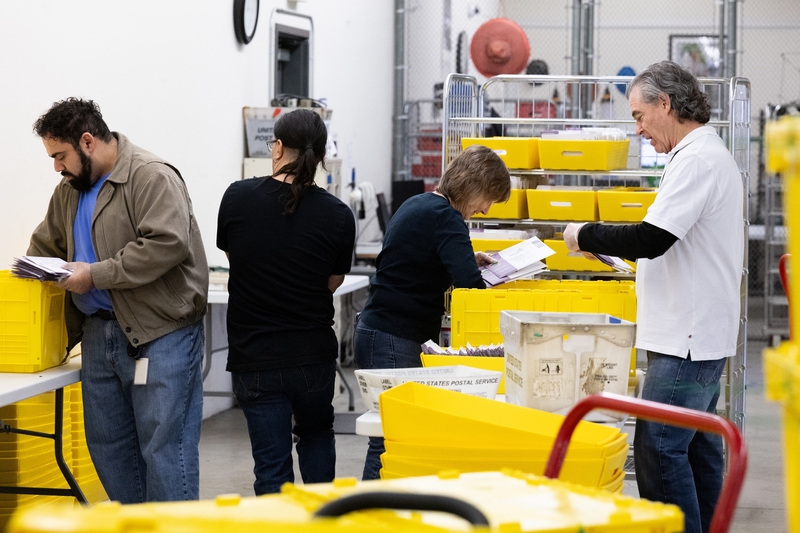
Election workers sort ballots at an election operations facility in Martinez, California, on May 27, 2026, ahead of California's statewide primary election. (Photo by Benjamin Fanjoy/Getty Images)
A federal appeals court on Friday denied a Trump administration demand that California set aside and not count the ballots of 20,000 suspected noncitizen voters, setting the stage for a possible appeal to the U.S. Supreme Court.
A three-judge panel of the U.S. 9th Circuit Court of Appeals ruled against a U.S. Department of Justice request for an emergency order that would have required state and local election officials to not tabulate the ballots of voters on a list developed by the U.S. Department of Homeland Security unless they could prove their citizenship.
A separate 9th Circuit panel on Friday also denied a Justice Department request to allow Homeland Security to restart election-related field operations that could sweep up U.S. citizens. Civil rights groups had warned the operations put naturalized citizens at risk of disenfranchisement.
The rulings marked the third and fourth courtroom losses in less than a week for President Donald Trump’s administration in its 11th-hour legal campaign to assert authority over elections, which under the U.S. Constitution are administered by states.
“Exercising the power endowed to it by the Constitution, California comprehensively administers its elections, including by regulating voter eligibility,” the panel wrote in an unsigned majority opinion over California’s ballot counting.
The Justice Department in October provided California election officials with a list of approximately 20,000 individuals that it said were likely noncitizens registered to vote in the state. The DOJ cited a federal misdemeanor crime against noncitizen voting in demanding their ballots be set aside.
The DOJ says Homeland Security compiled the list after obtaining a public copy of California’s voter roll and checking it against government records and information from the LexisNexis research service. Officials in California and Los Angeles County have questioned the list’s accuracy and warned against relying on it to prevent the tabulation of ballots.
The Trump administration has gone to extraordinary lengths to pressure California election officials to set aside the ballots.
It sued just 48 hours after giving election officials the list of 20,000 voters and since then, DOJ lawyers have raised the possibility that state and local officials could face criminal prosecution if they count the ballots of noncitizens. Grand jury subpoenas have been sent to election officials in Los Angeles County.
Risks ‘uncertain,’ panel says
The appeals court’s decision in the California ballots case upheld a ruling from Judge David Carter, an appointee of President Bill Clinton in U.S. District Court for the Central District of California, against the Justice Department. In a blistering decision, Carter wrote that the Trump administration was attempting to coerce California that evidence existed of federal interference.
Carter also echoed concerns raised by election officials over the origin of the list. The 9th Circuit panel voiced similar worries in its Friday decision and said the Justice Department request risks disenfranchising voters.
“There is a public interest in maintaining the integrity of elections,” the opinion says. “But as discussed, the district court found that the risks that noncitizens are voting are, at best, uncertain, and also tempered by California’s established voter-eligibility procedures.”
The 9th Circuit also previously rejected a preemptive appeal filed by the Justice Department.
Appellate Judge Patrick Bumatay, a Trump appointee, wrote in a dissent that he would have granted the Justice Department’s request. He wrote that the DOJ was seeking “limited relief” and that the federal government and the states can work together.
“California decided long ago that aliens can’t vote in its elections. Today, the federal government merely seeks to safeguard that decision. We should have let them try,” Bumatay wrote.
The Justice Department didn’t immediately respond to a request for comment and a question about whether it would appeal.
“Every day, more ballots are processed by election officials. This ongoing emergency disenfranchises American citizens through dilution,” Bill Essayli, first assistant U.S. attorney for the Central District of California, said in an earlier statement.
California Attorney General Rob Bonta, a Democrat, said in a social media post that the Trump administration’s three court losses over the past week make clear it has “zero authority to interfere in California’s elections.”
DHS election-related operations blocked
Another 9th Circuit panel on Friday affirmed a district court judge’s decision prohibiting DHS from conducting operations that could sweep up U.S. citizens. The prohibition applies in California, Connecticut, Georgia, Missouri, Nevada, New York, Pennsylvania, Washington and Wisconsin until polls close on Election Day.
A Homeland Security Investigations internal memo dated Aug. 31 describes a “surge initiative” beginning Sept. 1 that includes conducting field interviews. The memo, which was filed in court, identifies those states as targets of the surge during September. Additional locations are redacted in the document.
In an unsigned opinion, the panel questioned the Trump administration’s timing in pursuing a surge in voter fraud enforcement just before Election Day. The federal law enforcement activity is ostensibly focused on past voter fraud, the judges wrote, meaning that DHS had more than a year to pursue investigations before the pre-election period.
“The Federal Defendants have not indicated why restrictions on the Surge now prevent them from conducting these operations,” the panel wrote. “Nor have they explained why an injunction enjoining specific aspects of the Surge through Election Day causes irreparable harm when implementation of the Initiative can resume on November 4, 2026” — the day after Election Day.
The original lawsuit was filed by San Francisco, Santa Clara, the California Nurses Association, National Nurses United and the Voto Latino Foundation. They alleged voters, especially naturalized citizens, are at risk of intimidation and fear they could be wrongly targeted, the groups warned.
"Last week, the district court held that DHS's frantic, last-minute voter investigations are unlawful voter intimidation. Today, the government's attempt to restart that campaign failed,” Beau Tremitiere, a lawyer at Protect Democracy, said in a statement.
“This was one more desperate attempt by the Trump administration to interfere in the midterm elections, and the courts have again said no.”
Supreme Court next?
How the Supreme Court would rule if the Justice Department appeals either of these cases is unknown.
Conservatives hold six of its nine seats. The majority upended the electoral landscape earlier this year when it sharply weakened federal protections against racial gerrymandering, paving the way for Southern states to quickly redraw their congressional maps to favor Republicans.
But the Supreme Court has generally held that federal courts shouldn’t order dramatic changes just ahead of elections. For example, in September the justices repeatedly rejected requests to overturn a Missouri Supreme Court decision blocking a GOP gerrymander.
In the California ballots case, the 9th Circuit panel majority — which included Judge Mark Bennett, a Trump appointee, and Judge Gabriel Sanchez, an appointee of President Joe Biden — invoked that principle in denying the Trump administration’s request.
“Major concerns remain that granting the United States’s requested relief might … harm the public interest by risking the disenfranchisement of eligible voters and putting the entire tabulation process in jeopardy,” they wrote.
All States Newsroom content is free to republish. Read our republishing policy for more information.