Trump approves Hurricane Isaias disaster relief 12 days after it was made
Oct 28, 2026 | 2:33 pm ET
Description
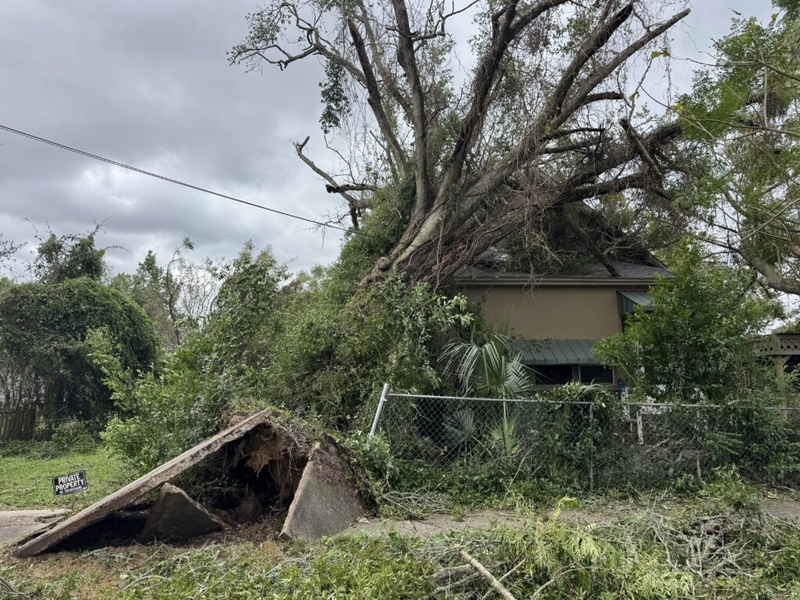
A tree from the neighboring lot fell on Darryl Sweet's home in Pensacola, Florida, during Hurricane Isaias on Oct. 9, 2026. (Photo by Jay Waagmeester/Florida Phoenix)
The Federal Emergency Management Agency has announced that President Donald Trump approved Florida’s request for a major disaster declaration authorizing public assistance funds to help Florida local governments recover from Hurricane Isaias.
The announcement, 12 days after Gov. Ron DeSantis submitted the request, doesn’t say how much money has been approved.
Florida Division of Emergency Management Director of Communications Stephanie Hartman told the Phoenix earlier this month the state sought roughly $237 million for “debris removal, public infrastructure, and emergency protective measures.”
The 15 counties approved for public assistance are Bay, Calhoun, Escambia, Franklin, Gadsden, Gulf, Holmes, Jackson, Jefferson, Liberty, Okaloosa, Santa Rosa, Wakulla, Walton, and Washington.
The FEMA website indicates the state’s request for individual assistance for nearly 1,000 damaged residencies in eight counties still is under review. Those counties are Bay, Escambia, Gulf, Holmes, Okaloosa, Santa Rosa, Walton, and Washington.
12 Days later
Hurricane Isaias made landfall as a Category 2 Hurricane in Destin Oct. 9 with maximum sustained winds of 105 mph.
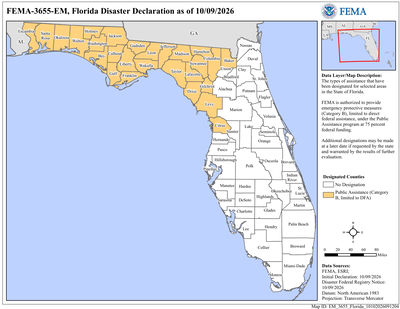
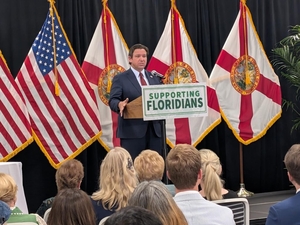
The DeSantis administration submitted a disaster request with FEMA on the evening of Oct. 15. During a press conference announcing the request, DeSantis said he expected a decision ” very, very, quickly.”
While the request was sent to FEMA, only the president was authorized to approve it.
GAO FEMA report
Trump announced in the summer of 2025 that he wanted to phase out FEMA and put states more in control of their emergency responses. Since then, Trump has continue to approve disaster requests from states stemming from weather events.
FEMA, like other federal agencies, has made workforce reductions.
An August 2026 General Accounting Office report found that in fiscal year 2025 more than 4,300 employees “separated” from FEMA, a 55% increase in separations from fiscal year 2024.
“These separations have resulted in a loss of institutional knowledge and experienced personnel, according to FEMA officials, and have exacerbated longstanding workforce challenges,” the GAO report found.
FEMA rescinded its strategic work plan in 2025.
“As a result, the agency has no overall strategic direction on which to base workforce planning — a systematic and continuous process for identifying the size and composition of a workforce needed to achieve an agency’s mission,” the GAO report notes. “Without a strategic plan that outlines clear goals and objectives, FEMA cannot effectively determine its future workforce needs, potentially putting its mission at risk.”
Tallahassee, FL