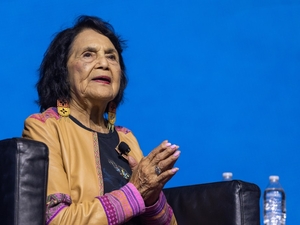
New Mexico leaders pay tribute to civil rights icon Dolores Huerta following her death at 96
Oct 28, 2026 | 2:27 pm ET
Description
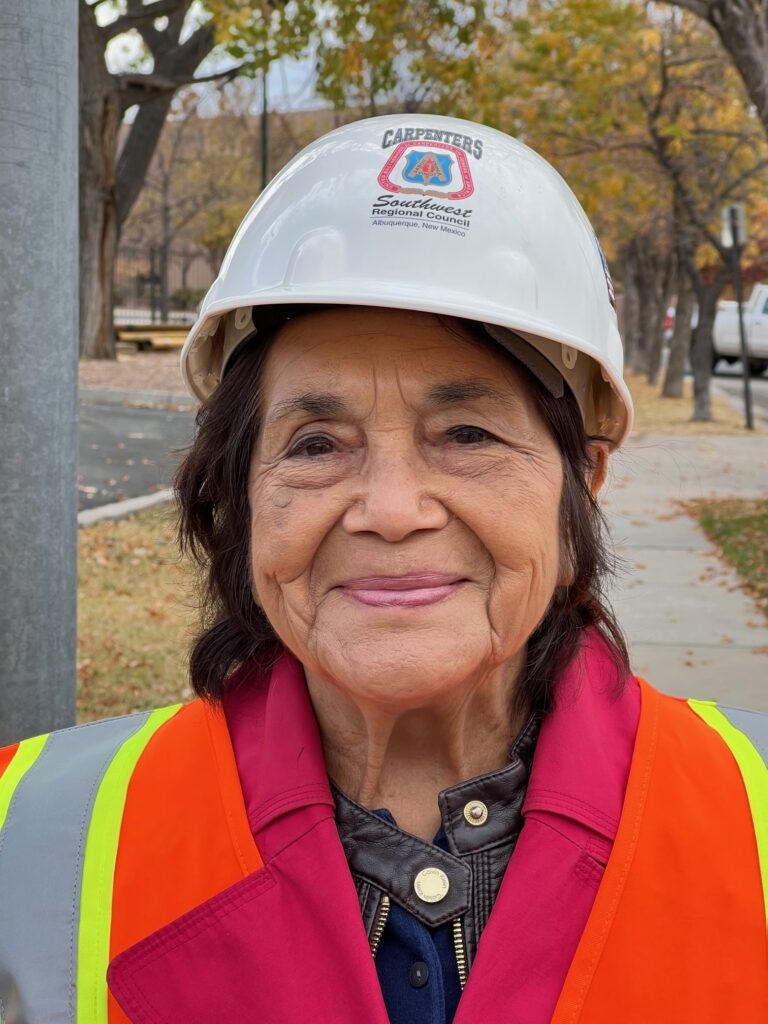
New Mexico-born civil rights activist Dolores Huerta, a celebrated labor leader who received the Presidential Medal of Freedom in 2012, died Oct. 28, 2026, at age 96, according to her family. Above: Huerta during a visit to Albuquerque in November 2021 to push for federal infrastructure spending. (Patrick Lohmann/Source NM)
Legendary civil rights activist and United Farm Workers co-founder Dolores Huerta, a native New Mexican, died Wednesday at her home in California.
“We are deeply saddened to announce that our beloved mother, Dolores Huerta, has passed away today at the age of 96,” her family wrote in a statement posted by the Dolores Huerta Foundation on Wednesday morning. “As you can imagine, this is an incredibly difficult time for us, and we ask for privacy as we grieve this incredible loss to our family. We know that many of you around the world share in our mourning, and we will be following up on plans to recognize and celebrate her incredible life and legacy.”
Erik Olvera, a spokesperson for Huerta’s foundation, told Source NM in an email that Huerta died Wednesday morning from cancer, “surrounded by her family.”
Huerta was born in Dawson, a small mining town in Northeastern New Mexico before becoming an effective and celebrated activist for migrant farmworkers across the United States. She co-founded United Farm Workers with Cesar Chavez in the early 1960s, where the pair first began mobilizing migrant farm workers working on large grape farms in California.
By the late 1960s, the organization had built a growing union through much of the West and began training college students in how to build union power. That’s where New Mexico Rep. Patricia Roybal Caballero (D-Albuquerque), then a student at the University of Texas at El Paso, first met Huerta in the 1960s.
The two struck up a relationship that grew closer in the six decades since, Roybal Caballero told Source NM on Wednesday. The longtime Latina leader cried during a phone interview as she described what she said felt like losing her mother.
“Every bit of who I am and what I do is rooted in my relationship with Dolores,” she said. “If I had not joined the United Farm Worker movement as young as I did, 60-plus years ago, I don’t know if my life would have been shaped in the manner that it has. It’s just in my blood.”
Roybal Caballero said Huerta’s death has further deepened her resolve to continue “la lucha,” the struggle for Latino migrant worker rights, and cement Huerta’s legacy in New Mexico, including by designating her Dawson home as a state-designated historical site.
Every bit of who I am and what I do is rooted in my relationship with Dolores.
Earlier this year, Roybal Caballero and other elected Latina leaders expressed solidarity with Huerta after she disclosed sexual abuse allegations against Chavez, her longtime partner in the labor movement. Huerta disclosed two incidents that led to pregnancies and two children she arranged to have raised by other families.
“I carried this secret for as long as I did because building the movement and securing farmworker rights was my life’s work,” Huerta wrote in a statement. “The formation of a union was the only vehicle to accomplish and secure those rights and I wasn’t going to let Cesar or anyone else get in the way. I channeled everything I had into advocating on behalf of millions of farmworkers and others who were suffering and deserved equal rights.”
Huerta’s decades of advocacy for farm workers prompted former President Barack Obama to award her the Presidential Medal of Freedom in 2012.
News of Huerta’s death prompted an outpouring of condolences from New Mexico leaders. Many of them shared selfies with Huerta at marches or in the Roundhouse in recent years.
U.S. Rep. Teresa Leger Fernández (D-N.M.) wrote in a statement that Huerta once told her, “‘You should dance in your 20s so you can march in your 90s.’ And march she did. For justice. For dignity. For those whose voices were too often ignored. She taught us that the fight for a better world should be filled with joy, that resistance can be a celebration, and that the rhythm of change lives in all of us. Today, we mourn a giant. But her footsteps will echo in every march, her spirit will live in every movement, and her words will carry us forward.”
She taught us that the fight for a better world should be filled with joy, that resistance can be a celebration, and that the rhythm of change lives in all of us.
U.S. Rep. Melanie Stansbury (D-N.M.) also described Huerta as a mentor, friend and source of inspiration.
“For so many of us, she was a beacon of the strength, power, and generosity of a movement that changed lives and which continues to propel us forward,” she wrote in a social media post. “To everyone grieving—we are with you and send our prayers and love to every one touched by Dolores’s work and fight.”
Even in her 90s, Huerta made appearances across the country and endorsed candidates for New Mexico local offices, including state representative and county commissioner.
State Sen. Leo Jaramillo (D-Española), posted a photo of Huerta with him and other state lawmakers and wrote, “I’ll always remember meeting her at the Legislature. I asked if we could take a selfie, and she smiled and said, “¡Sí se puede!” It was a small moment, but one I’ll carry with me. Thank you, Dolores, for a lifetime of courage and leadership and for reminding us that when we stand together, change is possible. ¡Sí se puede!”
New Mexico House Speaker Javíer Martínez (D-Albuquerque) issued a statement noting that Huerta “lived her long life with courage and compassion. In addition to being the godmother of the farm worker movement, she was a tireless champion for working people, immigrants, women, and children right up until the very end. Dolores was also a proud daughter of New Mexico and we were fortunate that she gave so generously of her time and talents to the people of our state. Her legacy will live on in the hearts of all who speak out against injustice, stand up for the most vulnerable among us, and help our communities find their voices and build collective power.” ¡Vaya con Dios, Dolores! ¡Sí, se puede!”
Her legacy will live on in the hearts of all who speak out against injustice, stand up for the most vulnerable among us, and help our communities find their voices.
The New Mexico Senate Democratic Caucus also issued the following statement that said, “New Mexico has lost one of its own. Dolores Huerta’s story began here, in a working community. Her father was a miner, a farmworker, and a union man who served in this Legislature. She carried that legacy from northern New Mexico to the fields of California and then to the entire nation.”
New Mexico’s Nov. 3 gubernatorial candidates both issued statements, with Republican Gregg Hull saying New Mexico “has lost one of its own,” and that while Huerta’s “work carried her across the country, she never stopped being a daughter of this state. To generations of New Mexicans, she was an icon, a woman who spent her life standing up for hardworking families and showed what one determined person can accomplish. Few New Mexicans have left a mark on our nation like she did. My prayers are with her family and with everyone whose life she touched.”
Former U.S. Interior Secretary and Democratic gubernatorial candidate Deb Haaland said in a statement that Huerta’s legacy will “never be forgotten or erased.”
“True servants of humanity give selflessly to make the world better for generations to come,” she said. “Dolores Huerta was a true servant of the people. Her long life fighting for workers and civil rights put dignity and respect at the forefront of our long march toward justice. She inspired generations who came after her with both words and actions, showing us all that we have the power to change the future.”
Santa Fe, NM