As the Trump administration dismantles Temporary Protected Status, Salvadorans may be next
Sep 04, 2026 | 12:28 pm ET
Description
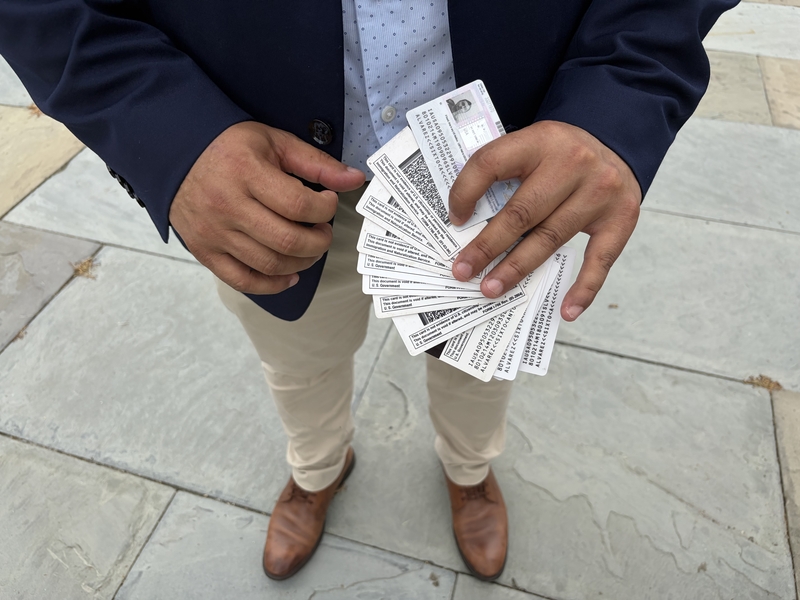
Jose Palma holds the work authorization cards of a Salvadoran member of the National TPS Alliance. The individual has renewed work permits 14 times since Temporary Protected Status was granted for El Salvador in 2001, submitting a background check and fingerprints with each renewal cycle. (Photo by Ariana Figueroa/States Newsroom)
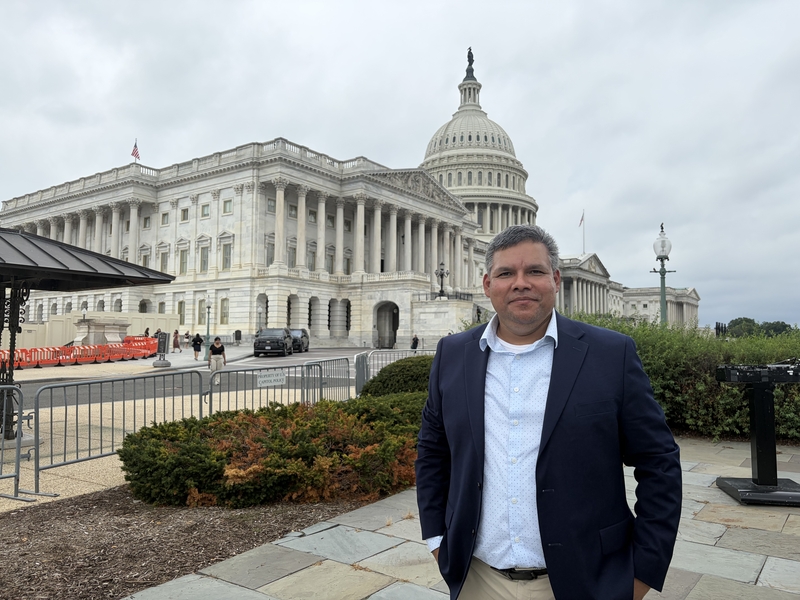
WASHINGTON — For years, Jose Palma has advocated for immigrants with Temporary Protected Status who hail from countries deemed too unstable for return.
But as the Trump administration has stripped those humanitarian protections for nearly a million people, the Salvadoran national is uncertain if his own legal status will remain in place next week.
“I’m going day by day,” Palma, who lives in Texas, told States Newsroom in an interview.
Within two years under the Trump administration, the bipartisan humanitarian Temporary Protected Status program created by Congress in 1990 and signed into law by former Republican President George H.W. Bush has been nearly obliterated.
Palma first obtained TPS in 2001, along with roughly 170,000 recipients from El Salvador, due to several earthquakes that displaced more than one-sixth of the population and left thousands dead. The United States renewed protections over the years, citing continued displacement and ongoing violence.
But the TPS designation for El Salvador is set to expire Sept. 9, and the Department of Homeland Security has made no indication if protections will be renewed.
Under DHS policy, an announcement typically is made 60 days in advance of the date of a TPS expiration if a renewal is planned.
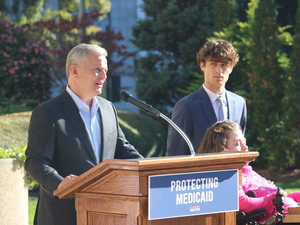
Democratic Rep. Jim McGovern of Massachusetts, who helped write the statute for TPS when he was a congressional staffer, said he’s asked Homeland Security Secretary Markwayne Mullin to renew protections for El Salvador.
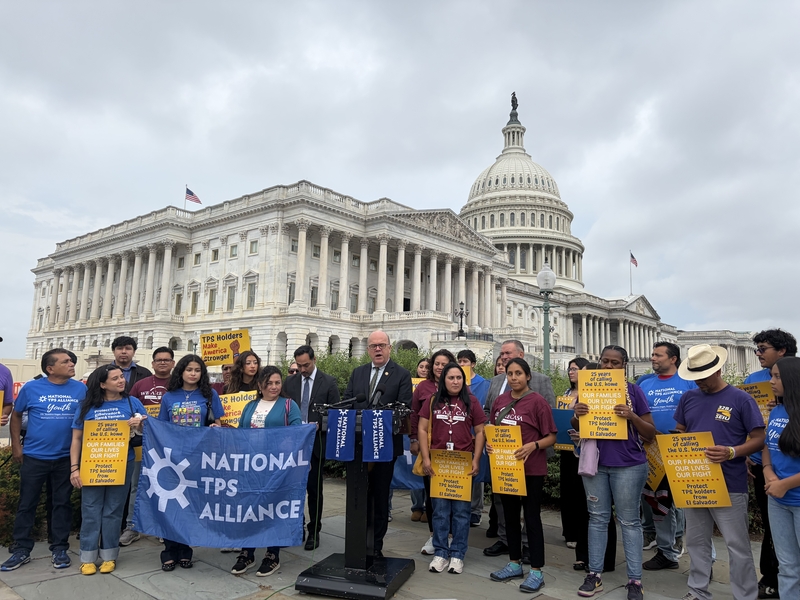
“I still haven't received a response back,” McGovern said during a Thursday press conference at the U.S. Capitol. He was joined by Nebraska GOP Rep. Don Bacon, who said many Salvadoran TPS recipients work and live in his Omaha district.
DHS did not respond to States Newsroom’s request for comment.
The Trump administration’s position on the program is that it’s “temporary,” and that country conditions have improved, despite warnings from the State Department to not travel to some of those countries where TPS designation has ended, such as Haiti.
If TPS for El Salvador ends, only 103,000 out of initially 1.3 million recipients from around the globe will have protections: 150 from Lebanon, 1,790 from Sudan and 101,150 from Ukraine.
Supreme Court decision
TPS is granted to nationals who hail from a country experiencing a natural disaster, violence, or other extreme circumstances, allowing them to remain in the U.S. and obtain work permits.
Some protections can last through six-to-18-month cycles, and each renewal process requires a TPS holder to go through a background check and other vetting.
Before the second Trump administration, 17 countries were in the program. Only four, including El Salvador, remain as the White House has forged ahead aggressively on its mass deportation campaign.
The Supreme Court made the move easier after it ruled this summer that decisions from the executive branch to end TPS were not subject to judicial review. The order meant that lower courts that initially blocked the Trump administration from ending the designations had to reverse their decisions.
Now recipients face the end of TPS with just 60 days’ notice.
“It's one of those things that is kind of cruel, to have families who are stable and have been stable for decades, to have people who have been doing everything the government asked them to do for 25 years, and suddenly, if the decision is to end TPS, provided only 60 days protection before forcing people to go back to a country they haven't been for decades,” Palma said.
One of the first countries after TPS was written into law to receive the designation was El Salvador.
Stripping TPS from Salvadorans would not only harm the U.S. economy, but it would also negatively impact El Salvador’s fragile economy, advocates predict. More than one quarter of El Salvador’s Gross Domestic Product comes from family members sending money back to relatives in their country of origin, known as remittances.
“El Salvador’s economy has been built thanks to all the remittances,” said Ana María Méndez-Dardón, the director for Central America at the Washington Office on Latin America, or WOLA. “So if people are returning, that would have a huge impact because the economy depends on the money that people from El Salvador living in the U.S. send to El Salvador.”
The spending also has an impact in the United States. Salvadoran TPS recipients contribute $5.4 billion to the U.S. economy and pay $1.5 billion in federal, state and local taxes, according to the immigration advocacy research group FWD.us.
About 152,000 TPS recipients from El Salvador are in the workforce, mainly in construction, manufacturing, building and transportation.
Attempts in Congress
TPS does not create a pathway to citizenship and a recipient can only apply for it when the country receives its designation.
Some TPS recipients can apply for asylum if they qualify, or others could apply to adjust their status to that of a lawful permanent resident, or green-card holder, through a family-based or employer-based petition.
Congress has made some effort to extend TPS for some recipients. Earlier this year, the House passed a bill to extend TPS for up to 350,000 Haitians on a bipartisan basis, but it’s stalled in the upper chamber.
Maryland Democratic Sen. Chris Van Hollen attempted to advance a bill in the Senate to create a legal pathway to citizenship for immigrants with TPS, but was blocked by Missouri Republican Sen. Eric Schmitt.
McGovern said Thursday that there is a bipartisan push to extend protections for TPS recipients. Proof of that was Bacon’s presence at the press conference.
“What good is it to force out folks who've been here legally, who are working, who are part of our community?” Bacon said. “It does no one any good.”
Human rights in El Salvador
Many Salvadorian TPS recipients are worried about being forced back to El Salvador, where human rights groups have raised concerns about the authoritarian government of President Nayib Bukele, said WOLA’s Méndez-Dardón.
WOLA is a research and advocacy group that aims to advance human rights in North and South America. It has documented how Bukele’s political party has suspended due process rights and has carried out a mass incarceration of suspected gang members in an effort to reduce crime and murders.
More than 90,000 Salvadorans have been jailed without due process and hundreds have died in prisons and altogether disappeared, human rights groups have reported.
“So for Salvadorians who might be returned, the risk no longer are the criminal groups or the gangs because many of them fled the country because of the security situation,” Méndez-Dardón said. “But although the gangs are no longer the threat, now the threat is the state.”
Bukele has met with President Donald Trump several times at the White House and has a years-long working relationship with Secretary of State Marco Rubio, who last year granted El Salvador the highest possible safety rating for travel, a level 1.
In 2024, the State Department gave El Salvador a level 3 advisory, warning people to reconsider travel because of security and safety concerns.
The Trump administration also last year made a deal with the Salvadoran government to pay up to $6 million to detain hundreds of Venezuelans at a brutal mega-prison. In the high-profile case of Kilmar Abrego Garcia, the Maryland Salvadoran who was mistakenly deported to the mega prison, lawyers documented mental and physical torture he experienced while there.
“People are basically under a constant fear of being detained by the security forces,” Méndez-Dardón said.
U.S. citizen children
Palma, who also attended the press conference, said he, along with other Salvadoran TPS recipients, are concerned about El Salvador’s government.
“So crime has gone down, but now abuses to human rights have increased,” he said. “That is concerning, because it's also the government is becoming more aggressive against opposition, public media.”
Palma questioned if El Salvador would have the infrastructure to accept as many as 200,000 Salvadorans, made up of the TPS recipients and their families. Many have U.S. citizen children.
Palma, who has four U.S. citizen children, said two of his kids are still in primary school. One is 11 and another is 8 years old.
“This is their country,” he said of his four children. “They are from here. But if I were to lose the TPS protection and I were to be forced to go back to El Salvador, it's not just affecting me. It's affecting the whole family. That's kind of like the situation that so many people across the country are going through right now.”
Supporting her mom
There are roughly 150,000 U.S. citizen children who have a parent who is a Salvadoran TPS recipient, according to the National TPS alliance.
Cristel Argueta is one of those children. At 20 years old, she’s a college student at Fairleigh Dickinson University in New Jersey. But on Thursday, she missed four classes relating to her criminology and criminal justice degree to travel to the nation’s capital and advocate for an extension to TPS for El Salvador.
“I'm missing class to be here, but it's worth it because it's for my family,” she said.
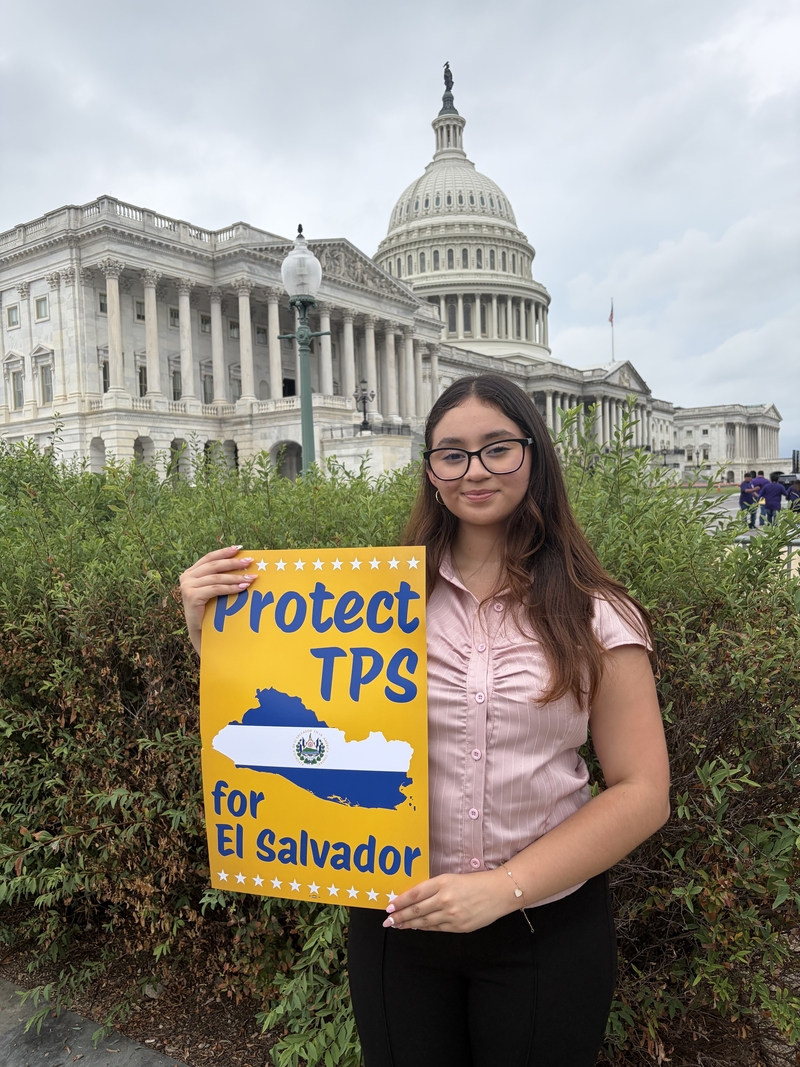
Her mother, a TPS holder from El Salvador, came to the U.S. when she was 19, fleeing the civil war that lasted from 1979 until 1992. Her mother was able to get TPS in 2001.
“She has been in this country longer than she has been in El Salvador,” Argueta said. “TPS was started by Salvadorans, and I don't want to lose my mother.”
She’s hoping her mother’s TPS is extended until at least Argueta’s 21st birthday, when Argueta will be able to become a sponsor and apply to change her mother’s status to that of a lawful permanent resident.
“No one should be going through this at any age,” she said. “Seeing the difference in my peers at school who are 20 years old, waiting to turn 21, to get that first legal drink or go party, but I want to turn 21 just to give my mom a legal status. A permanent legal status.”
All States Newsroom content is free to republish. Read our republishing policy for more information.