Tontitown traffic stops led to ICE detentions months before 287(g) agreement
Sep 21, 2026 | 6:00 am ET
Description
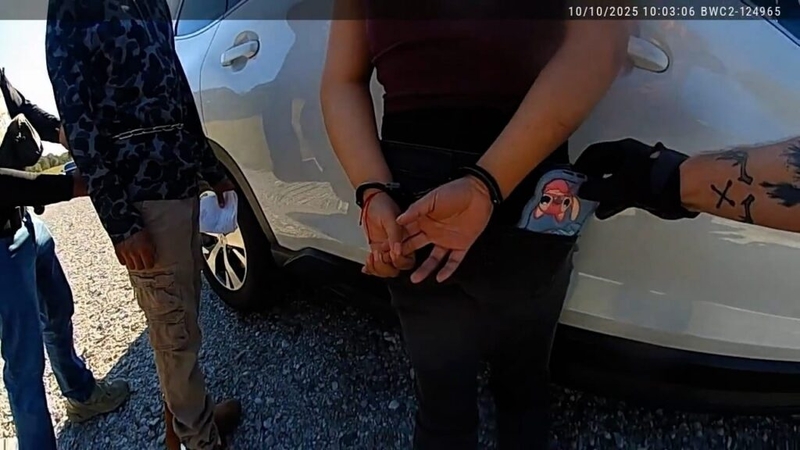
Screenshot from video of an Oct. 10, 2025 traffic stop in Tontitown, Arkansas. (Photo courtesy of Arkansas GRITA)
At least 20 people were detained by Immigration and Customs Enforcement (ICE) after routine traffic stops by Tontitown police before the department formally joined the federal 287(g) immigration enforcement program.
What began as traffic stops for minor violations resulted with several passengers being taken into federal custody despite facing no state or local charges.
The findings predate Tontitown Police Departments’s June 12, 2026, signing of a 287(g) Task Force Model agreement with ICE, which authorizes local police officers to perform some federal immigration enforcement functions that would otherwise be handled by federal agents.
Read more about 287(g) in Arkansas
Arkansas GRITA compared Tontitown traffic warnings and citations with available federal ICE detention records in Washington County to identify traffic stops that resulted in immigration detentions before the city signed its 287(g) agreement. Federal intake records became publicly available on the Washington County Detainee Intake Roster in mid-September 2025, establishing the earliest point for comparison.
The 13 traffic stops identified resulted in the federal detention of 20 people, including several passengers. Ten of the stops ended with warnings and three resulted in citations. Several of the passengers were detained despite not being accused of any traffic offenses. The majority of the vehicles involved in the identified traffic stops were work vans or trucks.
An October traffic stop
On the morning of Oct. 10, 2025, Tontitown police pulled over a work van. Although no one was arrested on state or local charges related to the traffic stop, Tontitown police officers called ICE to the scene.
Five of the van’s six occupants were detained by ICE and booked into Washington County Detention Center before being transferred to federal custody. Among them was 18-year-old Vicky Ramirez, a Guatemalan woman whose mugshot went locally viral.
In bodycam footage obtained by Arkansas GRITA through a Freedom of Information Act request (FOIA), Officer Darrin Bentley, who initiated the stop, can be heard saying “we’re going to ID everybody” before exiting his police cruiser.
Within 30 seconds of approaching the work van Bentley opened the van’s sliding door, making multiple passengers visible in the back. Within 90 seconds, the officer asked for the identification of all the passengers of the van.
After going back to his cruiser, Bentley told a second responding officer that he can “make the phone call,” apparently to ICE. In a phone conversation with a third officer, he said, “I’ve got a truck full.”
After issuing a traffic warning to the driver for speeding one to 15 miles per hour over the speed limit and driving continuously in the left lane, the van’s occupants were fingerprinted, then detained roadside for approximately one hour in total until ICE officers arrived. ICE then detained five of the van’s six occupants.
Irvin Camacho, an organizer with the Alliance for Immigrant Respect and Education (AIRE), told GRITA that Ramirez was sent to a detention facility in Louisiana and ultimately deported to Guatemala.
Tontitown police chief Corey Jenison declined to respond to a detailed list of questions about the traffic stop. The questions, and Jenison’s response, are reproduced below this story.
Excerpts from the bodycam footage are embedded below. This is a compilation of bodycam footage from three officers on scene, shortened for time. GRITA has redacted parts of the footage to protect the privacy of the people detained.
Attorney raises constitutional concern
Connor Thompson, an attorney with the Arkansas chapter of the National Lawyers Guild, said the body camera footage raises several potential constitutional concerns.
“Here, we have a traffic stop seizure that ends up ranging over an hour in length and appears to include waiting for an ICE officer to show up, patting down the occupants of the van, and fingerprinting them,” Thompson wrote in an email to Arkansas GRITA.
Thompson also questioned officers opening the van’s sliding door without reasonable suspicion and fingerprinting passengers who had not been arrested, calling both potential constitutional violations.
“Generally, police lack the authority to force the subject of a traffic stop (short of an arrest) [to] provide biometric data like fingerprints. To collect fingerprints outside of a custodial arrest, officers would need probable cause that a crime has been committed, a warrant, or valid consent,” Thompson wrote. “Based on the videos alone I’m not satisfied that any of these criteria were met before fingerprinting took place here.”
He also said officers generally lack the authority to open a vehicle door without reasonable suspicion that the occupants are armed and dangerous, if contraband is in plain view or if exigent circumstances exist.
“In my eyes, none of those criteria were met here, nor did the officer have consent from the van’s occupants to open the sliding door,” he wrote.
An Arkansas community founded by Italian immigrants becomes a flashpoint over ICE
Tontitown chief Jenison declined to respond to detailed questions about officers’ actions and potential constitutional violations during the stop.
Police denied plans to join 287(g)
On Dec. 23, 2025, local immigrant advocates with AIRE had a meeting with Tontitown Police Department officials. Jenison was one official from the department in attendance.
The meeting was requested after AIRE received numerous reports from community members about immigration-related incidents in Tontitown. Audio from the meeting was later shared with Arkansas GRITA. (The recording is audio-only, and individual speakers are not easily identifiable beyond their roles as community advocates or Tontitown Police Department officials.)
During the meeting, one Tontitown police official said the department did not intend to join the 287(g) program.
“We don’t have an agreement with ICE. We haven’t signed any of that. We don’t have intentions to sign,” the official said. “That is their task and their purpose. Ours is not that.”
“Getting deputized and [becoming] part of a task force to go out and do [immigration enforcement] is not benefiting Tontitown, in our opinion,” the same official said later in the recording.
Jenison told GRITA via email that the intent behind the department signing a 287(g) agreement “is not to make local officers responsible for broad immigration enforcement or to target members of our community. Rather, the agreement is intended to enhance public safety by allowing law enforcement to more effectively identify and coordinate with federal authorities when they encounter individuals who are wanted for serious crimes in other countries or who present a legitimate public safety concern. The goal is to help ensure that dangerous criminals do not evade justice simply because of international jurisdictional boundaries.”
Jenison previously told the Arkansas Advocate that federal funding promised to departments who join 287(g) programs was a benefit to the department, which is planning to build a new police station.
During the December meeting, police officials also said officers may call ICE after a traffic stop if they cannot identify a person. They did not say how often officers contacted ICE and said the decision was left to individual officers. Officials also said it would not be typical for officers to delay a traffic stop while waiting for ICE to arrive.
Thompson, the NLG attorney, told Arkansas GRITA that stalling a traffic stop for ICE to arrive could violate the Supreme Court’s decision in Rodriguez v. United States, which held that “a police stop exceeding the time needed to handle the matter for which the stop was made violates the Constitution’s shield against unreasonable seizures.”
After the meeting, Camacho, who attended the December meeting, said immigration-related encounters involving Tontitown police appeared to decline temporarily.
“We heard less arrests [were] happening in Tontitown – less photos, less videos, less people reaching out to us,” he said. “We thought that they had actually made a good difference with their policy.”
Camacho said that changed when the news broke that Tontitown Police Department signed the 287(g) agreement in June.
“You signing an agreement as a police department, you’re going the extra step, you’re purposefully being harmful to immigrant communities – and that’s the part that makes me sick,” Camacho said.
Cities are not required to sign 287(g) agreements under the legislation Gov. Sarah Huckabee Sanders signed into law last year. However, including Tontitown, 66 municipalities across the state currently have such agreements with ICE, almost all of them under the Task Force Model.
As Arkansas GRITA previously reported, DHS announced last year that it would reimburse police departments who signed onto 287(g) under the Task Force Model for trained officers’ salaries, benefits, and overtime.
Tontitown’s 287(g) memorandum allows trained local law enforcement officers to carry out immigration enforcement during routine policing activities, such as traffic stops or patrols. The Task Force Model of the 287(g) partnership, which was discontinued under former President Barack Obama and reinstated by the Trump administration in 2025, has been criticized for civil rights abuses and racial profiling.
This story was originally produced by Arkansas GRITA, and was republished with their permission. Email [email protected] if you’re interesting in republishing this article.

Little Rock