Dr. Oz, Trump Medicaid director, in Nebraska to root for state rural health program, Big Red
Oct 10, 2026 | 2:28 pm ET

Description
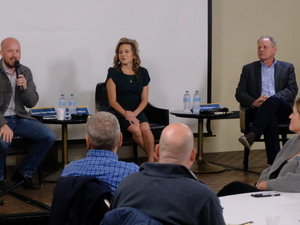
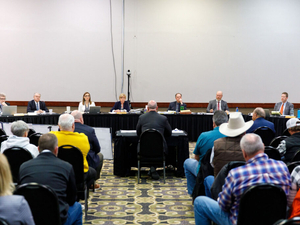
Dr. Mehmet Oz speaks at a press conference Saturday, Oct. 10, 2026, in the Governor's Office of the Nebraska State Capitol. Oz, administrator of the U.S. Centers for Medicare and Medicaid Services, is flanked on his left by Gov. Jim Pillen and Steve Corsi, who heads the Nebraska Department of Health and Human Services. To the right, Ashley Newmyer, DHHS director of public health, and Laura McDougall, director of Four Corners Health Department in York. (Courtesy of the Governor's Office)
LINCOLN — Nebraska officials were joined Saturday by a top Trump administration official, Dr. Mehmet Oz, to announce updates in Medicaid and public rural health programs.
At a news conference at the State Capitol, Oz helped Gov. Jim Pillen tout the state’s rollout of the Rural Health Transformation Program, a national five-year, $10 billion-a-year federal grant program aimed at filling health care gaps in rural communities.

Of the $218.5 million Nebraska received for the first year of the program, officials said $177 million has been deployed. Oz called that a good sign.
He said a goal is to beat the “rural death penalty,” which he described as a rural life expectancy that’s almost three years shorter than in urban areas.
“You should not be paying a price based on your zip code,” said Oz, administrator of the U.S. Centers for Medicare and Medicaid Services.
‘Bigger vision’
Last December, when the feds announced how much each state would get for the first fiscal year of a five-year RHTP rollout, Nebraska learned it had secured the eighth-highest funding amount among the 50 states. Oz said a state’s rollout and allocation of funds are important and could translate into a lesser or higher award in future years, relative to other states, or even a funding clawback.
The funds are part of $50 billion to be distributed among states in an effort to offset harm to rural areas due to sweeping cuts to Medicaid, the state-federal public health insurance for people with low incomes.

While Oz and Pillen see the grants creating more sustainable rural health initiatives, critics, including some policy analysts and health advocates, are concerned the program did not cover estimated rural Medicaid reductions driven by the federal budget legislation signed into law in July 2025. They said the gap leaves rural hospitals struggling.
The $177 million update compares to a late July 2026 update that the state at that time had awarded roughly $98 million of the annual award covering fiscal year 2026. Prior to that, Nebraska had not provided a tally of grants awarded.
Saturday’s media event came a day after Oz toured a Blair health facility with Rep. Adrian Smith, who represents Nebraska’s 3rd Congressional District, and hours before Oz joined Pillen on the sidelines of a Husker game in Lincoln.
Both fellow Republicans, Smith and Pillen are up for reelection Nov. 3.
Noting also that Nebraska was the first of all states to implement stricter Medicaid work requirements — eight months ahead of the federal requirement under Trump’s “One Big Beautiful Bill” — Nebraska Health and Human Services Director Steve Corsi reported Saturday that so far about 200 to 300 people per month, or between 600 to 900 since June, have been dropped from the public insurance program for low-income residents.
Corsi was critical of sources he said had predicted a loss of as many as 40,000 recipients. The nonpartisan Center on Budget and Policy Priorities estimated about 25,000.

Oz lauded Nebraska’s early launch of stricter Medicaid work requirements and a state and national focus on weeding out fraud. He announced that the federal government is tracking to spend about $27 billion less this year than last in the Medicare program.
The “bigger vision,” he said, is to move Medicaid recipients from poverty “into prosperity by getting them into the workforce, by educating them, getting them to volunteer.”
He posed what he called a fundamental question: “Did God put you on this earth to sit at home and watch 6.1 hours of television or enjoy leisure time when you know that you should have agency over your future to go out there and change the world?”
Most folks would say no, said Oz, also well known for being a longtime TV celebrity heart surgeon and host of the Emmy Award-winning Dr. Oz Show.
Advocates for low-income populations in Nebraska have pushed back on “rushed” Medicaid changes and said they are offended by a stigma that enrollees, often medically impacted, are “lazy.” Health and policy groups have voiced concern that implementation of the stepped-up work requirements risks cutting off eligible residents.
Oz gets ‘chills’
Oz said that the rural transformation grants help states to develop locally driven solutions to improve rural residents’ access to quality care. He said Nebraska’s work in that area and its crackdown on enforcing Medicaid work requirements gives him “chills” and shows a “can-do spirit.”

Laura McDougall, director of Four Corners Health Department in York, spoke to how the program has served Butler, Polk, Seward and York Counties. She cited the addition of 10 community healthcare workers who are embedded in facilities helping residents connect to resources needed to follow through on medical treatments and ensure stronger recoveries and lifestyles.
Ashley Newmyer, Nebraska DHHS director of public health, said the first-year grant allowed about 200 rural community health workers in various areas and 172 “recruitment and retention award” contracts to increase provider capacity.
Among other progress that state officials cited as part of the rural health grant:
- Three maternal and family health mobile units are being developed in maternity-care deserts, bringing services closer to families in the Panhandle Public Health District, Public Health Solutions and East Central District Health Department regions.
- 45 healthcare facilities, aided by 68 new devices, gained access to remote monitoring technology.
- 28 rural pharmacies are receiving financial incentives and training to support chronic disease patients in adhering to medical regimens.
- Rural and frontier schools are to receive School Kitchen Modernization Grants dedicated to improving school lunch meal quality statewide.
- 35 farmers, ranchers and food producers received funding to purchase equipment and supplies to help increase the availability of whole fresh foods in local communities.
- 19 stress debriefings were held during the Nebraska 2026 wildfires to provide community mental health support. Rural law enforcement and first responders are being equipped with app-based telehealth pocket co-responders, which give direct access to mental health professionals to support people in mental health crisis.
- Three community colleges and five community agencies were awarded funds to become Supplemental Nutrition Assistance Program employment and training providers, expanding the program’s reach into previously underserved rural areas.
Lincoln, NE