Three federal challenges to Tennessee redistricting now assigned to same judge
May 19, 2026 | 6:00 am ET
Description
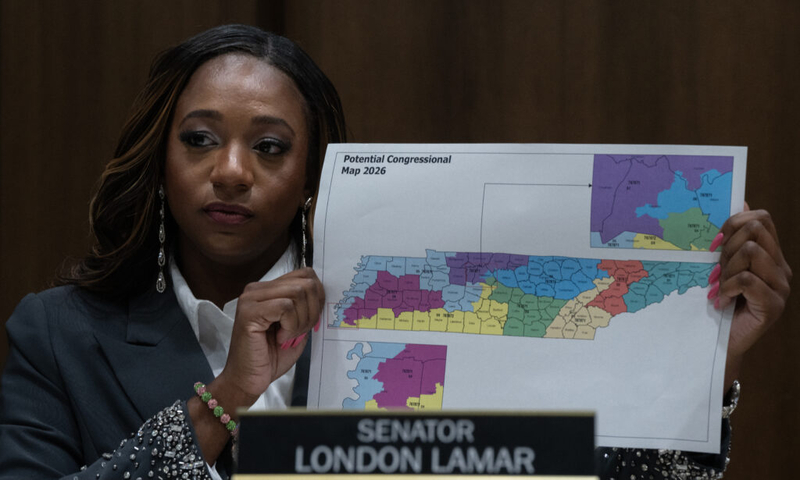
State Sen. London Lamar, a Memphis Democrat, holds a photo of the new U.S. House map passed by Tennessee Republicans. (Photo: John Partipilo/Tennessee Lookout
A federal judge has ordered a legal challenge to Tennessee’s redrawn congressional districts — brought by the ACLU on behalf of voters, clergy and nonprofits in Memphis — be assigned to the same judge hearing two other federal challenges.
Chief U.S. District Judge William Campbell, Jr., a Trump appointee, has been assigned the three cases, which could ultimately go before a three-judge panel consisting of Campbell, another federal judge and an appeals court judge. The two other judges have yet to be named.
A separate challenge to newly drawn maps was filed jointly by the NAACP Tennessee State Conference and the League of Women Voters of Tennessee; a legal challenge brought by Democratic congressional candidates and voters is also before Campbell.
Campbell last week denied a temporary restraining order sought in the challenge by Democratic candidates and voters, who requested the new maps be shelved for the 2026 election cycle while the court process continued.
The challenge brought by the NAACP and the League of Women Voters and the separate challenge brought by Memphis voters, clergy and nonprofits, likewise, seek a temporary halt to the redistricting process. Campbell has yet to rule on the requests to temporarily block redistricting sought in these lawsuits.
Election officials move quickly to adjust districts for August primary in Tennessee
All of the legal actions have the same goal: to dissolve Tennessee’s new Congressional map enacted in a three-day special legislative session by the state’s Republican supermajority after the U.S. Supreme Court dismantled key portions of the Voting Rights Act.
The new maps split Memphis and Shelby County into three separate voting districts, breaking apart the state’s only majority-Black, majority-Democrat district for the first time in 50 years. Tennessee’s eight other voting districts, before the map was redrawn, were predominantly white and Republican.
Each of the three lawsuits make separate, but interconnected, arguments against the redrawn maps:
The NAACP and League of Women Voters argue that map intentionally discriminates against Black voters in Memphis, in violation of the 14th and 15th Amendments. The lawsuit positions the vote to split Memphis voters as part of a pattern of racial discrimination by Tennessee Republican lawmakers.
The lawsuit by Democratic candidates and voters in affected districts argues that the redrawn maps, which took effect fewer than three months before the primary election on Aug. 6, would lead to chaos, confusion and disenfranchisement for voters. The plaintiffs also argue that redrawing the maps after U.S. House candidates had already qualified and, in some cases campaigned for months, sets a dangerous precedent potentially opening the door for redistricting at any time to gain partisan advantage once a race was already underway.
A hearing to consider a temporary injunction in a fourth case, brought in Davidson County Chancery Court by the Tennessee chapter of the NAACP and its president, Gloria Sweet-Love, is set for May 21.
The case challenges the process Gov. Bill Lee and the Tennessee Legislature took to redraw the maps as a violation of state law and the state constitution: the redistricting process took place outside the 10-year Census cycle, despite a state law that barred mid-decade redistricting. That state law was repealed during the special redistricting legislative session.
- 2:27 pmCorrection: Three federal challenges to Tennessee's newly-drawn congressional maps have now been assigned to the same federal judge. A previous version of this story incorrectly reported that three challenges have been consolidated into one case.
Nashville, TN